
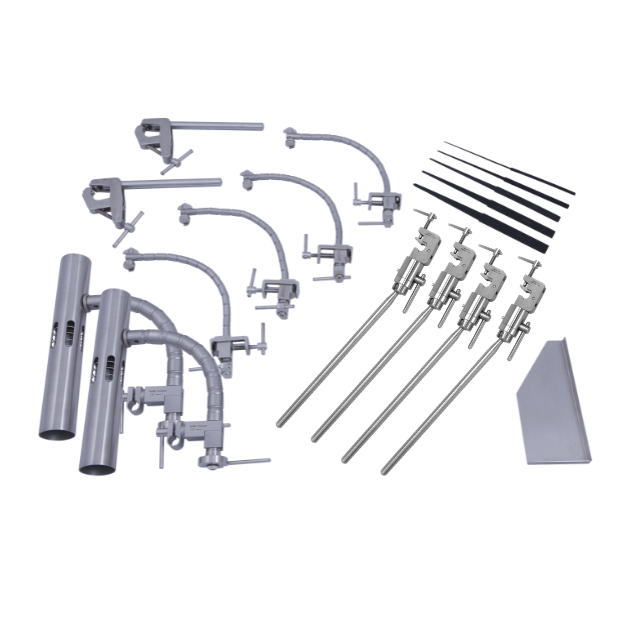
Greenberg Retractor
$3,999.00
& Free ShippingProduct Name: Greenberg Retractor System (Neurosurgical Exposure Set)
Intended Use: Engineered to provide precise, self-retaining, hands-free tissue retraction during complex cranial, skull base, and microneurosurgical procedures.
Primary Material: Non-magnetic, surgical-grade stainless steel
Configuration: Complete multi-level neurosurgical system (featuring 2 primary bars, 4 floating secondary bars, 4 long multi-axis flex arms, 2 ergonomic handrests, 5 malleable double-ended tapered blades, and an aluminum pattie tray)
Sterility: Supplied non-sterile (fully autoclavable)
Packaging: Securely organized inside a dedicated, perforated sterilization tray
Manufacturer: Retractor Maker
Product Condition: Brand new
Minimum Order Quantity (MOQ): 1 Complete System
Greenberg Retractor
The Greenberg Retractor is a modular, self-retaining neurosurgical retractor system developed to provide stable, adjustable, and precise tissue retraction during cranial and microsurgical procedures. While standard surgical retractors require constant manual holding or pull from fixed angles, this specialized system creates an independent mechanical framework above the surgical site, allowing neurosurgeons to hold back delicate cortical tissue with micro-level accuracy.
By anchoring directly to rigid skull fixation posts (such as Mayfield® head frames), the Greenberg Retractor removes physical stress from the patient’s scalp margins and eliminates vibration. Its multi-level structural design organizes the operative field, giving surgeons a continuous, hands-free view of deep anatomical structures while protecting delicate neural tissue. We manufacture this complete retractor system from surgical-grade, non-magnetic stainless steel at our facility in Pakistan, supplying direct wholesale shipments to healthcare networks, neurosurgical centers, and medical device distributors worldwide.
What Is the Greenberg Retractor?
The Greenberg Retractor is an advanced, self-retaining neurosurgical retraction platform engineered specifically for complex intracranial, skull base, and microneurosurgical procedures. It serves as a modular framework that adapts to varying craniotomy shapes, deep surgical corridors, and patient positions.
Unlike fixed-ring abdominal retractors, the Greenberg Retractor operates across multiple elevated planes. It combines rigid primary support bars, floating secondary tracks, multi-jointed long retractor flex arms, dual surgeon handrests, and soft-annealed malleable tapered blades. This setup allows operating teams to establish precise lines of retraction, manage neuro-pattie sponges, and stabilize their hands during delicate micro-dissections under surgical microscopes.
The Engineering Behind the Modular Flex Arm System
At the heart of the Greenberg Retractor functionality is its multi-axis flexible arm assembly. During deep brain or vascular surgery, rigid retractors can exert uneven pressure on surrounding tissue, raising the risk of focal ischemia or brain edema.
The Greenberg flex arms resolve this clinical challenge through specialized design features:
-
Multi-Ball Articulation: Each long retractor flex arm consists of interconnected ball-and-socket joints that move smoothly in any direction when loosened.
-
Single-Dial Mechanical Tensioning: A central tensioning knob allows the surgeon to fluidly position the blade inside a narrow surgical corridor and lock the entire arm rigidly with a single turn.
-
Low-Profile Trajectory: The slim profile of the flex arms keeps the space directly above the craniotomy clear, ensuring unobstructed sightlines for operating microscopes, endoscopes, and micro-instruments.
How the Greenberg Retractor Works
The primary bars, floating secondary bars, flexible retractor arms, handrests, tapered blades, and Pattie tray work together to create an organized and efficient operating field while minimizing pressure on delicate brain tissue:
-
Anchor to Skull Fixation: The two 6-inch primary bars are clamped securely to the upright posts of the rigid skull clamp holding the patient’s head.
-
Establish Secondary Frame: The four 12-inch floating secondary bars are attached to the primary bars. These secondary tracks can be angled and extended to form a customized perimeter around the craniotomy.
-
Attach Flex Arms: Long retractor flex arms are mounted onto the secondary bars at the required approach angles.
-
Shape Malleable Blades: The surgeon selects an appropriately sized tapered blade and hand-shapes its soft stainless steel body to match the depth and contour of the brain tissue.
-
Atraumatic Placement: The blade tip is placed against a protective cottonoid neuro-pattie resting on the brain tissue. Tightening the flex arm lock maintains a stable, continuous hold without drift.
-
Position Utility Rests: Dual 10-inch handrests are locked onto the upper frame to provide physical forearm support for the surgeon, while the aluminum Pattie tray is attached nearby for quick access to surgical sponges.
System Component Specifications
Our factory manufactures and inspects every element of the Greenberg Retractor system to ensure complete mechanical reliability and precise dimensional accuracy.
| Quantity | Component | Dimensions / Specifications | Clinical Function |
| 2 | Primary Bars | 6″ (15 cm) | Mounts directly to rigid skull clamp posts |
| 4 | Floating Secondary Bars | 12″ (30 cm) | Extends outer support perimeter around craniotomy |
| 4 | Long Retractor Flex Arms | 9.5″ (24 cm) | Multi-jointed friction arms for blade positioning |
| 2 | Handrests | 10″ (25 cm) | Provides physical forearm support to reduce surgeon fatigue |
| 1 | Tapered Retractor Blade | ¼″ to ¾″ (6 mm to 19 mm) | Extra-wide blade for broad cortical retraction |
| 1 | Tapered Retractor Blade | 5/32″ to ⅝″ (4 mm to 16 mm) | Medium-wide blade for lobar and subtemporal access |
| 1 | Tapered Retractor Blade | ⅛″ to ½″ (3 mm to 12.5 mm) | Standard blade for deep interhemispheric corridors |
| 1 | Tapered Retractor Blade | 3/32″ to ⅜″ (2.4 mm to 9 mm) | Fine-tapered blade for narrow skull base pathways |
| 1 | Tapered Retractor Blade | 1/16″ to ¼″ (1.5 mm to 6 mm) | Micro-blade for delicate nerve/vascular retraction |
| 1 | Aluminum Pattie Tray | 3″ × 6¾″ (7.5 cm × 16.8 cm) | Mounts on frame to organize neuro-patties |
| 1 | Sterilization Tray | 17″ × 10″ × 2½″ (43 cm × 25 cm × 6.3 cm) | Heavy-duty perforated organizing tray |
Tapered Blade Profile & Surgical Advantages
The Greenberg Retractor utilizes specialized double-ended, tapered malleable blades designed specifically for fragile neural tissue.
| Blade Option | Broad Outer Base Width | Narrow Deep Tip Width | Clinical Application |
| Blade 1 | ¾″ ($19\text{ mm}$) | ¼″ ($6\text{ mm}$) | Extra-wide cortical surface support |
| Blade 2 | ⅝″ ($16\text{ mm}$) | 5/32″ ($4\text{ mm}$) | Medium lobar and subtemporal access |
| Blade 3 | ½″ ($12.5\text{ mm}$) | ⅛″ ($3\text{ mm}$) | Standard interhemispheric corridors |
| Blade 4 | ⅜″ ($9\text{ mm}$) | 3/32″ ($2.4\text{ mm}$) | Fine-tapered skull base pathways |
| Blade 5 | ¼″ ($6\text{ mm}$) | 1/16″ ($1.5\text{ mm}$) | Micro-nerve and vascular retraction |
Key Advantages of Tapered Geometry:
-
Load Distribution: The wider base near the superficial cortex spreads physical retraction forces across a larger surface area, preventing localized tissue crushing.
-
Corridor Access: The narrow tip glides easily into deep sulci, cisternal spaces, or tumor margins without tearing soft structures.
-
Reversible Utility: Because each blade is double-ended and malleable, a single set provides 10 distinct tip configurations to match varying anatomical depths.
Surgical Specialties and Clinical Applications
The modular adaptability of the Greenberg Retractor makes it a core system across major neurosurgical disciplines:
-
Brain Tumor Surgery: Holds back surrounding brain parenchyma gently during resections of glioblastomas, meningiomas, and metastatic lesions.
-
Skull Base Surgery: Secures narrow access corridors during acoustic neuroma, craniopharyngioma, and petroclival tumor procedures.
-
Cerebral Aneurysm & Vascular Neurosurgery: Delivers steady, micro-level exposure of delicate blood vessels during arterial aneurysm clipping and AVM resections.
-
Microvascular Decompression (MVD): Provides stable, hands-free cerebellar retraction during trigeminal neuralgia or hemifacial spasm procedures.
-
Intracranial & Spinal Microsurgery: Assists in deep posterior fossa approaches and cervical or thoracic intradural tumor removals.
-
Functional & Trauma Neurosurgery: Stabilizes surgical fields during deep brain stimulation (DBS) lead placements and cranial trauma interventions.
Technical Specifications, Material, and Quality
Materials and Manufacturing Standards
Every component of the Greenberg Retractor system is forged from medical-grade, non-magnetic stainless steel. This high-tensile alloy ensures that primary clamps, articulating ball joints, and extension bars maintain structural rigidity under mechanical load. All surfaces are treated with an anti-glare satin finish to prevent light reflections under high-intensity operating microscopes and overhead surgical lamps.
Reprocessing and Sterilization Compatibility
The entire system is completely reusable, latex-free, and designed to meet hospital sterile processing standards:
-
Cleaning Compatibility: Safe for use with neutral-pH enzymatic detergents, ultrasonic bath washers, and automated washer-disinfectors.
-
Steam Autoclave Compatibility: Fully compliant with standard hospital pre-vacuum steam sterilization parameters ((134C to 273F for 4 to 5 minutes), with no loss of flex arm tension or locking strength over time.
-
Perforated Case Organization: The included 17″ × 10″ × 2½″ sterilization tray features dedicated silicone-lined brackets for every bar, arm, and blade to ensure thorough steam penetration.
Product Advantages vs. Limitations
| Key Greenberg Advantages | Practical Considerations |
| Stable Hands-Free Retraction: Eliminates assistant hand tremor and maintains position throughout multi-hour procedures. | Setup Time: Requires initial assembly of primary and secondary bars prior to drapes and microscope positioning. |
| Integrated Handrests: Dual 10-inch handrests support surgeon forearms, reducing physical fatigue during microsurgery. | Skull Clamp Required: Must be mounted to rigid head fixation posts (e.g., Mayfield®) to function properly. |
| Precision Flex Arm Control: Single-dial tensioning allows fluid multi-axis blade placement. | Careful Decontamination: Multi-ball joint flex arms require thorough rinsing and periodic lubrication. |
Why Source Directly from Retractor Maker?
Retractor Maker is a specialized manufacturer focused exclusively on surgical retractor systems. We do not manufacture a broad, unfocused range of general instruments; our entire engineering, machining, and quality assurance processes are dedicated to retractor production.
-
Direct Factory Sourcing: Purchasing your retractor systems directly from our factory lowers procurement costs by eliminating third-party trading markups.
-
Guaranteed Compatibility: All primary clamps, secondary bars, and flex arm connections are machined to industry-standard dimensions, ensuring seamless integration with existing hospital inventory.
-
Reliable Supply Chain: Supported by a skilled workforce of over 50 employees and strict quality control, we maintain a consistent average factory production lead time of 12 to 16 days for wholesale orders, serving more than 500 healthcare partners globally.
Frequently Asked Questions (FAQs)
What is the Greenberg Retractor used for?
It is a modular, self-retaining neurosurgical retractor system used to provide stable, adjustable, and precise tissue exposure during cranial, skull base, and microneurosurgical procedures.
How does the Greenberg Retractor attach to the surgical setup?
The system’s primary bars clamp directly onto the upright posts of a rigid skull fixation frame (such as a Mayfield® head holder), creating a stable base above the head.
How do the long retractor flex arms function?
The flex arms utilize a series of articulated ball-and-socket joints. A central locking dial allows the surgeon to position the blade smoothly at any angle and secure it rigidly with a single turn.
What is the purpose of the dual handrests included in the system?
The two 10-inch handrests attach to the elevated frame above the surgical field, providing a stable platform to support the surgeon’s forearms and reduce muscle fatigue during fine micro-dissections.
How do the tapered malleable blades protect brain tissue?
The blades are made from soft-annealed stainless steel that can be shaped by hand. Their tapered shape distributes retraction force across a wider surface area near the cortex while maintaining a narrow profile deep in the surgical channel.
Is the Greenberg Retractor system autoclavable?
Yes. All components—including primary/secondary bars, flex arms, handrests, aluminum Pattie tray, and blades—are made of surgical-grade stainless steel and are fully autoclavable using standard steam sterilization (134C /273F for 4 to 5 minutes).
Can individual components be purchased separately?
Yes. We supply replacement parts, including individual flex arms, primary clamps, handrests, and single malleable tapered blades, to complete or upgrade existing hospital sets.
What is the purpose of the aluminum Pattie tray?
The Pattie tray clamps directly onto the secondary bar frame near the surgical site, providing a sterile surface to organize saline-soaked neuro-patties (cottonoids) and micro-instruments.
What is the average manufacturing lead time for wholesale orders?
Our average factory production, quality auditing, and export packaging timeline for wholesale orders is 12 to 16 days from order confirmation.
Is the system supplied sterile or non-sterile?
All components are supplied non-sterile. They are fully reusable and must undergo standard hospital cleaning and steam autoclave sterilization before clinical use.
Request Your Direct Factory Quote
Equip your neurosurgical operating rooms with precision-engineered, factory-direct retractor systems. Contact Retractor Maker today to receive an itemized wholesale price quote, request technical catalogs, or discuss OEM custom manufacturing.
- Submit a Direct Quote Request: https://retractormaker.com/request-a-quote/
- Browse All Surgical Retractors: https://retractormaker.com/surgical-retractors/
- Contact Our Technical Sales Team: https://retractormaker.com/contact/
- Visit Our Bookwalter Retractor Website: https://bookwalterretractor.com/
- Visit Our Leyla Retractor Website: https://leylaretractor.com/
Only logged in customers who have purchased this product may leave a review.

Reviews
There are no reviews yet.