
Orthopedic Retractor Guides
What Is a Weitlaner Retractor? Types, Uses & Weitlaner vs. Gelpi
الكاتب: Saad Shahid · تم التحديث · 6 دقائق قراءة

Maintaining stable surgical exposure in compact, moderate-depth wounds requires continuous, steady mechanical separation. Relying on handheld instruments for long procedures occupies surgical assistants and introduces unwanted field movement.
المبعدات التي يتناولها هذا الدليل: مبعد Weitlaner Retractor, مُبعد B-Z Weitlaner Retractor, مُباعد Beckman-Weitlaner ذاتي التثبيت, مُباعد Paparella-Weitlaner ذاتي الثبات. تصفح جميع المبعدات الجراحية.
A Weitlaner retractor is a self-retaining surgical retractor that holds soft tissue, muscle margins, and wound edges open without manual holding. Opposing multi-pronged rake blades and a graduated ratchet lock provide broad, even tissue displacement. The Weitlaner retractor is used in orthopedics, neurosurgery, vascular surgery, and plastic surgery.
Contents
What Is a Weitlaner Retractor?
A Weitlaner retractor is a scissor-style, self-retaining mechanical retractor. It has dual finger rings, a central hinge pivot, and an integrated ratchet-and-pawl locking bar. Two outward-curving distal shanks end in downward-angled, multi-pronged rake blades.
Compressing the finger rings moves the distal working ends outward. Ratchet teeth engage incrementally to lock the prongs at the desired expansion width. This hands-free mechanism stabilizes the operative corridor. It frees the surgical team for primary dissection, instrumentation, or implant placement.
What Weitlaner Designs Are Available?
Weitlaner retractors come in several configurations for different tissue types and anatomical depths. Designs vary by prong count, tip profile, frame dimensions, and shank configuration.
What Do 2x3 and 3x4 Prong Configurations Mean?
- 2x3 Prongs: Two prongs on one blade interlock with three on the opposing blade. This narrower configuration suits compact incisions, small joint approaches, and pediatric surgery.
- 3x4 Prongs: Three prongs on one side oppose four on the other. The wider profile distributes traction across a broader tissue line for large orthopedic or spinal exposures.
When Are Sharp or Blunt Prongs Used?
- Sharp Prongs: Tapered, pointed tips grip tough, fibrous fascia, aponeurosis, and periosteum to prevent slipping under heavy tension.
- Blunt Prongs: Rounded, atraumatic tips displace soft tissue, muscle, or cuticular flaps near fragile vascular sheaths, peripheral nerves, or viscera while minimizing puncture risks.
What Frame Sizes and Profiles Are Available?
Weitlaner retractors range from compact 105 mm (4.25-inch) models to extended 250 mm (10-inch) heavy-duty units. Specialized models may have hinged shanks. These let the finger rings drop flat against the patient's body, maximizing overhead clearance for surgical microscopes.
What Is a Weitlaner Retractor Used For?
The Weitlaner retractor provides localized, self-retaining exposure in orthopedic, spinal, neurosurgical, vascular, plastic, and general surgery.
- Orthopedic Extremity Surgery: Retracts subcutaneous fat and muscle during open reduction and internal fixation (ORIF) of the radius, ulna, tibia, or fibula.
- Spine and Neurosurgical Procedures: Holds superficial paraspinal musculature and lumbosacral fascia open during microdiscectomies, laminectomies, and peripheral nerve repairs.
- Vascular Surgery: Maintains hands-free lateral exposure during femoral cutdowns, carotid endarterectomies, and arteriovenous (AV) fistula creations.
- Plastic and General Surgery: Elevates thick tissue margins during scar revisions, excision of large subcutaneous masses, and groin explorations.
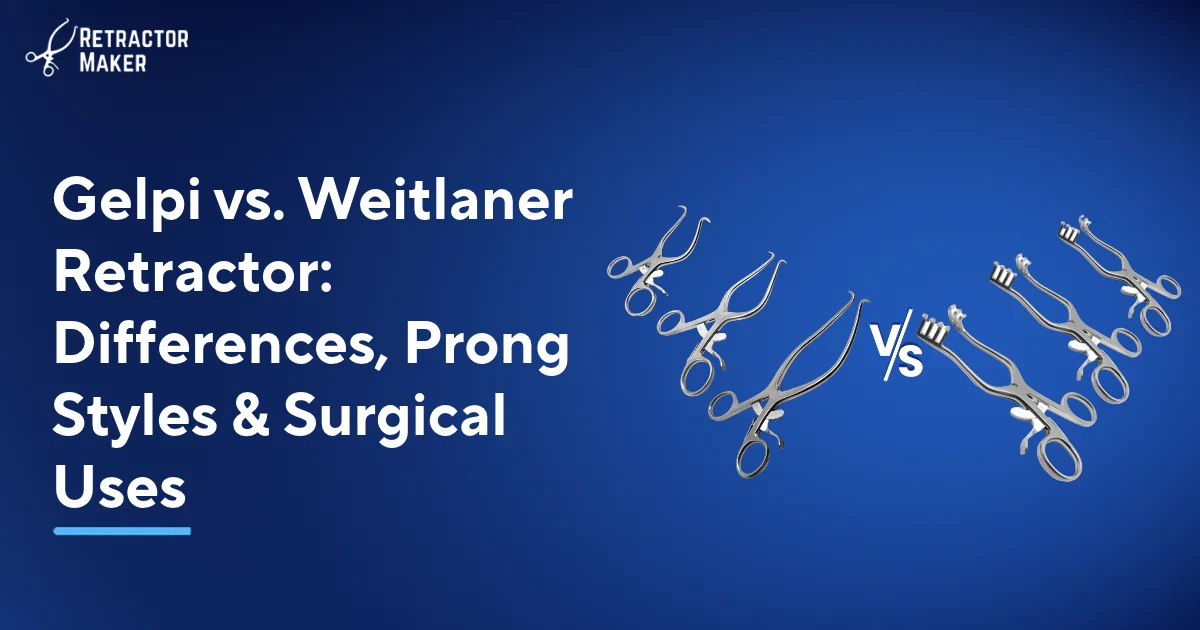
Weitlaner vs. Gelpi Retractor: What Is the Difference?
The Weitlaner and Gelpi differ in blade configuration and clinical role. Both are scissor-action, ratcheted self-retaining retractors.
| Feature | Weitlaner Retractor | Gelpi Retractor |
|---|---|---|
| Blade Geometry | Multi-pronged rake blades (2x3 or 3x4) | Single, outward-curving pointed/blunt beaks |
| Force Distribution | Broad force distribution across multiple prongs | Concentrated, single-point retraction vector |
| Depth of Retraction | Primarily superficial to intermediate | Intermediate to deep anatomical corridors |
| Typical Applications | Long linear incisions, muscle bellies, extremity surgery | Deep, focused exposures: spinal decompression, joint capsule |
| Tissue Slippage Risk | Low (interlocking prongs grip broad fascia) | Moderate (depends on single-point cortical/fascial purchase) |
Neither design is universally superior. The Weitlaner distributes tension across wide wound edges. The Gelpi provides deep, targeted retraction in confined working fields.
How Do You Choose the Right Configuration?
Choose a Weitlaner retractor by tissue sensitivity, incision length, and the depth needed to reach the target fascia.
- Tissue Sensitivity: Choose blunt prongs near major nerves or vessels and sharp prongs for tough, non-delicate connective tissue.
- Incision Length: Select 2x3 prongs for incisions under 5 cm. Use 3x4 prongs for longer incisions to prevent tissue bulging.
- Instrument Depth: Ensure the shanks reach the target fascia without compressing deep neurovascular structures.
How Should Cleaning and Sterilization Be Performed?
Cleaning, inspection, lubrication, and sterilization help maintain reliable ratchet engagement and box-lock alignment. Follow the manufacturer's IFU for autoclaving.
- Cleaning: Open the ratchet fully and unlock the hinge before soaking in enzymatic solutions. Use soft nylon brushes to remove biological debris from the ratchet teeth and box-lock crevice.
- Inspection: Regularly test the ratchet teeth and pawl for wear or slipping. Check that prongs are straight, symmetrical, and free of cracks.
- Lubrication and Autoclaving: Apply water-soluble surgical instrument lubricant to the hinge pin and ratchet bar. Autoclave in the open, unlatched position according to the manufacturer's IFU.
Summary and Manufacturing Details
The Weitlaner retractor provides consistent, hands-free exposure in soft-tissue and musculoskeletal procedures. Interlocking multi-pronged blades and a reliable ratcheting frame reduce operative fatigue while maintaining a stable surgical field.
Retractor Maker manufactures precision-crafted Weitlaner retractors in Sialkot, Pakistan. They are forged from certified Premium Grade AISI 304/316 Stainless Steel (Non-Magnetic). Features include hardened ratchet teeth, smooth box-lock pivots, and sharp or blunt prong profiles. Retractor Maker supplies hospital operating rooms and medical distributors globally.
تنبيه سريري: هذا الدليل موجّه للفرق الجراحية ومشتري المستشفيات. اتبع دائمًا تعليمات الاستخدام (IFU) الصادرة عن الشركة المصنعة وقواعد التعقيم في مستشفاك قبل الاستخدام السريري.
الأسئلة الشائعة
What is a Weitlaner retractor?
A Weitlaner retractor is a self-retaining surgical retractor with opposing multi-pronged rake blades and a ratchet locking mechanism. It holds soft tissue, muscle margins, and wound edges open without manual holding. Its scissor-style frame includes finger rings and a central hinge pivot.
What is the difference between sharp and blunt Weitlaner retractors?
Weitlaner retractors with sharp prongs grip tough, fibrous tissue securely, while blunt prongs protect delicate subcutaneous tissues and adjacent nerves from puncture trauma. Sharp tips resist slipping under tension. Rounded, blunt tips displace soft tissue near fragile structures while minimizing puncture risks.
What do 2x3 and 3x4 prongs mean on Weitlaner retractors?
On Weitlaner retractors, 2x3 and 3x4 describe the number of prongs on each opposing blade. A 2x3 configuration has two prongs on one side and three on the other. A 3x4 configuration has three and four, providing a wider working surface.
What is a Weitlaner retractor used for?
It is used to maintain hands-free exposure of soft tissue and muscle during orthopedic, spinal, vascular, and plastic surgeries.
Is the Weitlaner retractor self-retaining?
Yes. Its integrated ratchet bar locks the blades in place once opened, eliminating the need for manual holding.
What is the difference between a Weitlaner and a Gelpi retractor?
A Weitlaner uses multi-pronged rake blades for broad traction, while a Gelpi retractor uses single-point opposing tips for deep, localized retraction. Both have scissor-action, ratcheted self-retaining mechanisms. The Weitlaner distributes tension across wide wound edges; the Gelpi suits confined working fields.
Can Weitlaner retractors be sterilized in an autoclave?
Yes, reusable Weitlaner retractors made from high-grade Premium Grade AISI 304/316 Stainless Steel (Non-Magnetic) are fully autoclavable when processed according to validated IFU protocols. Autoclave them in the open, unlatched position. Follow the manufacturer's IFU for the sterilization process.
How should a Weitlaner retractor be cleaned?
Clean a Weitlaner retractor by fully opening the ratchet and unlocking the hinge before soaking it in enzymatic solutions. Use soft nylon brushes to remove biological debris from the ratchet teeth and box-lock crevice. This helps maintain reliable ratchet engagement and box-lock alignment.
What should be inspected on a Weitlaner retractor?
Inspect a Weitlaner retractor for worn or slipping ratchet teeth and pawl components, and check that its prongs are straight, symmetrical, and free of cracks. Regular testing of the locking mechanism and inspection of the prongs are part of recommended care.
What sizes and frame profiles are available for Weitlaner retractors?
Weitlaner retractors range from compact 105 mm (4.25-inch) models to extended 250 mm (10-inch) heavy-duty units. Specialized models offer hinged-shank profiles. These shanks let the finger rings drop flat against the patient's body, maximizing overhead clearance for surgical microscopes.
عن الكاتب
Saad Shahid · مدير المبيعات والتسويق
سعد شاهد هو مدير المبيعات والتسويق ومؤسس Retractor Maker التي انطلقت عام 2023 في سيالكوت، باكستان. ويعمل أيضًا مع والده في Hospitech Traders، الشركة العائلية للأدوات الجراحية التي تأسست عام 1989.
مدونات وأدلة ذات صلة
مبعدات ذات صلة
مبعد Senn Forward Retractor
$49.00
مُبعّد Brewster Retractor
ابتداءً من $159
مُبعّد Langenbeck Retractor-Solid Handle
$49.00
Murphy Retractor
ابتداءً من $44.00
مبعد Leriche Retractor-Atraumatic Wide Blade
ابتداءً من $94.00
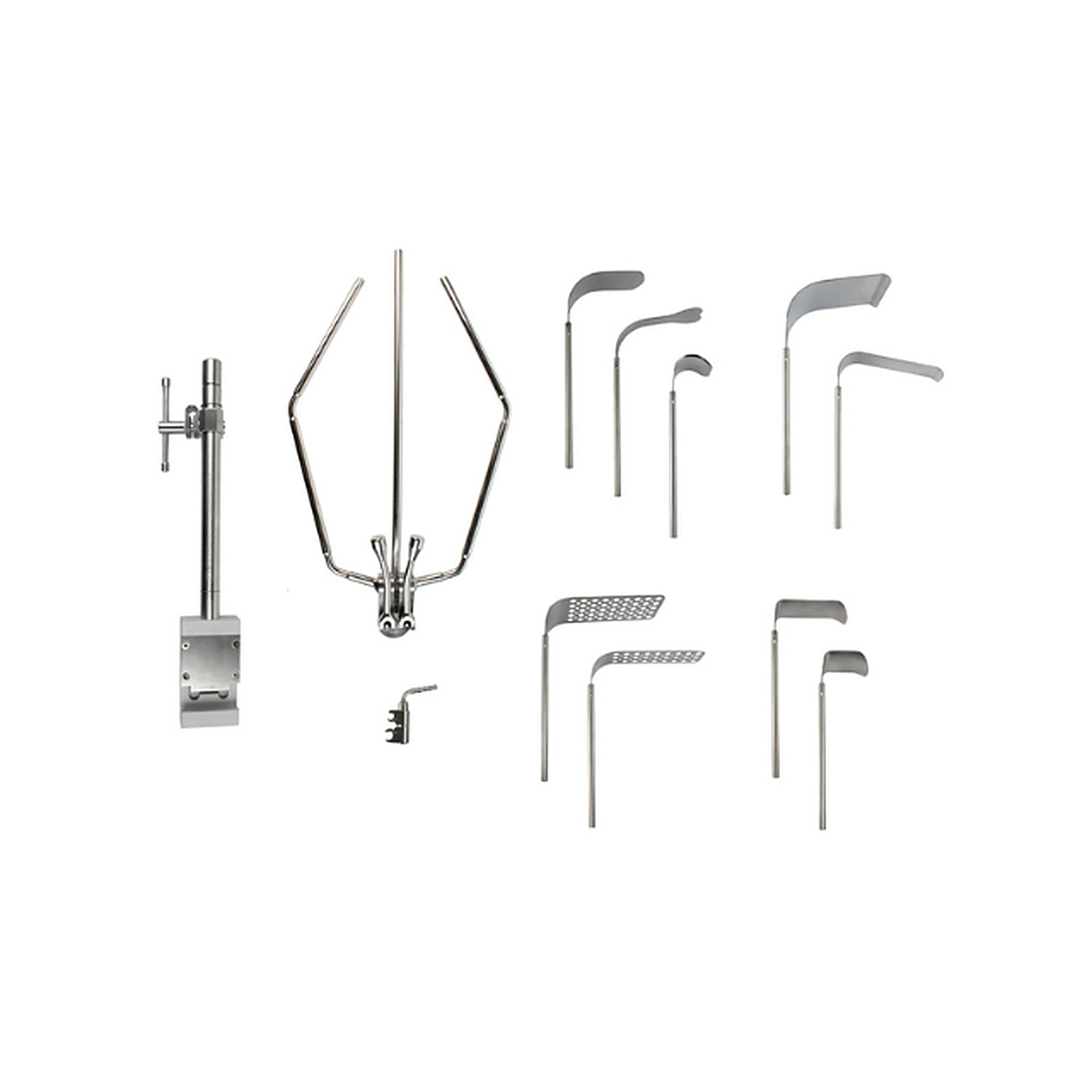
نظام المبعد الجراحي العام Lobster General Retractor System
$2,699Free Shipping
هل تحتاج إلى مبعدات جراحية أو مكونات؟
أخبرنا بما تحتاجه، بما في ذلك المنتج، والتكوين، والكمية، وبلد الوجهة. يمكن لـ Retractor Maker توفير التوفر والمواصفات والأسعار.
طلب عرض سعر