
Orthopedic Retractor Guides
Volkmann (Rake) Retractor: Uses, Prongs & Surgical Applications
Autor: Saad Shahid · Atualizado · 6 min de leitura
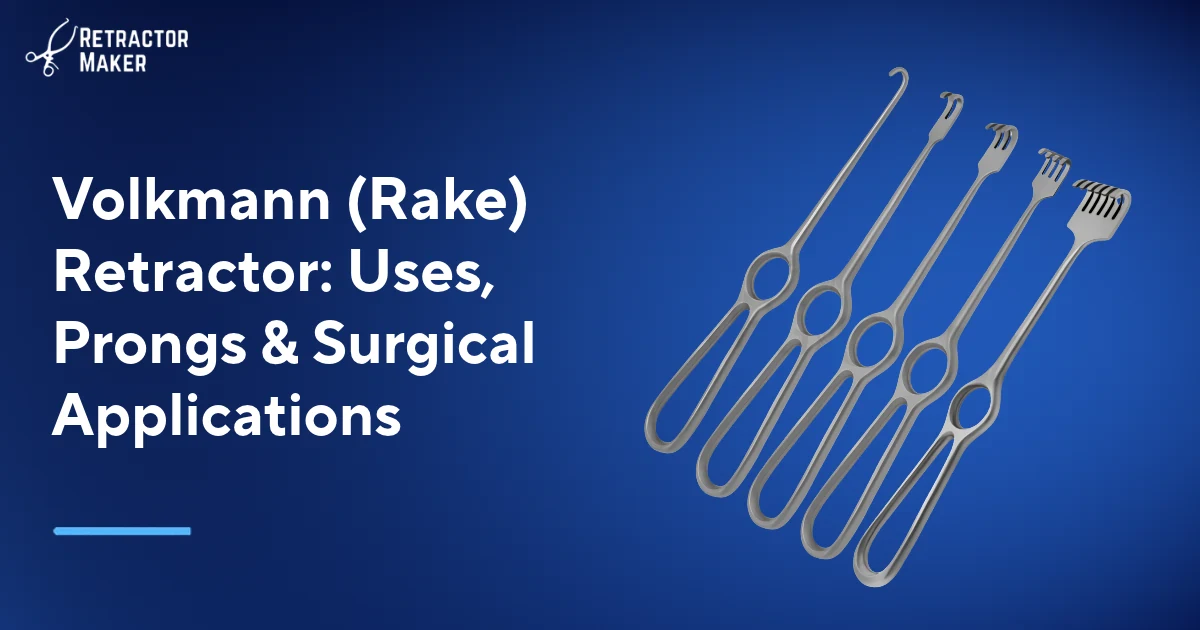
In musculoskeletal and soft-tissue surgery, surgical assistants frequently encounter fibrous tissues that slip out from smooth, flat retractor blades. Mobilizing tough fascia, subcutaneous fat layers, and connective tissue envelopes requires instruments engineered to gain positive traction without crushing adjacent structures.
Afastadores abordados neste guia: Afastador Volkmann, Afastador Volkman-USA Pattern. Ver todos os afastadores cirúrgicos.
A Volkmann retractor, commonly called a "rake retractor," is a classic handheld surgical instrument for retracting soft tissues and fascia. Its multi-pronged working end and ring-style handle provide directional, slip-resistant counter-traction in orthopedic, plastic, and general procedures.
Contents
What Is a Volkmann Retractor?
The Volkmann retractor is a manual surgical instrument with an ergonomic handle, an elongated shaft, and a curved, rake-like head with multiple parallel prongs. It is named after the German surgeon Richard von Volkmann.
The main structural features are a multi-pronged working end, sharp or blunt tips, and a teardrop or ring handle.
- Multi-pronged rake: The working end curves into an arc with 2, 3, 4, or 6 prongs that hook beneath tissue margins.
- Sharp or blunt prongs: Sharp points provide a non-slip grip on tough fibrous connective tissue. Blunt, rounded tips allow gentle retraction near neurovascular structures.
- Teardrop or ring handle: A wide proximal loop or teardrop opening provides comfortable finger purchase and a steady pull.
How Do Prong Number, Spacing, and Tip Geometry Affect Retraction?
Prong configuration determines how mechanical force is distributed across tissue.
| Prong Feature | Engineering Characteristic | Clinical Role |
|---|---|---|
| 2-Prong Head | Narrow profile (approx. 5–8 mm wide) | Compact corridors, small tendon repairs, digital surgery |
| 3-Prong Head | Intermediate profile (approx. 10–12 mm wide) | Standard wound margin retraction in extremity surgery |
| 4-Prong Head | Broad profile (approx. 15–18 mm wide) | Distributes force across thick subcutaneous fat and muscle |
| 6-Prong Head | Extra-wide profile (approx. 20–25 mm+ wide) | Broad fascia retraction in major orthopedic approaches |
| Sharp Tips | Tapered, pointed needle-like tips | Positive grip in tough aponeurosis and fibrous dermis |
| Blunt Tips | Smooth, spherical or rounded tips | Non-traumatic retraction preventing puncture injuries |
What Is a Volkmann Retractor Used For?
- Orthopedic surgery: Moves subcutaneous tissue, periosteum, and fascia away from bone during fracture reduction, plate fixation, and joint procedures.
- Tendon and joint repairs: Elevates deep soft tissue during Achilles tendon repairs, rotator cuff repairs, and hand surgery.
- Soft-tissue mass excisions: Provides steady retraction around lipomas, cysts, or fibrous tumors.
- Plastic and reconstructive procedures: Blunt-pronged models retract cutaneous flaps without compromising vascular supply.
How Does Volkmann Compare With Other Handheld Retractors?
| Feature | Volkmann Retractor | Senn Retractor | Army-Navy Retractor |
|---|---|---|---|
| Working End | Multi-pronged rake (2 to 6 prongs) | Double-ended (3-prong rake + flat blade) | Double-ended flat blades |
| Handle | Teardrop / ring handle | Central flat shaft | Central fenestrated bar |
| Prong Flexibility | Wide choice of prong numbers (2 to 6) | Fixed 3-prong rake only | No prongs (solid flat blades) |
| Application | Deep soft tissue, fascia, bone exposure | Delicate superficial plastic/hand surgery | Superficial general wound opening |
How Should You Clean, Inspect, and Sterilize It?
- Cleaning: Use soft nylon brushes and ultrasonic cleaning baths. Focus on recesses and crevices between curved prongs, where bioburden commonly lodges.
- Inspection: Examine prong tips under magnification for bent alignment, chips, or blunting of sharp-type tips.
- Sterilization: Autoclave in validated instrument trays according to the manufacturer's IFU and institutional infection control protocols.
Summary and Manufacturer Options
The Volkmann rake retractor provides positive, slip-resistant retraction across a variety of musculoskeletal procedures. Customizable prong counts and tip profiles provide dependable exposure while respecting delicate anatomical tissues.
Retractor Maker manufactures precision Volkmann retractors in Sialkot, Pakistan, for international healthcare markets. Sharp and blunt configurations are offered in 2, 3, 4, and 6-prong designs.
Volkmann Retractor Blade Measurements and Sizes
Blade size means width, not prong depth or spacing. Use the supplied measurements below for purchasing specifications or tray requirements. The product data does not link individual widths to particular prong counts or overall lengths. Confirm the requested combination before ordering; do not assume every option is available together.
| Model | Overall Length | Blade Size | Notes |
|---|---|---|---|
| Volkmann Retractor | 11.5 cm or 22.0 cm reach footprint | Widths: 8, 10, 11, 13, 18, 19, 28, 42 mm; other dimensions: On request | 2, 3, 4, 6 or 8 prongs; blunt or sharp tips |
How Should Surgical Assistants Handle Retraction?
- Keep a secure, relaxed grip and support the wrist where practical. Avoid locking a finger tightly into the ring so release or repositioning remains smooth.
- Apply traction gradually in the surgeon's requested direction. Align the pull with intended tissue movement; avoid twisting the head or levering against the wound edge.
- Use only the traction needed for the current step. If exposure is inadequate, request repositioning or a different retractor rather than increasing force.
- Agree with the surgeon on opportunities to ease or release pressure. Coordinate releases with operative steps and tissue condition, not an arbitrary fixed interval.
- Keep engaged tissue and prongs visible where possible. Promptly report blanching, tearing, slipping, or unexpected resistance, and reduce traction in coordination with the surgeon.
- Tell the surgeon before changing hand position, traction direction, or assistant position. At handover, confirm the replacement assistant has control before releasing your grip.
- Pass handle-first with prongs directed away from hands. Follow the team's agreed sharps-transfer method for sharp tips, and do not leave exposed prongs beneath drapes.
What Should You Know About Autoclave Cycles?
Steam sterilization must follow thorough cleaning, rinsing, drying, and inspection; it does not replace cleaning. Follow validated packaging and loading instructions so steam reaches all surfaces. Exposure time is the sterilization holding phase, not the total cycle duration. Drying requirements depend on packaging, load, and sterilizer configuration.
| Cycle | Temperature | Exposure | Drying |
|---|---|---|---|
| Pre-vacuum | 132°C/270°F | 4 min | 20–30 min |
| Pre-vacuum | 134°C/273°F | 3 min; some regions use 18 min for prion protocols | Per validated IFU |
| Gravity displacement | 121°C/250°F | 30 min | 15–30 min |
These typical reference values are not validated processing instructions for this product. The validated instructions for use (IFU), sterilizer manufacturer's instructions, and hospital policy always take precedence. Prion protocols require separate institutional guidance. The product is supplied non-sterile and must be sterilized before first use.
Aviso clínico: este guia destina-se a equipes cirúrgicas e compradores hospitalares. Siga sempre as instruções de uso (IFU) do fabricante e as regras de esterilização do seu hospital antes do uso clínico.
Perguntas Frequentes
What is a Volkmann retractor?
A Volkmann retractor is a handheld surgical instrument with a multi-pronged rake-style head and a ring handle for soft-tissue retraction. Its curved, parallel prongs hook beneath tissue margins. The design provides directional, slip-resistant counter-traction during orthopedic, plastic, and general procedures.
Why is it called a rake retractor?
Its parallel curved prongs resemble a miniature garden rake, designed to hook beneath tissue margins.
What is the difference between sharp and blunt Volkmann retractors?
Sharp Volkmann retractors provide a non-slip grip on tough fibrous tissue, while blunt versions protect delicate tissues, nerves, and vessels from puncture trauma. Sharp models have pointed prongs. Blunt models have rounded tips for gentle retraction near neurovascular structures.
What prong configurations are available for Volkmann retractors?
Volkmann retractors are commonly available in 2, 3, 4, and 6-prong designs to accommodate varying incision widths.
What is a Volkmann retractor used for?
It is used in orthopedic surgery, joint procedures, tendon repairs, and general soft-tissue excisions to hold back tissue margins.
Can a Volkmann retractor be autoclaved?
Yes. Forged from Premium Grade AISI 304/316 Stainless Steel (Non-Magnetic), reusable Volkmann retractors are fully compatible with steam autoclave sterilization.
How should a Volkmann retractor be cleaned and inspected?
Clean a Volkmann retractor with soft nylon brushes and ultrasonic cleaning baths, focusing on the crevices between its curved prongs. Inspect tips under magnification for bent alignment, chips, or blunting of sharp prongs. Complete cleaning, rinsing, drying, and inspection before steam sterilization.
What does blade size mean for a Volkmann retractor?
Volkmann retractor blade size means the working end's width, not prong depth or spacing. Listed widths are 8, 10, 11, 13, 18, 19, 28, and 42 mm. The product data does not link individual widths to specific prong counts or overall lengths. Confirm the requested combination before ordering.
How should surgical assistants apply traction with a Volkmann retractor?
Apply traction with a Volkmann retractor gradually in the surgeon's requested direction, using only the force needed for the current step. Align the pull with intended tissue movement. Avoid twisting or levering against the wound edge. If exposure is inadequate, request repositioning or a different retractor rather than simply increasing force.
Sobre o autor
Saad Shahid · Gerente de Vendas e Marketing
Saad Shahid é gerente de vendas e marketing e fundador da Retractor Maker, criada em 2023 em Sialkot, Paquistão. Ele também trabalha com o pai na Hospitech Traders, a empresa familiar de instrumentos cirúrgicos fundada em 1989.
Blogs e guias relacionados
Afastadores relacionados
Afastador Senn Forward
$49.00
Afastador Brewster
A partir de $159
Afastador Langenbeck Retractor-Solid Handle
$49.00
Afastador Murphy
A partir de $44.00
Afastador Leriche Atraumático com Lâmina Larga
A partir de $94.00
Sistema de Afastador Geral Lobster
$2,699Free Shipping
Precisa de afastadores cirúrgicos ou componentes?
Diga-nos o que você precisa, incluindo o produto, configuração, quantidade e país de destino. A Retractor Maker pode fornecer disponibilidade, especificações e preços.
Solicitar um Orçamento