
Surgical Retractor Guides
What Is a Balfour Retractor? Uses, Types, and Surgical Applications
Author: Saad Shahid · Updated · 8 min read

The Balfour Retractor is a self-retaining surgical instrument that maintains operative exposure with adjustable lateral and center blades. This guide explains how it works, available types, blade selection, operating-room use, and reprocessing.
Retractors discussed in this guide: Balfour Retractor, Balfour Baby Self Retaining Retractor, Balfour USA Self Retaining Retractor. Browse all surgical retractors.
A Balfour retractor is a self-retaining surgical instrument that holds tissue open for clear sight and access during open surgery. Soft tissue can block the view, making continuous retraction necessary. Hand-held retractors hold wound edges back, but constant manual pulling can cause fatigue and obstruct the field.
The Balfour Retractor holds tissue open without continuous holding by a human assistant. This self-retaining surgical retractor mechanically stabilizes soft tissue, addressing fatigue and field obstruction from manual pulling. Understanding how it works helps surgical teams, operating room staff, and buyers choose tools.
Contents
What Is a Balfour Retractor?
A Balfour Retractor is a self-retaining surgical instrument that holds tissue and wound margins open during procedures. Self-retaining means it locks in place after adjustment to the right tension. This frees a surgical assistant's hands.
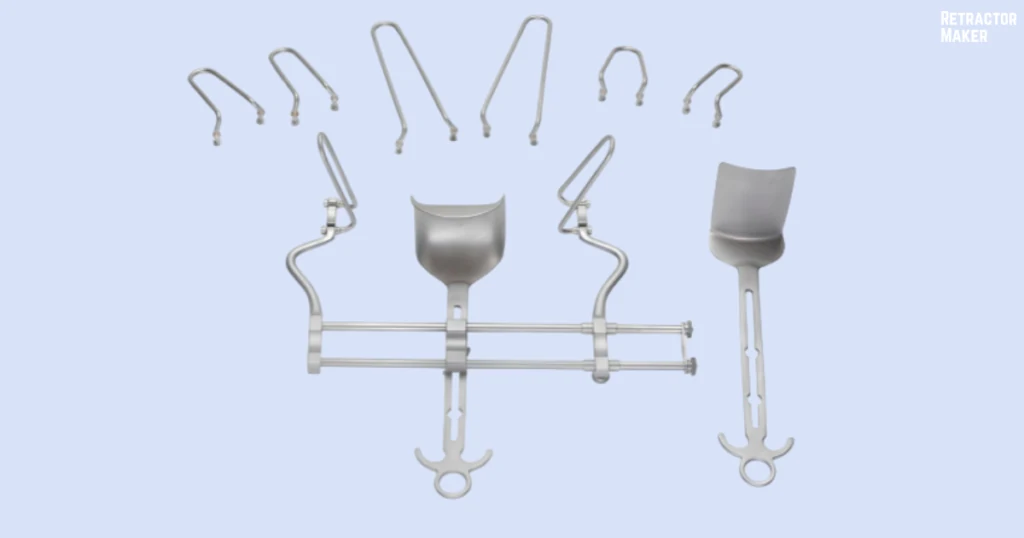
The classic Balfour design has three main parts:
- Balfour Frame: Central support around the surgical field, with tracks that let retraction parts move and lock.
- Lateral Blades: A pair of blades attached to the frame's side arms that move outward to push incision edges aside.
- Center Blade: An adjustable blade mounted on the frame's central line to pull tissue downward or along its length.
These parts create a three-point retraction area. Together, they keep the operative field open and clear.
How Does a Balfour Retractor Work?
The Balfour Retractor uses mechanical counter-traction to hold the surgical field open:
- Positioning: Place the main support frame across the surgical site, aligned with the incision.
- Lateral Retraction: Engage tissue edges with the side blades and separate them along the frame to create a side opening.
- Central Retraction: Position and secure a center blade when greater depth or a downward view is needed.
- Mechanical Retention: Once the blades are adjusted for good exposure, the frame maintains tissue displacement.
Mechanical force against soft tissue prevents the surgical field from collapsing. No continuous manual holding is needed.
What Is a Balfour Retractor Used For?
The Balfour Retractor maintains exposure during surgeries that need self-retaining retraction. It provides access to underlying structures by holding back soft tissue, muscle, or wound edges.
Key functional uses include:
- Maintaining a clear view of target anatomy.
- Providing steady working space for surgical tools.
- Holding lateral and central wound edges open at the same time.
- Reducing physical strain and clutter near the incision.
The right setup depends on the surgery, surgical field size, patient anatomy, and surgeon's preference.
What Types of Balfour Retractors Are Available?
Balfour Retractors come in different types and sizes to suit procedure needs and body sizes.
Balfour USA Self-Retaining Retractor
The Balfour USA Self-Retaining Retractor provides flexibility through interchangeable blades on a standard Balfour frame. Side blades come in different depths, with standard and straight center blade options. Teams can select blades to match tissue thickness.
Balfour Baby Self-Retaining Retractor
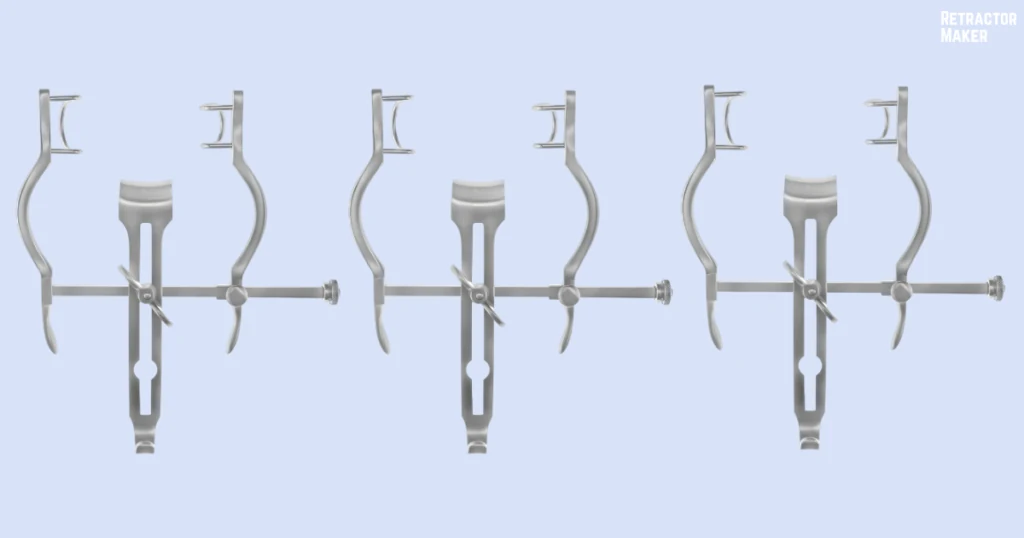
The Balfour Baby Self-Retaining Retractor is a smaller version with a compact frame and smaller blades. It is used when a standard frame is too large. It provides the same self-retaining benefits in a smaller size.
Standard Balfour Retractor
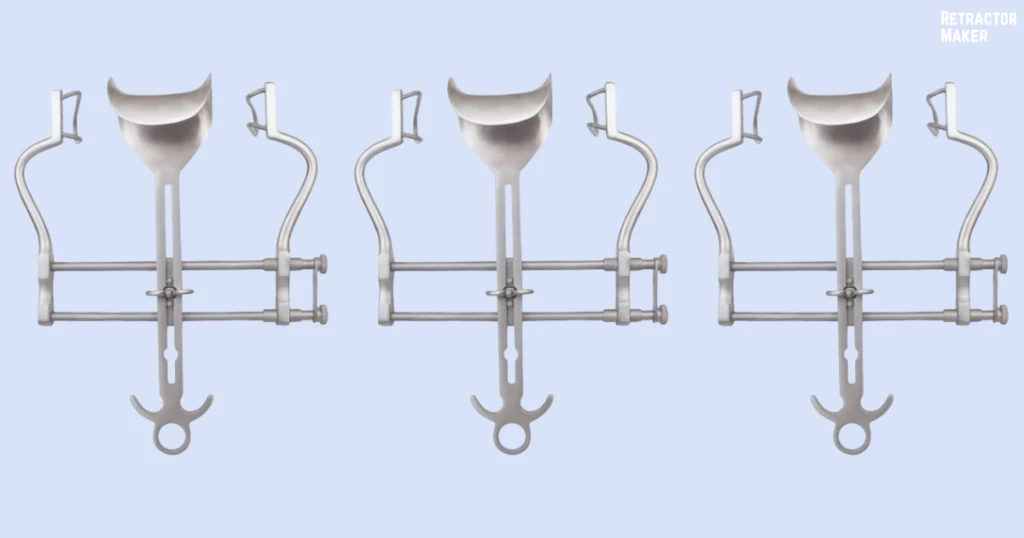
The standard Balfour Retractor has fixed or semi-modular parts. Sizes vary by frame, center blade, and side blade depth, including 60 mm or deeper 90 mm profiles. Teams select the size according to incision size and field depth.
Balfour Retractor vs. Manual Retractors
Self-retaining Balfour designs hold tissue mechanically, while manual handheld retractors require continuous holding. This difference helps clarify their roles.
| Feature | Balfour Retractor (Self-Retaining) | Manual Retractors (e.g., Richardson, Deaver) |
|---|---|---|
| Holding Requirement | Static mechanical hold; hands-free once positioned | Requires continuous manual holding by surgical staff |
| Traction Consistency | Constant, uniform mechanical counter-traction | Subject to minor positional shifts and assistant fatigue |
| Operative Space | Low-profile frame leaves the field open | Assistant hands and retractor handles occupy entry angles |
| Primary Indication | Sustained exposure throughout long procedures | Rapid, dynamic, or short-duration tissue shifts |
Why Are Different Balfour Blade Sizes Available?
Different blade sizes accommodate differences in patient anatomy and surgical fields. One blade size cannot suit every case.
Key factors for blade selection include:
- Operative Field Dimensions: Longer incisions need wider blades to distribute tissue tension evenly.
- Depth of Retraction: Thicker soft tissue needs deeper side blades to reach deep boundaries without slipping, such as 85, 90, 105, 155 mm.
- Available Working Space: Narrow areas need shorter or narrower blades to prevent crowding.
- Surgical Approach: The entry angle determines whether a standard curved or deeper straight center blade is suitable.
Trained surgical teams select blades carefully to maintain a good view and avoid excessive tissue pressure.
How Is a Balfour Retractor Used in the Operating Room?
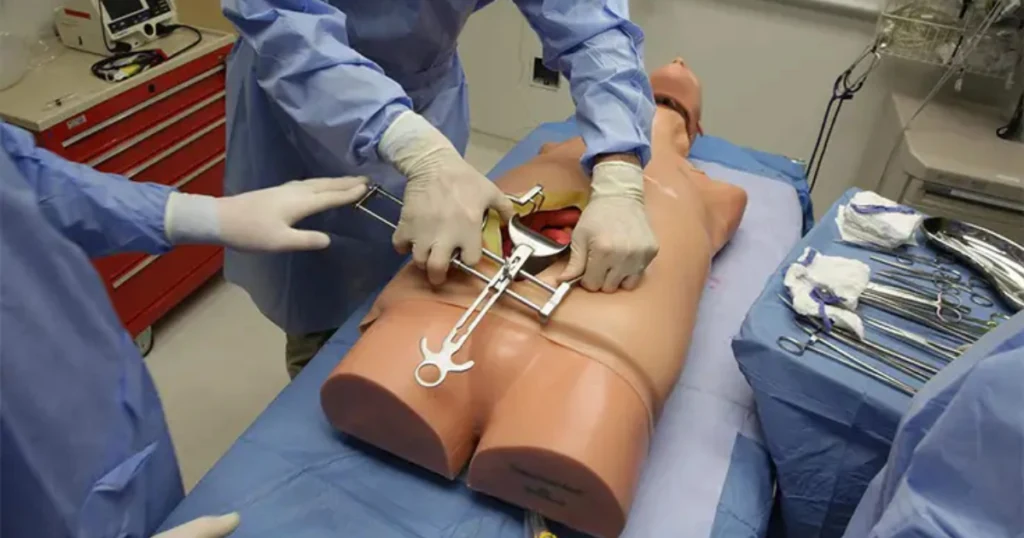
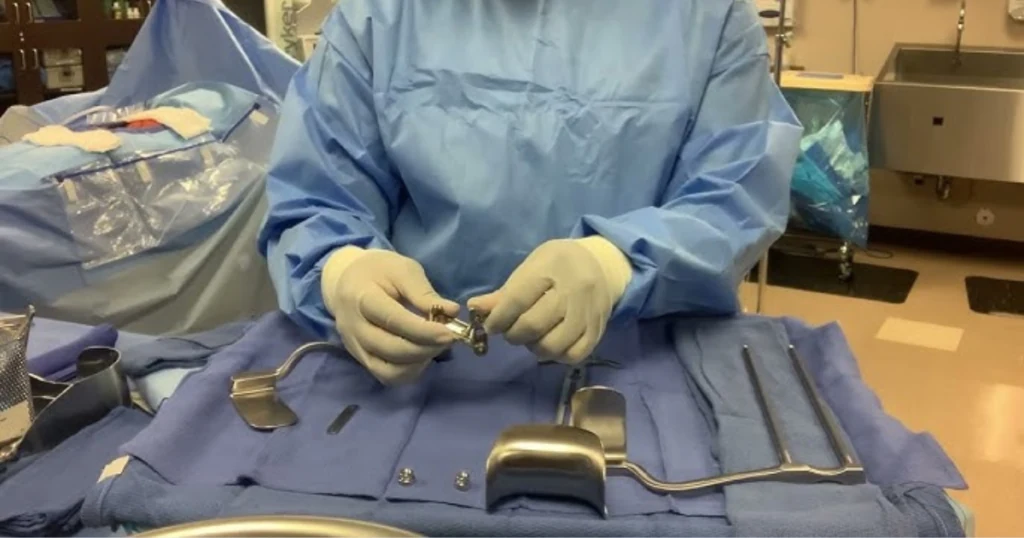
Using a Balfour Retractor requires systematic preparation and careful handling. Key steps include inspection, configuration, placement, and ongoing checks.
- Pre-Operative Inspection: Check the frame and blades. Confirm that adjustment screws, slides, and locks move smoothly and secure tightly.
- Configuration Selection: Match the frame size and blade set to the surgery and patient anatomy.
- Placement & Adjustment: Position carefully around wound edges. Gradually adjust lateral and central tension for exposure.
- Intraoperative Maintenance: Keep the frame stable and ensure it does not obstruct surgical tools or cameras.
Balfour Retractor Maintenance and Reprocessing
Reusable surgical retractors require full reprocessing to support mechanical reliability and patient safety.
- Decontamination & Cleaning: Disassemble modular blades and removable frame parts immediately after surgery. Clean all surfaces and tracks with hospital-approved enzymatic detergents to remove residue.
- Inspection: Regularly check frame alignment and blade edges. Inspect locking parts for wear, damage, or rust.
- Sterilization & Storage: Sterilize parts according to hospital rules and manufacturer instructions. Store sterilized sets in special trays to protect delicate surfaces.
What Are the Benefits of a Self-Retaining Balfour Retractor?
- Self-retaining retraction: Mechanically holds soft tissue edges open throughout the operation.
- Consistent exposure: Prevents the visual field from collapsing without manual drift.
- Less assistant fatigue: Frees staff from holding manual retractors for long periods.
- Adjustable blades: Supports side-only (two-way) and side-plus-center (three-way) setups.
- Multiple sizes: Available in standard, interchangeable, and compact (Baby) forms for clinical needs.
- Operating room workflow: Creates an organized, predictable working corridor for the surgical team.
Who Uses a Balfour Retractor?
The Balfour retractor is a self-retaining surgical device used for open surgery in all healthcare settings. Users and buyers include surgical teams, healthcare facilities, and medical equipment suppliers.
- Hospital surgical suites and general operating departments.
- Ambulatory surgical centers and specialized surgical clinics.
- Operating room nurses, surgical technologists, and surgeons.
- Medical equipment distributors and healthcare importers.
- Hospital supply chain and procurement departments.
About Retractor Maker
Retractor Maker engineers and supplies surgical retractor systems globally. We partner with healthcare systems worldwide. Our facilities manufacture surgical devices.
We make durable surgical instruments with a focus on precise sizing and secure locking. Our specialized platforms include table-mounted and self-retaining systems. Retractor Maker provides reliable supply, direct pricing, and full OEM support.
Choosing a Frame and Blades for Open Surgery
The Balfour retractor maintains operative exposure with a stable frame instead of continuous manual holding. This self-retaining system provides consistent visibility, reduces operating room fatigue, and keeps the working area organized.
The right frame size and blade depth are key to good tissue management. This applies to standard, interchangeable Balfour USA, and compact Balfour Baby models. With use and maintenance by trained staff, these systems are dependable for open surgery.
Related Products and Sourcing Options
Retractor Maker offers specialized surgical retraction platforms, component sets, and custom OEM manufacturing solutions. Explore the product and sourcing options below.
- Product categories: Rochard Retractor Product Page; Abdominal Surgical Retractor Systems; Table-Mounted Surgical Retractor Systems; Complete Surgical Retractor Catalog.
- B2B sales team: Request a Direct Factory Quote; Contact Us for Wholesale & OEM Inquiries.
Clinical notice: This guide is for surgical teams and hospital buyers. Always follow the manufacturer's instructions for use (IFU) and your hospital's sterilization rules before clinical use.
Frequently Asked Questions
What is a Balfour retractor?
A Balfour retractor is a self-retaining surgical device that holds wound margins open during surgery. Its components include a support frame, side blades, and an optional center blade. The frame maintains exposure without continuous manual holding.
What is a Balfour retractor used for?
It keeps the surgical field open without hands. It moves soft tissue and muscle margins away.
How does a self-retaining Balfour retractor work?
The frame locks blades in place once adjusted. This provides constant pull without manual holding.
What is the difference between a Balfour retractor and a manual retractor?
A Balfour Retractor holds itself in position. A manual retractor needs continuous holding by a person.
What types of Balfour retractors are available?
Types include standard, Balfour USA (interchangeable blades), and compact Balfour Baby.
What is a Balfour Baby retractor?
The Balfour Baby retractor is a smaller version with a compact frame and blades for surgeries with limited space. It is the compact option among the available forms, alongside standard models and Balfour USA models with interchangeable blades.
Why are different Balfour blade sizes available?
Different sizes match various patient bodies. They fit incision lengths and tissue thicknesses.
How should a Balfour retractor be cleaned and sterilized?
Disassemble it, clean with hospital detergents, and inspect. Sterilize parts per facility rules and maker instructions.
Who uses a Balfour retractor?
Trained surgeons and staff use it in hospitals. It is also used in surgical centers.
Where can I request a Balfour retractor quotation?
Balfour retractor quotations are available from Retractor Maker through our website portal. Hospital buyers, distributors, and surgical centers can contact our B2B sales team to request a direct factory quote or discuss wholesale and OEM inquiries.
What should be checked on a Balfour retractor before surgery?
The Balfour retractor’s frame, blades, adjustment screws, slides, and locks should be inspected before surgery. Confirm that adjustment parts move smoothly and secure tightly. Regular inspection should also check frame alignment and blade edges, with attention to wear, damage, or rust on locking parts.
How should a Balfour retractor be monitored during surgery?
The Balfour retractor’s frame should remain stable during surgery without obstructing surgical tools or cameras. Monitor placement around wound edges. Adjust side and central tension gradually to establish exposure, while checking that the frame stays stable and the working area remains clear.
About the author
Saad Shahid · Sales & Marketing Manager
Saad Shahid is the Sales & Marketing Manager and founder of Retractor Maker, started in 2023 in Sialkot, Pakistan. He also works with his father at Hospitech Traders, the family surgical instrument business founded in 1989.
Related Blogs & Guide


Related Retractors
Senn Forward Retractor
$49.00
Brewster Retractor
From $159
Langenbeck Retractor-Solid Handle
$49.00
Murphy Retractor
From $44.00
Leriche Retractor-Atraumatic Wide Blade
From $94.00
Lobster General Retractor System
$2,699Free Shipping
Need Surgical Retractors or Components?
Tell us what you need, including the product, configuration, quantity and destination country. Retractor Maker can provide availability, specifications and pricing.
Request a Quote