
Orthopedic Retractor Guides
What Is a Hohmann Retractor? Uses, Types & Orthopedic Applications
Author: Saad Shahid · Updated · 8 min read
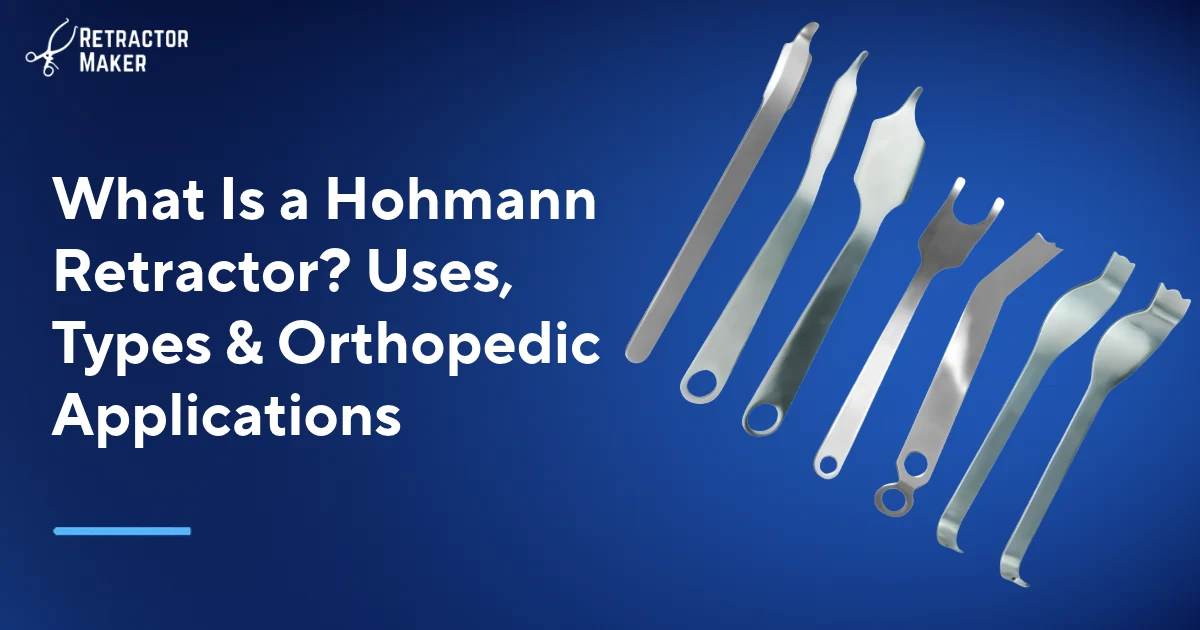
Orthopedic surgery presents unique mechanical demands. Operating around dense cortical bone, heavy muscle envelopes, and fibrous joint capsules requires instruments capable of exerting firm leverage without slipping across wet osseous margins. In open fracture reduction, joint reconstruction, and osteotomy procedures, surgeons rely on specialized levering retractors to clear the surgical field.
Retractors discussed in this guide: Hohmann Retractor, Beard Distal Radius Wide Hohmann Retractor, Bent Hohmann Retractor, Hohmann Posterior Inferior Retractor. Browse all surgical retractors.
The Hohmann retractor is a prominent orthopedic exposure instrument that uses an elongated shaft, contoured blade, and beveled beak or tip to expose bone shafts and joint cavities. Its design provides mechanical stability during exposure.
Contents
What Is a Hohmann Retractor?
A Hohmann retractor is a specialized, hand-held orthopedic surgical instrument that levers soft tissues away from bone shafts and joint margins. It functions primarily as a mechanical lever. It is named after German orthopedic surgeon Dr. Georg Hohmann, who introduced its foundational design in the early 20th century.
The main design features are a contoured blade, distal beak, elongated shank, and ergonomic handle:
- Contoured blade body: A flat or slightly curved blade rests against muscle bellies or soft-tissue flaps, shielding them from rotating drills, oscillating saws, or osteotomes.
- Distal tip (beak): A sharp, blunt, narrow, or wide beak-like projection hooks directly over the far cortical edge of a bone.
- Elongated shank: A rigid, heavy-duty shaft acts as a lever arm. Gentle downward traction on the handle by the surgeon or assistant levers soft tissues away from the periosteum, using bone as the fulcrum.
- Ergonomic handle: Finger cutouts, weight-reducing holes, or ring attachments support a steady manual grip or attachment of surgical traction weights.
Dimensions, curvatures, and tip configurations vary widely by model to suit different skeletal regions.
What Does a Hohmann Retractor Do?
The Hohmann retractor provides direct, stable visualization of bony anatomy during orthopedic and musculoskeletal procedures. Uses include:
- Fracture reduction and internal fixation (ORIF): For long-bone fractures, including the femur, tibia, or humerus, the Hohmann retractor's beak hooks over the cortex. It levers thick muscle bellies back to expose fracture lines for anatomical reduction and plate osteosynthesis.
- Total joint arthroplasty: In total hip arthroplasty (THA) and total knee arthroplasty (TKA), specialized Hohmann retractors displace the femoral neck, retract the acetabular labrum, and mobilize the patellar tendon. This creates clear sightlines for reaming and component seating.
- Osteotomies and bone grafting: Provides stable exposure during corrective osteotomies and shields surrounding neurovascular bundles during bone cuts.
- Musculoskeletal tumor and trauma resections: Isolates bone pathology by holding overlying muscle compartments steadily away from the dissection zone.
Controlled leverage is essential. Excessive mechanical force against osteoporotic cortical bone can cause focal bone indentation or soft-tissue crushing.
What Types of Hohmann Retractors Are Available?
Hohmann retractors come in a wide range of dimensions and profiles for specific anatomical zones:
- Standard / Broad-Blade Hohmann: A wide, spatulated blade with a central beak displaces broad muscle groups around large long bones, including the femur and tibia.
- Narrow-Blade Hohmann: A slender blade with a sharp or semi-sharp tip suits small bone corridors, including the radius, ulna, fibula, and pediatric orthopedics.
- Mini-Hohmann Retractor: A miniature, lightweight variant for hand, wrist, foot, and ankle procedures where tight intermetacarpal or metatarsal spaces prevent use of large retractors.
- Bent / Angled-Shank Hohmann: An acute drop-bend or bayonet curve keeps the assistant's hands and handle below or away from the surgeon's visual field and fluoroscopic C-arm path.
- Curved / Acetabular Hohmann: A pronounced semi-circular blade curve cups the femoral head or wraps around the acetabular rim during total hip reconstruction.
How Does Bone-Based Leverage Work?
The Hohmann retractor works by using bone as a fulcrum to lever soft tissue away. Selection and placement involve these considerations:
- Subperiosteal placement: After the initial incisional split, the surgeon develops a subperiosteal plane around the bone. The Hohmann retractor's beak advances carefully around the far cortex under tactile or visual confirmation.
- Cortical seating: The tip hooks over the opposite cortical ridge and rests on bone, rather than impinging on adjacent neurovascular bundles. Examples include the radial nerve along the humerus and the sciatic nerve behind the acetabulum.
- Calibrated levering: The assistant depresses the handle. The blade shields and elevates muscle bellies to expose the bare osseous surface.
- Tissue monitoring: The surgical team checks that leverage force is distributed safely without pressure blanching at the retracted muscle margins.
How Does It Compare With Other Orthopedic Retractors?
| Retractor | General Characteristics | Typical Application |
|---|---|---|
| Hohmann Retractor | Elongated rigid shaft with distal beak for cortical levering | Bone and joint exposure during fracture fixation, hip/knee arthroplasty |
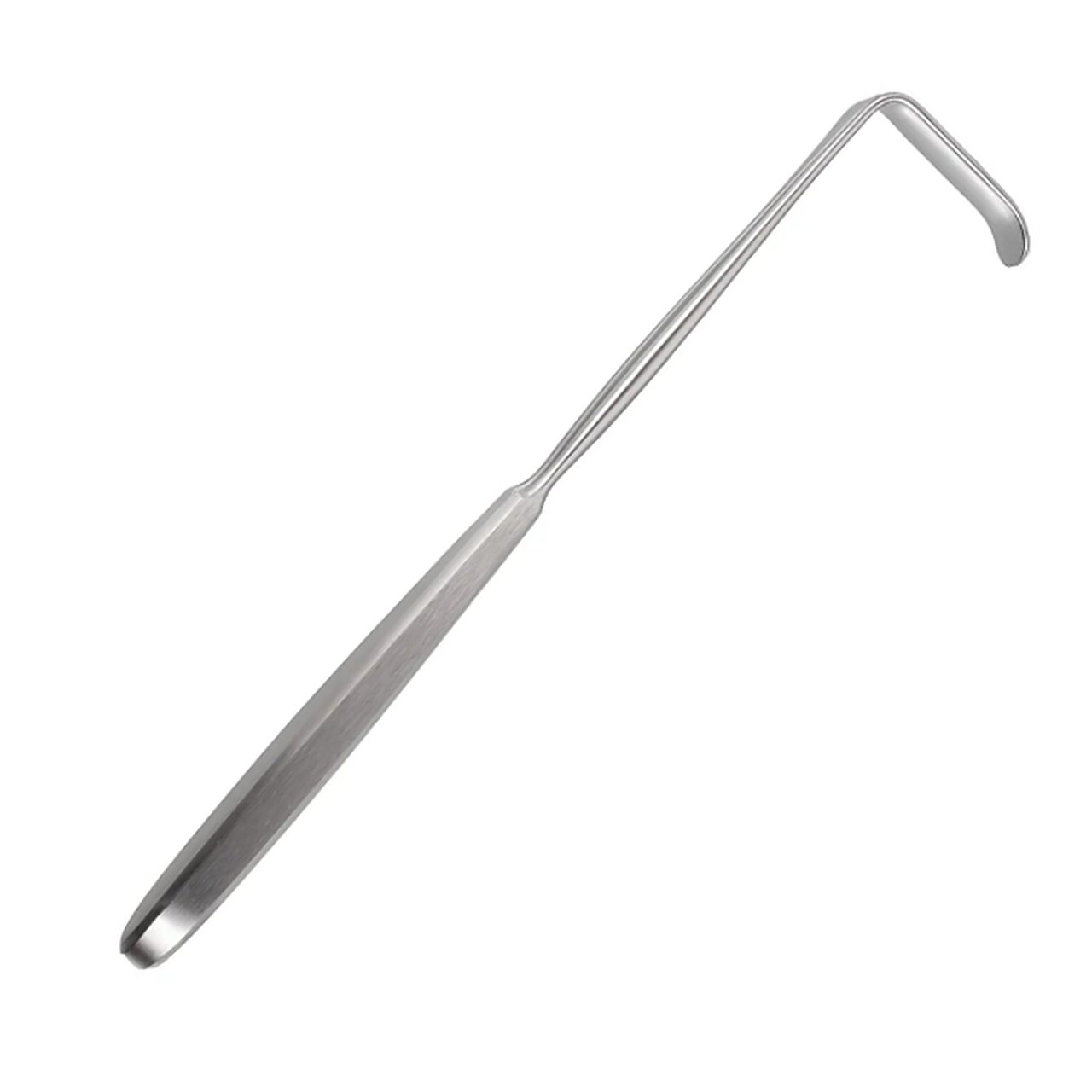
| Langenbeck Retractor | Right-angled flat blade with teardrop handle | Soft-tissue and muscular retraction without bone levering |
| Farabeuf Retractor | Double-ended, compact flat-blade handheld instrument | Superficial and intermediate soft-tissue exposure in extremity surgery |
| Cobra Retractor | Flared, broad curved blade with a pointed beak tip | Deep hip and pelvic exposure during major arthroplasty |
The Hohmann retractor uses bone as a stable mechanical fulcrum to lever tissue away. By contrast, the Langenbeck or Farabeuf pulls soft tissue horizontally through manual traction.
How Do You Choose a Hohmann Retractor?
Orthopedic teams choose a Hohmann retractor by matching blade width, tip profile, curvature, and material to the procedure:
- Target skeletal caliber: Match blade width to bone diameter. Use broad blades for the femoral shaft, intermediate profiles for the humerus or tibia, and Mini-Hohmann models for metatarsals and phalanges.
- Tip profile, sharp vs. blunt: Sharp beaks anchor on tough cortical ridges without slipping. Blunt beaks are preferred near neurovascular structures, such as the posterior column of the acetabulum, to prevent puncture trauma.
- Blade curvature and drop angle: Deep joint approaches, such as the anterior approach to the hip, require contoured or bent shanks to clear the wound margin without blocking visual axes.
- Material and finish: Choose certified Premium Grade AISI 304/316 Stainless Steel (Non-Magnetic), with non-reflective matte or satin passivation to prevent harsh glare under intense surgical lighting.
How Should Hohmann Retractors Be Cleaned and Sterilized?
Hohmann retractors require meticulous cleaning and sterilization because they frequently contact dense cortical bone, marrow, and bone debris:
- Point-of-use handling: Immediately after removal from the wound, rinse gross blood, bone dust, and marrow lipids with sterile water. Do not let bone debris dry on the blade or handle cutouts.
- Decontamination and cleaning: Submerge in a neutral or enzymatic cleaning bath. Clean the distal beak, blade edges, and handle holes thoroughly with stiff nylon-bristle brushes. Ultrasonic cleaning is recommended to remove microscopic particles from knurling and joints.
- Inspection: Examine the beak under magnification for micro-chipping, blunting, or bending. Check the rigid shaft for stress fractures or deformation from heavy levering.
- Sterilization: Package in approved sterilization wraps or orthopedic instrument cassettes. Autoclave with validated moist heat steam sterilization cycles, strictly following the manufacturer's Instructions for Use (IFU) and hospital infection control protocols.
Key Points for Orthopedic Teams and Buyers
The Hohmann retractor is a core instrument in modern orthopedic surgery. Mechanical leverage against bone margins provides clear views of fracture lines and joint cavities while shielding surrounding soft tissues from cutting instrumentation.
Appropriate blade width, tip geometry, and curvature provide stable osseous purchase and safe, non-traumatic exposure.
Retractor Maker, based in Sialkot, Pakistan, manufactures and internationally supplies precision orthopedic and spinal retractor systems. Its systems are forged from certified Premium Grade AISI 304/316 Stainless Steel (Non-Magnetic), with reinforced lever shafts and refined atraumatic blade edges. Retractor Maker supplies healthcare facilities, orthopedic clinics, and surgical distributors worldwide.
Frequently Asked Questions
Clinical notice: This guide is for surgical teams and hospital buyers. Always follow the manufacturer's instructions for use (IFU) and your hospital's sterilization rules before clinical use.
Frequently Asked Questions
What is a Hohmann retractor?
A Hohmann retractor is a specialized handheld orthopedic instrument that levers soft tissue away from bone surfaces. Its elongated shaft, contoured blade, and distal beak work together to expose bone shafts and joint margins, using bone as a mechanical fulcrum.
What does a Hohmann retractor do?
A Hohmann retractor exposes bone shafts and joint margins during orthopedic procedures. Uses include open reduction and internal fixation (ORIF) of fractures, total hip and knee arthroplasties, and corrective osteotomies. Its lever action moves soft tissues away from the underlying bone.
Is a Hohmann retractor used in orthopedic surgery?
The Hohmann retractor is an essential instrument in orthopedic trauma, reconstructive joint surgery, and musculoskeletal procedures. It provides exposure by levering soft tissues away from bone shafts and joint margins. The blade also shields surrounding soft tissues from cutting instrumentation.
What are the different types of Hohmann retractors?
They are available in broad, narrow, mini, angled-shank, and deep-curved (acetabular) profiles, with sharp, semi-sharp, or blunt tips.
How do I choose the right Hohmann retractor?
Choose a Hohmann retractor according to bone diameter, anatomical depth, proximity to neurovascular bundles, and required leverage clearance. Match the blade width to the bone and assess whether a straight or angled shank is needed. Tip profile and blade curvature also guide selection.
Are Hohmann retractors reusable?
Hohmann retractors forged from high-tensile Premium Grade AISI 304/316 Stainless Steel (Non-Magnetic) are fully reusable. They are engineered to withstand repeated cleaning, ultrasonic processing, and steam autoclaving cycles, allowing reuse after these cleaning and sterilization processes.
How should a Hohmann retractor be cleaned and sterilized?
A Hohmann retractor should be cleaned and steam autoclaved according to validated hospital protocols and the manufacturer's IFU. Wipe away bone debris at the point of use. Clean with enzymatic detergent and nylon brushes, then inspect for beak damage before sterilization.
What is the difference between a Hohmann retractor and a Langenbeck retractor?
A Hohmann retractor hooks over bone to lever tissue away, while a Langenbeck retractor manually pulls soft tissue. The Hohmann retractor has a distal beak for this purpose. The Langenbeck retractor has a smooth, right-angled blade for manual soft-tissue pulling.
How does a Hohmann retractor differ from a Farabeuf retractor?
A Hohmann retractor uses bone as a fulcrum to lever tissue away, while a Farabeuf retractor pulls soft tissue through manual traction. The Hohmann has an elongated, rigid shaft and distal beak for bone and joint exposure. The Farabeuf is compact and double-ended, providing superficial and intermediate soft-tissue exposure.
Why does a Hohmann retractor have a beveled beak?
The Hohmann retractor has a beveled beak to hook over the far cortical edge of a bone and provide purchase for mechanical levering. Its rigid shaft acts as a lever arm. Downward traction on the handle allows the contoured blade to move soft tissues away from the periosteum.
About the author
Saad Shahid · Sales & Marketing Manager
Saad Shahid is the Sales & Marketing Manager and founder of Retractor Maker, started in 2023 in Sialkot, Pakistan. He also works with his father at Hospitech Traders, the family surgical instrument business founded in 1989.
Related Blogs & Guide


Related Retractors
Senn Forward Retractor
$49.00
Brewster Retractor
From $159
Langenbeck Retractor-Solid Handle
$49.00
Murphy Retractor
From $44.00
Leriche Retractor-Atraumatic Wide Blade
From $94.00
Lobster General Retractor System
$2,699Free Shipping
Need Surgical Retractors or Components?
Tell us what you need, including the product, configuration, quantity and destination country. Retractor Maker can provide availability, specifications and pricing.
Request a Quote