
ENT Retractors
Jansen Mastoid Retractor: Uses, Sizes & Selection
Author: Saad Shahid · Updated · 7 min read
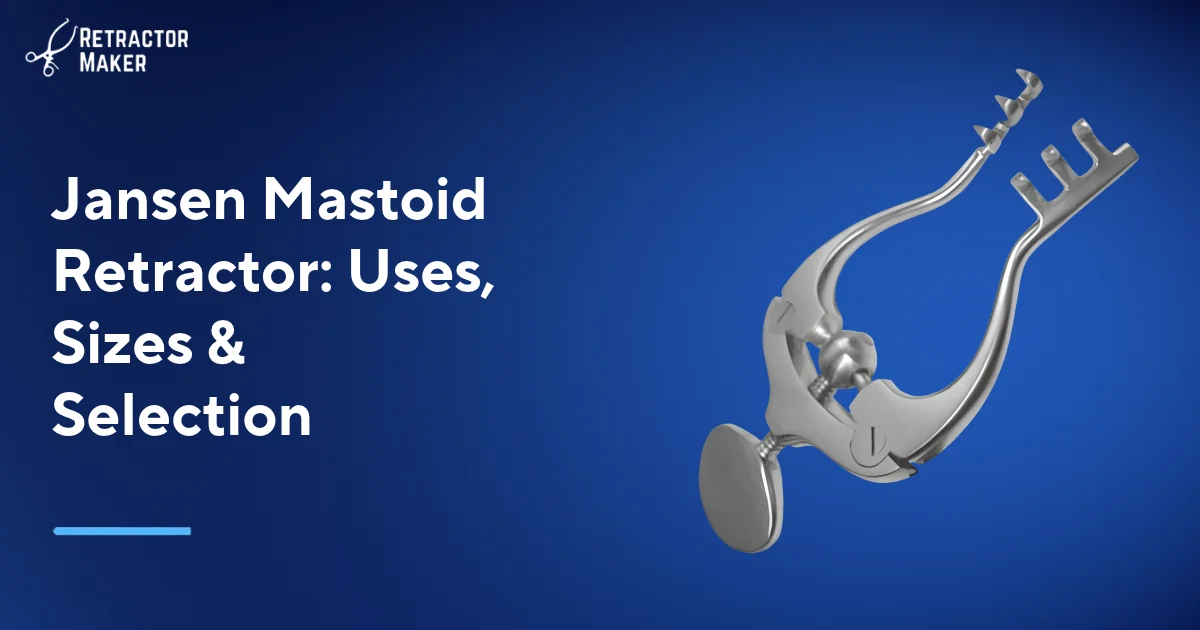
Explore Jansen mastoid retractor uses, prong options, sizes, positioning, and sterilization considerations for surgical teams and hospital buyers worldwide.
Retractors discussed in this guide: Jansen Mastoid Retractor. Browse all surgical retractors.
A Jansen mastoid retractor is a compact, self-retaining surgical instrument used to hold periosteal tissue and wound margins apart during mastoid and scalp surgery. Outward-curving multi-prong blades engage the selected tissue margins, while a precision-threaded thumbscrew adjusts the opening. For surgeons, the practical purpose is sustained exposure without continuous handheld retraction. For operating room staff and buyers, the main selection points are overall length, prong layout, tip profile, and available spread. These specifications should be matched to the planned procedure rather than chosen by instrument name alone.
What is a Jansen mastoid retractor?
The Jansen mastoid retractor is a screw-adjusted, self-retaining retractor, rather than a handheld hook or blade. Its mechanical thumbscrew maintains the selected opening, allowing the surgical team to work within the exposed field. Self-retention does not remove the need to monitor tissue tension: the placement and opening must remain appropriate as the procedure progresses.
Its intended role is soft-tissue and periosteal exposure, not bone removal. In mastoid surgery, retraction supports access to the operative area while other instruments perform the procedure. The related Gifford-Jansen Retractor also provides self-retaining wound margin and periosteal retraction, with a stated intended use covering mastoid, ear, and scalp surgery.
What is a Jansen mastoid retractor used for?
The Jansen model is specifically intended for mastoid and scalp surgery. These applications require controlled separation of wound margins or periosteal tissue so that the surgeon can see and access the working area. Instrument suitability depends on the incision, tissue condition, and surrounding anatomy, not simply the specialty listed on a tray.
- Mastoid surgery: provides self-retaining periosteal and wound margin retraction to support exposure.
- Scalp surgery: holds selected tissue margins apart when the incision and tissue characteristics suit the instrument.
- Ear surgery: included in the stated intended use of the Gifford-Jansen Retractor.
- Confined surgical fields: the Gifford-Jansen design provides hands-free exposure with adjustable spread tension.
For an ENT or scalp surgery tray, confirm which model the surgeon requests and which tissue will be engaged. Neither a familiar instrument name nor a self-retaining mechanism establishes suitability for every incision. The clinician should choose the tip profile and opening needed for exposure while avoiding unnecessary pressure on tissue.
What are its main parts and dimensions?
The main functional elements are the opposing multi-prong blades and the mechanical thumbscrew drive. The Jansen model has outward-curving blades, with a precision-threaded mechanism for smooth, micro-adjustable opening. Both listed models use Premium Grade AISI 304/316 Stainless Steel (Non-Magnetic). That material description does not replace the need for correct cleaning, inspection, and sterilization.
- Jansen overall lengths: 3″, 3 ¼″, 3 ⅝″, 4″, 4 ¼″, and 4 ½″.
- Jansen prong arrays: 3×3 or 4×4, with sharp or blunt tips.
- Jansen prong functional depth: 8 mm across all variations.
- Jansen spread options: 15 mm blade length × 70 mm spread, or 20 mm blade length × 64 mm spread.
- Gifford-Jansen overall length: 11.5 cm, approximately 4.5 inches.
- Gifford-Jansen options: 3×3 or 4×4 prongs, sharp or blunt tips, and a fine-pitch mechanical thumb-screw lock.
Overall length, blade length, functional depth, and spread describe different aspects of fit. A longer instrument should not automatically be treated as offering greater opening. The Gifford-Jansen product information does not specify prong depth or spread dimensions, so buyers should request those details rather than carry over the Jansen measurements.
Jansen vs. Gifford-Jansen: which variant fits?
Both products provide self-retaining retraction, but their listed dimensions and option structures differ. The Jansen model offers selectable overall lengths and specified blade-and-spread options. The Gifford-Jansen model lists a single overall length with selectable prong layouts. Confirm the complete configuration before treating the models as interchangeable.
| Product name | Design and listed options | Typical intended use |
|---|---|---|
| Jansen Mastoid Retractor | Outward-curving multi-prong blades; precision-threaded thumbscrew; selectable overall lengths; 3×3 or 4×4 prongs; sharp or blunt tips | Self-retaining periosteal and wound margin retraction during mastoid and scalp surgery |
| Gifford-Jansen Retractor | Compact screw-lock design; 11.5 cm overall length; fine-pitch thumb-screw adjustment; 3×3 or 4×4 prongs; sharp or blunt tips | Self-retaining wound margin and periosteal retraction during mastoid, ear, and scalp surgery |
Should you choose sharp or blunt prongs?
Sharp tips provide secure engagement, while blunt tips are offered to minimize tissue trauma. For the Gifford-Jansen model, the sharp option is described for secure osseous or fascial grip. Blunt tips still require careful placement and tension control; they do not eliminate pressure injury. Tip choice belongs to the clinician assessing the tissue and required exposure.
How is a Jansen mastoid retractor positioned?
Positioning requires direct visualization, deliberate tissue engagement, and only enough opening to obtain the necessary exposure. This is a general safety overview for trained surgical personnel, not a substitute for supervised technique or the manufacturer's instructions for use. Before placement, confirm that the selected configuration suits the wound and that the mechanism functions correctly.
- Inspect the prongs and screw mechanism before use; remove damaged or malfunctioning instruments from service.
- Place the prongs under direct vision, keeping vulnerable structures clear of the intended contact points.
- Adjust the thumbscrew gradually while observing tissue engagement and tension.
- Reassess exposure and tissue condition throughout use, especially after changes in operative position or access.
- Release tension in a controlled manner and disengage the prongs before removing the instrument.
If exposure is inadequate, reassess position, configuration, and the surgical approach rather than simply increasing spread. A self-retaining instrument can continue applying pressure while attention shifts elsewhere, making ongoing observation important.
How should it be cleaned and sterilized?
Both models are supplied non-sterile and are fully autoclavable. They require appropriate processing before initial surgical use and reprocessing after subsequent use. Individual Protective Packaging protects the supplied instrument but must not be interpreted as sterile packaging.
Cleaning must precede sterilization. Follow the manufacturer's instructions and the facility's validated reprocessing procedures, paying attention to prongs, threads, and other areas where soil may remain. Inspect cleanliness, condition, and screw operation before preparing the instrument for sterilization. Any maintenance products must be compatible with the instrument and its processing instructions.
The supplied product information does not include a validated cycle, detergent specification, or disassembly procedure. Obtain the applicable instructions before establishing a processing protocol. Do not infer steam exposure settings from the material description alone, and follow facility requirements for drying, packaging, storage, and release for use.
How do you choose and order from Retractor Maker?
Choose the configuration from the clinical requirement, then document it clearly for purchasing. Retractor Maker is a surgical retractor manufacturer and exporter in Sialkot, Pakistan, offering wholesale supply, OEM services, and worldwide shipping. Both listed products are brand new, individually protectively packaged, and available with a minimum order quantity of 1 piece.
Listed Jansen prices by overall length are 3″ ($69), 3 ¼″ ($74), 3 ⅝″ ($79), 4″ ($84), 4 ¼″ ($89), and 4 ½″ ($94). Gifford-Jansen pricing is $84.00 for the 3×3 layout and $89.00 for the 4×4 layout. Request a quotation confirming the selected options, shipping costs, and applicable order terms.
Include the product name, length, prong array, tip profile, and required blade-and-spread option where specified. For wholesale or OEM enquiries, state the quantity and requested customization, and ask Retractor Maker to confirm feasibility. Hospital buyers should also request the applicable reprocessing instructions and documentation required by their institution and destination market before approval.
Clinical notice: This guide is for surgical teams and hospital buyers. Always follow the manufacturer's instructions for use (IFU) and your hospital's sterilization rules before clinical use.
Frequently Asked Questions
What is a Jansen mastoid retractor used for?
A Jansen mastoid retractor is used for self-retaining periosteal and wound margin retraction during mastoid and scalp surgery. Its multi-prong blades hold selected tissue margins apart while the thumbscrew adjusts the opening. This provides hands-free exposure, but the surgical team must continue monitoring placement and tissue tension throughout use.
Is a Jansen mastoid retractor self-retaining?
The Jansen mastoid retractor is a self-retaining instrument with a mechanical thumbscrew drive. Its precision-threaded mechanism allows micro-adjustable opening without continuous handheld retraction. Self-retaining does not mean unattended: clinicians still need to reassess tissue engagement, pressure, and exposure as the procedure progresses and release tension carefully before removal.
What sizes does the Jansen mastoid retractor come in?
The Jansen Mastoid Retractor is offered in overall lengths of 3″, 3 ¼″, 3 ⅝″, 4″, 4 ¼″, and 4 ½″. Its listed functional prong depth is 8 mm across variations. Available spread options are 15 mm blade length × 70 mm spread or 20 mm blade length × 64 mm spread; confirm the required combination when ordering.
What is the difference between Jansen and Gifford-Jansen retractors?
The listed Jansen and Gifford-Jansen retractors differ in their specified dimensions, option structures, and intended-use wording. Jansen offers selectable overall lengths and specified spread options for mastoid and scalp surgery. Gifford-Jansen lists an 11.5 cm overall length and includes ear surgery alongside mastoid and scalp surgery. Both offer sharp or blunt tips and screw-adjusted self-retention.
Are sharp or blunt Jansen retractor prongs better?
Neither sharp nor blunt Jansen retractor prongs are universally better; selection depends on tissue and exposure requirements. Sharp tips provide secure engagement, while blunt tips are offered to minimize tissue trauma. Both require careful positioning and controlled tension. The operating clinician should select the profile rather than assuming blunt tips cannot injure tissue.
Can a Jansen mastoid retractor be autoclaved?
The listed Jansen Mastoid Retractor is fully autoclavable and supplied non-sterile. It must be appropriately cleaned and sterilized before surgical use, including before its first use. The supplied product details do not provide validated cycle parameters, so obtain the manufacturer's reprocessing instructions and follow the facility's validated procedures rather than selecting settings from the material description.
About the author
Saad Shahid · Sales & Marketing Manager
Saad Shahid is the Sales & Marketing Manager and founder of Retractor Maker, started in 2023 in Sialkot, Pakistan. He also works with his father at Hospitech Traders, the family surgical instrument business founded in 1989.
Related Blogs & Guide

Related Retractors
Senn Forward Retractor
$49.00
Brewster Retractor
From $159
Langenbeck Retractor-Solid Handle
$49.00
Murphy Retractor
From $44.00
Leriche Retractor-Atraumatic Wide Blade
From $94.00
Lobster General Retractor System
$2,699Free Shipping
Need Surgical Retractors or Components?
Tell us what you need, including the product, configuration, quantity and destination country. Retractor Maker can provide availability, specifications and pricing.
Request a Quote