
Orthopedic & Spine Retractors
Scoville Retractor: Uses, Types, Sizes & Selection
Author: Saad Shahid · Updated · 7 min read
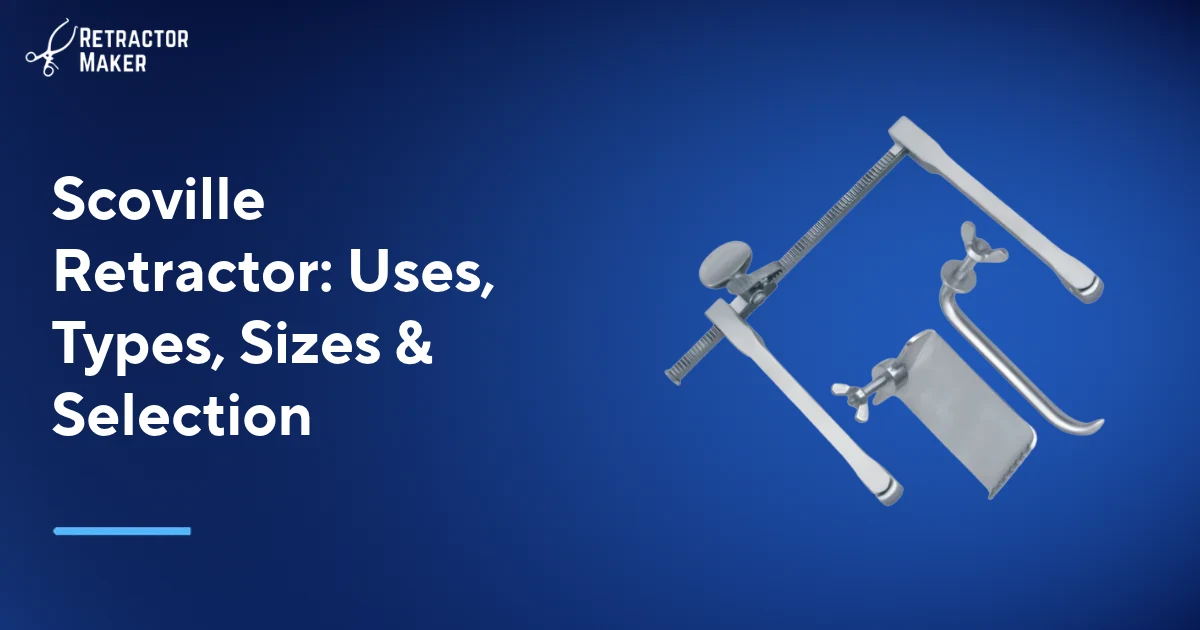
Compare Scoville retractor types, sizes, surgical uses and care guidance, with selection advice for surgeons, OR teams and hospital instrument buyers.
Retractors discussed in this guide: Scoville Nerve Retractor, Scoville Nerve Root Retractor, Scoville Self Retaining Retractor, Scoville-Haverfield Self Retaining Retractor. Browse all surgical retractors.
A scoville retractor is a surgical instrument used to retract paraspinal muscles or to mobilize and protect nerves, depending on the model. The name covers both self-retaining spinal exposure systems and handheld nerve retractors, so it does not identify a single interchangeable instrument. For surgeons, OR staff and hospital buyers, the essential distinction is the tissue being retracted: heavy musculature requires a different working end and support mechanism from delicate neural structures.
What is a Scoville retractor?
Scoville retractors fall into two practical groups: self-retaining retractors for maintaining spinal exposure and handheld retractors for controlled nerve handling. Self-retaining models use a frame, blades and a manual screw lock to maintain the selected opening. Handheld models use a slender shaft and a contoured working tip, with positioning controlled by the operator.
These groups may serve different roles within spinal surgery, but they are not substitutes for one another. A muscle-retraction system establishes access to deeper anatomy; a nerve retractor supports more localized tissue handling. Instrument identification should therefore include the complete product name rather than simply requesting a Scoville.
What is a Scoville retractor used for?
The listed Scoville instruments support lumbar spinal exposure and nerve mobilization. Their intended uses relate principally to spine surgery and neural tissue handling, with the choice determined by the operative task rather than the specialty name alone.
- Lumbar muscle retraction: the Scoville-Richter Self Retaining Retractor retracts heavy paraspinal musculature and maintains wide exposure.
- Lamina exposure: the Scoville Self Retaining Retractor retracts paraspinal muscles during lumbar laminectomy and discectomy.
- Microscopic access: the Scoville-Haverfield Self Retaining Retractor combines muscle retraction with downward-hinged shanks for line-of-sight clearance.
- Compact nerve access: the Scoville Nerve Retractor mobilizes and protects nerve roots and peripheral nerves in compact surgical corridors.
- Lumbar discectomy: the Scoville Nerve Root Retractor mobilizes, cradles and protects traversing spinal nerve roots and the dural sac.
Retraction supports visualization; it does not remove the need to monitor tissue response. Exposure requirements can change during surgery, and a locked frame still requires reassessment. Similarly, a contoured nerve tip does not make excessive traction safe.
What are the main parts and dimensions?
Self-retaining frames, blades and locks
The Scoville Self Retaining Retractor uses a slider track frame, modular asymmetric blades and a manual screw lock. Its maximum horizontal expansion is 150 mm. The blade specifications include a single sharp prong with a 50 mm structural height and a toothed lateral blade measuring 60 mm × 25 mm.
The Scoville-Haverfield model also opens horizontally up to 150 mm. It has a jointed scissor-action frame with downward-hinged shanks, detachable asymmetric blades and a manual screw lock. Its single sharp prong has a 50 mm operational height, while its lateral paddle measures 60 mm × 25 mm and has a micro-toothed tip.
The Scoville-Richter model uses a slider track and detachable semi-sharp claw blades, with a maximum opening of 155 mm. Its 3-prong blade footprint is 62 mm × 37 mm; its 4-prong footprint is 62 mm × 52 mm. These specifications describe blade footprints and mechanical limits, not recommended tissue displacement.
Handheld shafts, tips and handles
The Scoville Nerve Retractor measures 16.5 cm overall, while the Scoville Nerve Root Retractor measures 23.5 cm. Both have slender shafts, angled contoured tips and flat handles with lateral serrations. All five listed products use Premium Grade AISI 304/316 Stainless Steel (Non-Magnetic). Overall length should not be confused with working-tip dimensions.
Which Scoville retractor types are available?
Retractor Maker lists five Scoville models with distinct configurations. Compare their intended tissue contact and frame geometry before comparing dimensions. Similar naming does not establish blade compatibility or equivalent surgical function.
| Product name | Design | Typical use |
|---|---|---|
| Scoville-Richter Self Retaining Retractor | Slider track, detachable multi-prong semi-sharp claw blades, manual screw lock | Wide exposure through heavy paraspinal muscle retraction during lumbar spine surgery |
| Scoville Nerve Retractor | Handheld compact instrument, slender shaft, angled contoured tip | Mobilizing and protecting nerve roots and peripheral nerves in compact corridors |
| Scoville-Haverfield Self Retaining Retractor | Downward-hinged shanks, detachable asymmetric blades, manual screw lock | Paraspinal muscle retraction with microscopic line-of-sight clearance |
| Scoville Nerve Root Retractor | Handheld deep-reach instrument, slender shaft, angled contoured tip | Protecting traversing spinal nerve roots and the dural sac during lumbar discectomy |
| Scoville Self Retaining Retractor | Guide rail system, modular asymmetric blades, manual screw lock | Retracting paraspinal muscles and exposing the vertebral lamina |
How should a Scoville retractor be positioned?
Positioning should match the intended tissue, operative exposure and surgeon's technique. The following principles are for trained surgical teams and do not replace device instructions or procedure-specific training. Before use, confirm the model, inspect its working surfaces and verify that any detachable components are securely fitted according to the manufacturer's instructions.
For self-retaining systems, placement should provide exposure without unintended contact with neural structures. Apply only the retraction needed, confirm stability after engaging the manual screw lock and reassess tissue contact throughout use. Maximum track expansion is a device specification, not a clinical target.
For handheld nerve retractors, the operator maintains control of tip position and traction. Use visualization and gentle handling appropriate to delicate neural tissue. Avoid blind placement and excessive or prolonged pressure, and reassess the contact point whenever exposure or instrument position changes.
How are Scoville retractors cleaned and sterilized?
All listed Scoville retractors are supplied non-sterile and are fully autoclavable. They must undergo appropriate cleaning and sterilization before surgical use. Protective packaging is not evidence of sterility, and autoclavability alone does not specify a validated processing cycle.
Follow the current manufacturer instructions and the facility's validated reprocessing procedures. Pay attention to blade attachments, serrations, tracks, hinges and screw mechanisms where present. Disassemble only as directed, clean before sterilization and inspect for residual soil, damage and impaired movement. Obtain validated cycle parameters and assembly instructions rather than inferring them from the material description.
How do you choose and buy a Scoville retractor?
Choose by task first: muscle exposure, microscopic clearance, compact nerve handling or deeper lumbar nerve-root access. Then compare blade geometry, overall length, frame arrangement and the surgeon's preferences. Confirm the supplied components, replacement-part compatibility and reprocessing documentation before approving a purchase.
Retractor Maker is a surgical retractor manufacturer and exporter in Sialkot, Pakistan, offering wholesale supply, OEM services and worldwide shipping. The listed self-retaining products are supplied as complete system sets in protective packaging, with a minimum order of 1 set. Handheld models have individual protective packaging and a minimum order of 1 piece.
For a quotation, provide the full product name, required quantity, destination and any OEM requirements. Ask for confirmation of set contents, available documentation and shipping arrangements. Keep the purchase specification tied to the exact model so clinical teams and procurement staff evaluate the same instrument.
Clinical notice: This guide is for surgical teams and hospital buyers. Always follow the manufacturer's instructions for use (IFU) and your hospital's sterilization rules before clinical use.
Frequently Asked Questions
What is a Scoville retractor used for?
A Scoville retractor is used for paraspinal muscle retraction or nerve mobilization, depending on the model. Self-retaining versions maintain spinal exposure, while handheld versions support localized nerve handling. The Scoville Nerve Root Retractor is specifically intended to mobilize, cradle and protect traversing spinal nerve roots and the dural sac during lumbar discectomy.
Is a Scoville retractor self-retaining?
Some Scoville retractors are self-retaining, but handheld versions are also available. The Scoville, Scoville-Richter and Scoville-Haverfield self-retaining systems use manual screw locks to maintain an opening. The Scoville Nerve Retractor and Scoville Nerve Root Retractor are handheld instruments whose position and traction remain under operator control.
What is the difference between Scoville and Scoville-Haverfield retractors?
The principal listed difference is the Scoville-Haverfield model's downward-hinged shank arrangement for line-of-sight clearance. The Scoville Self Retaining Retractor uses a slider track frame with dual-arm shanks, while the Haverfield has a jointed scissor-action frame. Both list a maximum horizontal opening of 150 mm and use modular asymmetric blades with a manual screw lock.
What sizes do Scoville nerve retractors come in?
The listed Scoville Nerve Retractor is 16.5 cm long, and the Scoville Nerve Root Retractor is 23.5 cm long. These are overall instrument lengths, not tip measurements. The shorter model is intended for compact surgical corridors, while the longer model is configured for deep-reach spinal nerve-root handling during lumbar discectomy.
Can Scoville retractors be autoclaved?
All five listed Scoville retractors are fully autoclavable and supplied non-sterile. Cleaning and sterilization are required before surgical use, following manufacturer instructions and the facility's validated procedures. The supplied specifications do not provide cycle parameters, so processing teams should obtain the applicable instructions rather than select a cycle based only on the material.
Where can hospitals buy Scoville retractors wholesale?
Hospitals can request Scoville retractors from Retractor Maker, a manufacturer and exporter in Sialkot, Pakistan, offering wholesale, OEM services and worldwide shipping. The listed minimum order is 1 set for self-retaining systems or 1 piece for handheld instruments. Specify the exact model and confirm contents, documentation and shipping details when requesting a quotation.
About the author
Saad Shahid · Sales & Marketing Manager
Saad Shahid is the Sales & Marketing Manager and founder of Retractor Maker, started in 2023 in Sialkot, Pakistan. He also works with his father at Hospitech Traders, the family surgical instrument business founded in 1989.
Related Blogs & Guide


Related Retractors
Gifford-Jansen Retractor
From $84.00
Hajek Cheek Retractor
$24.00
Lip And Cheek Retractor
$49.00
Bellucci Endaural Retractors
From $174
Aufricht Nasal Retractor
From $59.00
Aufricht Walter Nasal Retractor
$69.00
Need Surgical Retractors or Components?
Tell us what you need, including the product, configuration, quantity and destination country. Retractor Maker can provide availability, specifications and pricing.
Request a Quote