
Surgical Retractor Guides
Bookwalter vs Omni Retractor: Key Differences, Features & Which One to Choose
Author: Saad Shahid · Updated · 10 min read

Bookwalter and Omni retractors are self-retaining, table-mounted systems built around different frame geometries. This guide compares their setup, components, blades, stability, flexibility, applications, and selection considerations.
Retractors discussed in this guide: Bookwalter Retractor, Bookwalter Retractor (Standard), Omni Retractor System. Browse all surgical retractors.
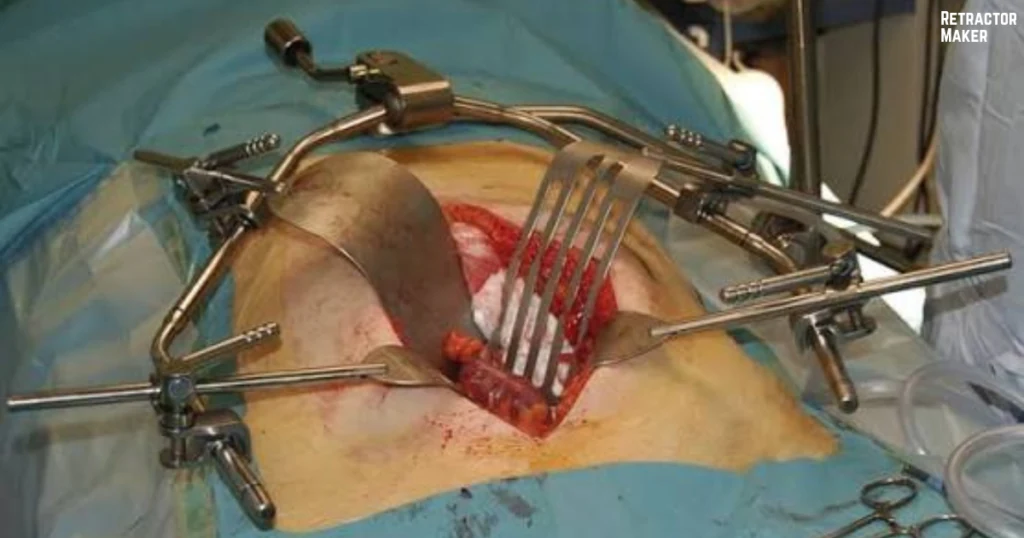
The Bookwalter retractor is a table-mounted, self-retaining system for open surgery, often compared with the Omni retractor by hospitals and procurement boards. Both are reliable mechanical exposure systems that clamp to operating table side rails for stable, hands-free wound retraction. Their main difference is frame design. Bookwalter uses a central closed ring, such as an oval or segmented ring, with slide-on ratchets that hold surgical blades. Omni uses a split, fork-shaped Wishbone frame with quick-connect slide clamps and pivoting swivel-joint blades. The choice depends on surgical specialty, anatomical depth, and adjustment speed during complex operations.
Contents
What is a Bookwalter retractor?
The Bookwalter Retractor Set & System is a table-mounted, self-retaining system built around a central, closed perimeter ring. A solid post, coupler, and horizontal flex bar anchor it to the table side rails. Together, they form a rigid 360-degree boundary over the patient’s abdomen.
Surgeons attach independent standard or tilt ratchets to the ring. These pull blades outward or at an angle to keep tissues cleanly retracted. Its structural strength supports wide abdominal and deep pelvic exposure for hours without slipping.

What is an Omni Retractor?
The Omni Retractor is a table-mounted, self-retaining system with a split, open-loop Wishbone frame. Instead of forming a closed ring over the patient, the frame branches around the incision. This leaves the workspace directly above the wound completely open.
Quick-connect, spring-loaded SnapClamp holders slide freely along the frame. Specialized swivel-joint blades pivot inside the wound. This design makes Omni particularly effective for deep lateral exposure and rapid blade-tension adjustment.
How do Bookwalter and Omni systems compare?
Both systems use the operating room table as a mechanical anchor to eliminate assistant hand fatigue. They achieve surgical exposure through different mechanical designs:
- Bookwalter System: Structural strength, continuous 360-degree perimeter retraction, and heavy-duty blade holding.
- Omni System: Low-profile working space, fast clamp adjustment, and pivoting tissue contouring.
How do the frame designs differ?
Frame geometry is the main mechanical difference. Bookwalter uses complete closed-loop rings, either oval or segmented hinged rings, to surround the wound. This provides equal tension in all directions but can sometimes create a high profile above the patient.
Omni uses a fork-shaped Wishbone frame that splits along both sides of the incision. The flat fork design keeps bulky overhead metal bars out of the workspace.
How do the systems mount to the operating table?
Both systems attach to operating table side rails but distribute physical loads differently. Bookwalter generally uses one heavy-duty table post clamp to support its central horizontal flex bar and ring assembly.
The Omni system supports single or bilateral post-clamp configurations. A modular extension arm positions the Wishbone frame precisely above asymmetric wounds.
Which components does each system include?
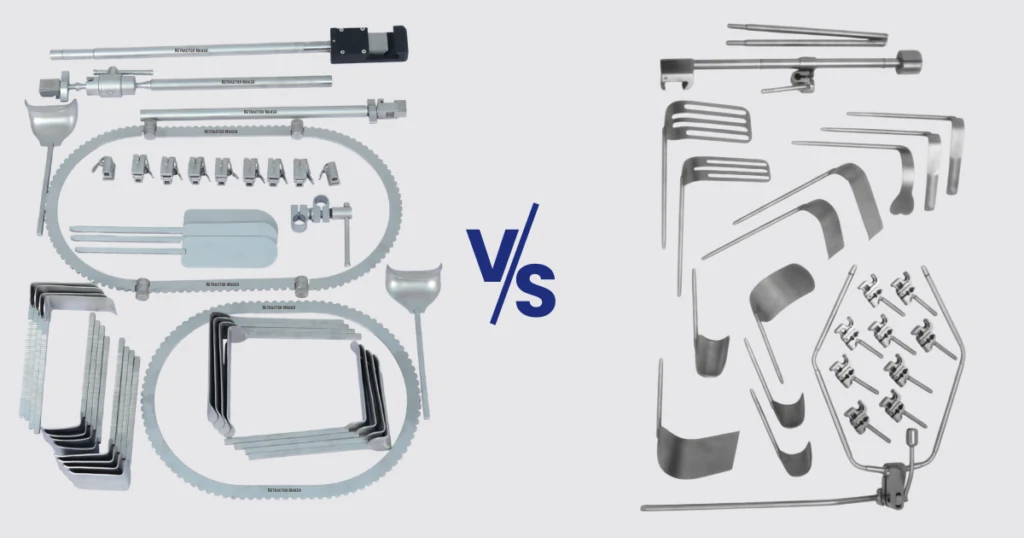
A standard Bookwalter set includes rigid rings, vertical posts, horizontal bar couplers, standard sliding ratchets, and tilt ratchets. An Omni set includes a split Wishbone frame, sterile field posts, hinged extension bars, quick-connect SnapClamps, and swivel-joint blade shafts. Bookwalter ratchets slide onto the ring. Omni SnapClamps clip directly onto and off the Wishbone bars without sliding.
How do the blade options compare?
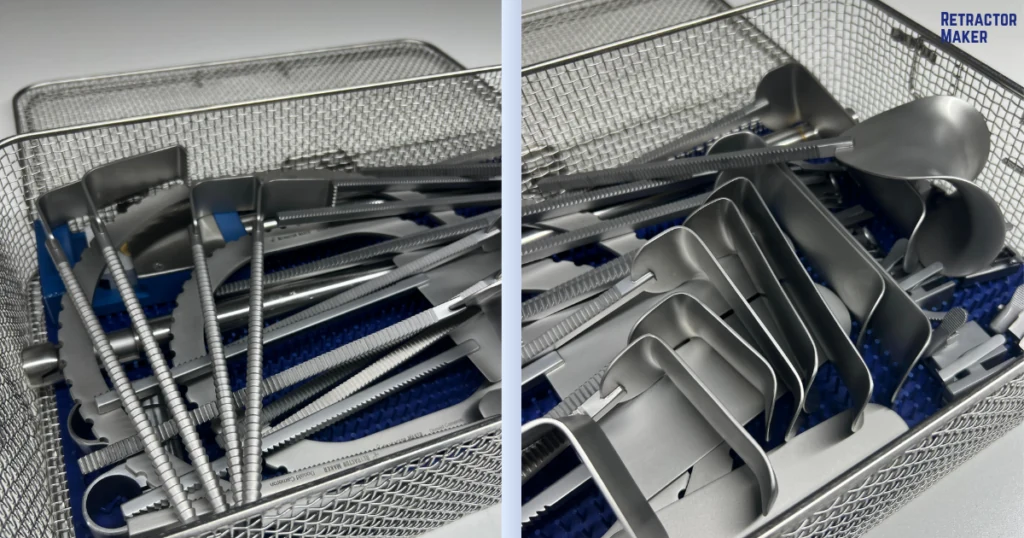
Bookwalter blades have straight, rigid shafts that fit directly into standard or tilt ratchets. They provide a stable hold on heavy abdominal wall muscle blocks.
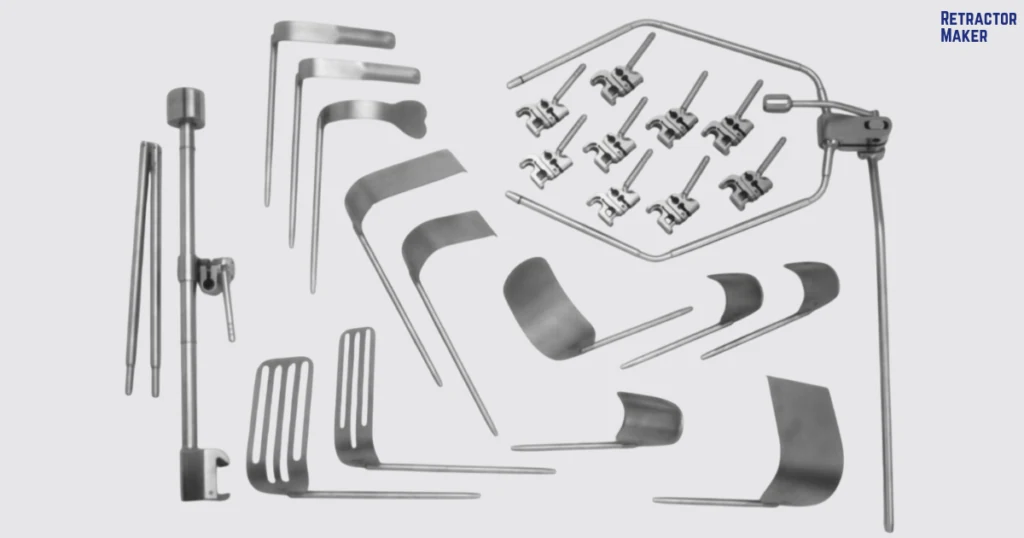
Omni blades are specialized swivel retractors with a pivot hinge where the blade face meets the shaft. The swivel joint lets the metal blade follow the natural curves of deep internal organs. This distributes retraction pressure evenly to prevent tissue trauma.
How to set up Bookwalter retractor and Omni systems
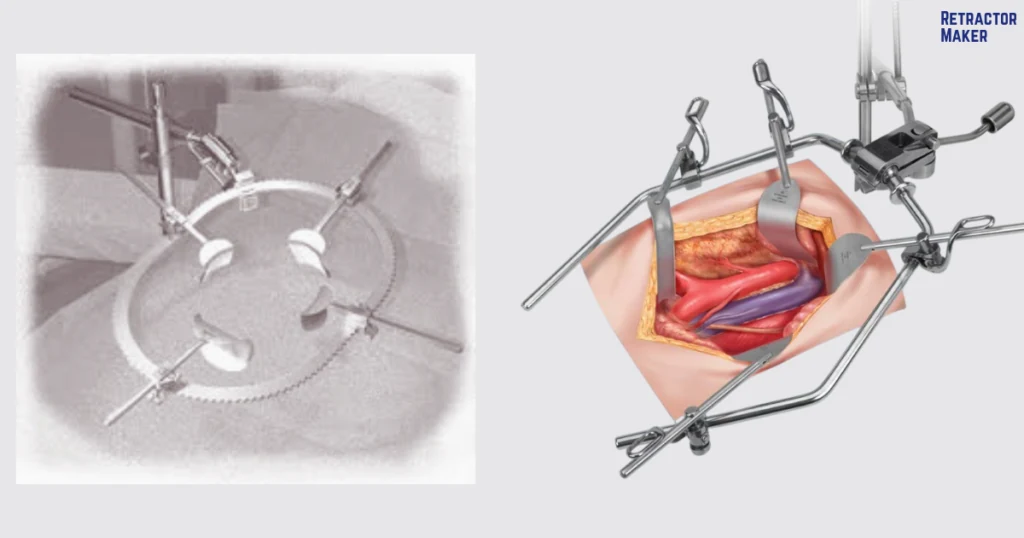
- Bookwalter Assembly: Straightforward, with manual alignment. Securely lock the post coupler, vertical post, horizontal bar, and ring frame before sliding ratchets onto the ring.
- Omni Assembly: Modular setup. Attach the Wishbone frame to the vertical post and snap SnapClamps directly onto the frame bars instantly. Slot swivel blades into the clamps and adjust them with a hand wheel.
How do surgical exposure and stability compare?
Bookwalter provides strong, continuous downward and outward force for stable retraction of thick muscle walls in large patients. Omni has a lower physical profile, allowing surgeons to work closer to the skin surface. Omni’s pivoting swivel blades provide deep cavity flexibility. Under heavy, high-tension muscle loads, they may have slightly more pivot movement than rigid Bookwalter blades.
How are blades adjusted during surgery?
- Bookwalter: Specialized tilt ratchets adjust the blade-shaft angle. Repositioning a blade requires sliding its ratchet along the ring perimeter.
- Omni: Flexible adjustment. SnapClamps snap instantly onto any part of the Wishbone frame. Swivel-joint blades pivot automatically with moving organs, while a micro-adjustable handle provides fine tension control.
What are the common surgical applications?
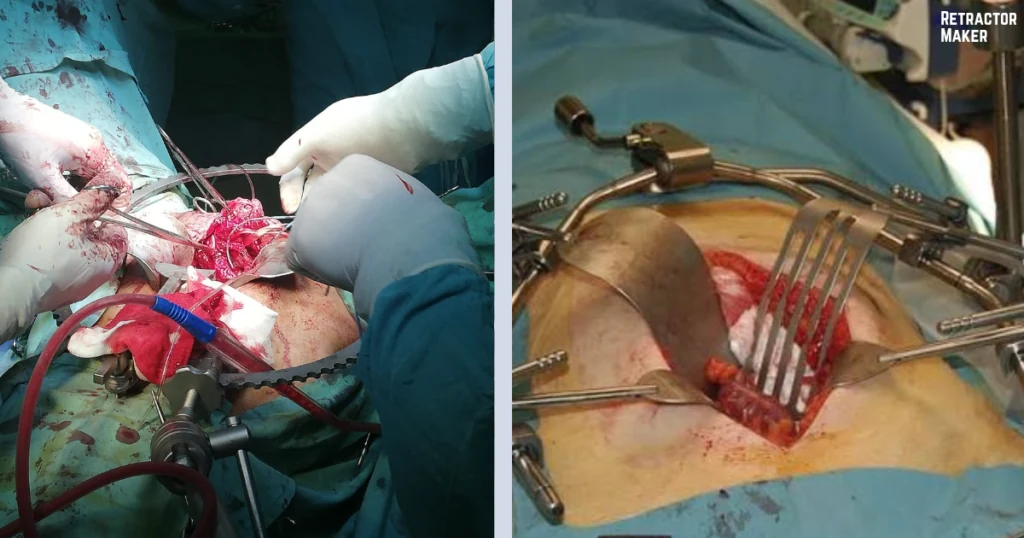
Typical surgical procedures: comparison table
| Surgical Specialty | Bookwalter System Ideal Procedures | Omni System Ideal Procedures | Primary Sourcing Category |
|---|---|---|---|
| General Surgery | Exploratory Laparotomy, Cholecystectomy, Gastric Bypass | Hernia Repair, Bowel Resection, Appendectomy | General Surgery Retractors |
| Urology | Open Prostatectomy, Radical Cystectomy | Nephrectomy, Ureteral Surgery, Kidney Transplant | Urology Retractors |
| Gynecology | Total Abdominal Hysterectomy, Ovarian Debulking | Pelvic Node Dissection, Myomectomy | Obstetrics & Gynecology Retractors |
| Vascular Surgery | Abdominal Aortic Aneurysm (AAA) Repair | Aortofemoral Bypass, Carotid Exposure | General Surgery Retractors |
What are the advantages and limitations?
Advantages and limitations: comparison table
| Retractor System | Key Structural Advantages | Practical Limitations |
|---|---|---|
| Bookwalter | • Outstanding structural strength • Rigid 360-degree frame hold • Easy manual locking mechanism | • Bulkier frame profile above the incision • Requires sliding ratchets along the ring paths to move blades |
| Omni | • Low-profile Wishbone split frame • Quick-connect SnapClamp holders • Swivel blades prevent point pressure | • Pivoting joints require proper care during reprocessing • Multiple small clamps must be tracked in inventory |
Bookwalter and Omni: side-by-side comparison table
| Performance Parameter | Bookwalter Retractor System | Omni Retractor System |
|---|---|---|
| Mounting Method | Single rail post coupler | Single or bilateral table rail posts |
| Frame Design | Closed ring (Oval or Segmented) | Split fork-style (Wishbone Frame) |
| Blade Options | Rigid blades (Balfour, Kelly, Malleable) | Swivel-joint blades (Mayo, Renal, Splanchnic) |
| Adjustment Mechanism | Slide-on Standard & Tilt ratchets | Quick-connect SnapClamp holders |
| Stability | Exceptional for high-tension muscle holds | Highly stable with a low physical profile |
| Flexibility | Rigid 360-degree perimeter | Pivoting, multi-angle swivel control |
| Typical Procedures | Hysterectomy, exploratory laparotomy, cystectomy | Nephrectomy, AAA repair, transplant surgeries |
| Surgical Specialties | General Surgery, OB/GYN, Urology | Urology, Vascular, General, Transplant |
| Ease of Assembly | Simple, linear post-to-ring setup | Modular, quick-snap clamping setup |
| Sterilization | Steam Autoclave (134°C pre-vacuum) | Steam Autoclave (134°C pre-vacuum) |
| Customization Options | Adjustable ring shapes and blade depths | Swivel-angle variations and extension arms |
Technical specifications: comparison table
| Specification Parameter | Bookwalter System Standard | Omni System Standard |
|---|---|---|
| Primary Material | Premium Grade AISI 304/316 Stainless Steel (Non-Magnetic) | Premium Grade AISI 304/316 Stainless Steel (Non-Magnetic) |
| Surface Finish | Non-Reflective Satin Matte Texture | Non-Reflective Satin Matte Texture |
| Magnetic Class | Non-Magnetic | Non-Magnetic |
| Frame Thickness | Standard rigid ring bar diameters | Standard flat Wishbone bar dimensions |
| Blade Shaft Style | Smooth slotted flat bars | Pivoting round-shaft swivel connections |
| Sizing Configurations | Standard Adult, Pediatric, Bariatric | Standard Adult, Extended-reach, Micro |
Which system should your hospital choose?
Choose based primarily on your surgical team’s procedures and patient demographics. The following criteria distinguish the two systems:
When to choose the Bookwalter Retractor Set & System
- High volumes of major open abdominal surgery, exploratory laparotomies, and deep pelvic operations, such as total hysterectomies.
- A need for a highly rigid frame that maintains constant, heavy tension on thick muscle walls without joint play.
- Staff preference for a classic, straightforward post-and-ring setup with simple sliding ratchets.
When to choose the Omni Retractor
- Delicate vascular, renal transplant, and retroperitoneal surgery requiring low-profile workspace access.
- Deep cavity procedures requiring blades to conform safely to curved walls of fragile internal organs, such as the renal vein or spleen.
- OR teams that value quick-connect SnapClamps for instant clipping onto and off the frame and rapid blade adjustments mid-operation.
Why do hospitals buy from Retractor Maker?
Retractor Maker specializes exclusively in manufacturing surgical retractors. We do not produce general, high-volume tools. Our entire facility, machinery, and quality control systems serve this single category.
- Guaranteed Compatibility: Table posts, frames, ratchets, and blades use standard industry-recognized dimensions, ensuring seamless replacement of missing or broken components in existing hospital trays.
- Material Construction: High-tensile, Premium Grade AISI 304/316 Stainless Steel (Non-Magnetic) helps all frames and clamps resist bending and maintain tight mechanical tolerances under load.
- Direct Factory Sourcing: Buying directly from our Pakistan facility lowers procurement budgets by eliminating third-party trading brokers.
- Reliable Lead Times: Over 50 skilled employees maintain a predictable average production lead time of 12 to 16 days for bulk orders. We support more than 500 satisfied customers globally with complete export documentation.
Choosing a system for your surgical needs
Both the Bookwalter and Omni retractor systems provide surgical exposure that helps OR teams work with greater precision, safety, and efficiency. The right choice depends on your primary procedures, surgeon preferences, and each case’s exposure requirements.
Retractor Maker provides direct factory access to both standardized systems. Our clinical customers receive durable, high-precision instrumentation made to standard industry dimensions.
Our team can assist with surgical suite upgrades, replacement of missing tray components, and reliable direct-factory sourcing.
Equip your surgical suites through direct-factory sourcing.
- Explore our complete collection of table-mounted frames and systems in our Products catalog.
- Visit our Request a Quote page for an itemized price sheet or wholesale volume brackets.
- Visit our Contact Us page to discuss private-label OEM contract manufacturing or export shipping details.
Clinical notice: This guide is for surgical teams and hospital buyers. Always follow the manufacturer's instructions for use (IFU) and your hospital's sterilization rules before clinical use.
Frequently Asked Questions
Which is better, Bookwalter or Omni retractor?
The Bookwalter retractor is a rigid perimeter retraction system, but neither Bookwalter nor Omni is universally better. Bookwalter is preferred for exceptional structural strength and rigid 360-degree perimeter retraction in major abdominal surgeries. Omni is favored for vascular, transplant, and deep cavity procedures requiring a low-profile Wishbone frame and pivoting swivel blades.
Can Bookwalter and Omni use the same blades?
Bookwalter and Omni cannot use the same standard blades because their shafts and holders differ. Standard Bookwalter blades have flat, slotted shafts that fit Bookwalter sliding ratchets. Omni blades have rounded shafts with swivel joints that lock into SnapClamp holders.
Is Bookwalter or Omni easier to assemble?
Bookwalter has a simpler assembly sequence, while Omni is faster to adjust during surgery. Bookwalter uses an easy-to-understand, linear post-to-ring setup. Omni has a more modular design with quick-snap clamps, but organizing its swivel blades requires slightly more training.
Is Bookwalter or Omni better for urology?
Omni is highly favored for nephrectomies and transplant surgeries, while Bookwalter is widely used for major pelvic urology. Both systems are used in urology. Omni’s split Wishbone frame and narrow renal vein swivel blades allow safe access to deep retroperitoneal spaces. Bookwalter applications include open radical cystectomies.
Is Bookwalter or Omni preferred for gynecology?
Bookwalter is generally preferred for open gynecological oncology and total abdominal hysterectomies. Its large oval and segmented ring frames provide excellent, continuous exposure of the deep pelvic basin. This pelvic exposure is the reason for its preference in these open gynecological procedures.
Does Bookwalter or Omni offer more flexibility during surgery?
Omni offers more adjustment flexibility during surgery. Its SnapClamps can snap instantly onto any part of the Wishbone frame. Its swivel blades also pivot automatically to adapt to the patient’s internal anatomy, providing flexibility in both clamp placement and blade positioning.
Are Bookwalter and Omni systems autoclavable?
Bookwalter and Omni systems are fully compatible with standard hospital steam autoclave cycles (134C to 273C). All components, including table clamps, posts, frames, and sliding ratchets, are manufactured from high-grade Premium Grade AISI 304/316 Stainless Steel (Non-Magnetic).
Can I order OEM versions of Bookwalter and Omni systems?
Bookwalter and Omni systems are available through our complete contract OEM and private-label manufacturing services. We can adjust blade dimensions or post lengths. We can also laser-etch your company logo directly onto the instruments as part of these manufacturing services.
What is the average lead time for wholesale orders?
Bookwalter and Omni wholesale orders have an average timeline of 12 to 16 days from order confirmation. This timeline covers our factory production, quality inspection, and packaging. The 12 to 16 days therefore includes all three stages, not production alone.
Can I order separate Bookwalter and Omni parts or only complete kits?
Bookwalter and Omni are supplied as both complete pre-configured retractor systems and individual replacement components. Separate parts include table clamps, segmented rings, single ratchets, and specific blades. These replacement components help you replenish existing hospital trays rather than ordering only complete kits.
What is a Bookwalter retractor used for?
A Bookwalter retractor maintains wide abdominal and deep pelvic exposure during open surgery. Its table-mounted closed ring and independent standard or tilt ratchets hold blades in position. This arrangement provides rigid perimeter retraction for prolonged exposure and heavy muscle-wall holds.
What is the Wishbone frame on an Omni retractor?
The Omni retractor’s Wishbone frame is a split, open-loop structure that branches around the incision. It leaves the workspace directly above the wound open. Its low-profile fork design supports quick-connect SnapClamp holders and swivel-joint blades rather than forming a closed ring over the patient.
How do Bookwalter and Omni retractors attach to the operating table?
Bookwalter and Omni retractors attach to the operating table’s side rails for stable, hands-free wound retraction. Bookwalter generally uses a single heavy-duty post clamp supporting a horizontal flex bar and ring. Omni can use single or bilateral post clamps with a modular extension arm.
About the author
Saad Shahid · Sales & Marketing Manager
Saad Shahid is the Sales & Marketing Manager and founder of Retractor Maker, started in 2023 in Sialkot, Pakistan. He also works with his father at Hospitech Traders, the family surgical instrument business founded in 1989.
Related Blogs & Guide



Related Retractors
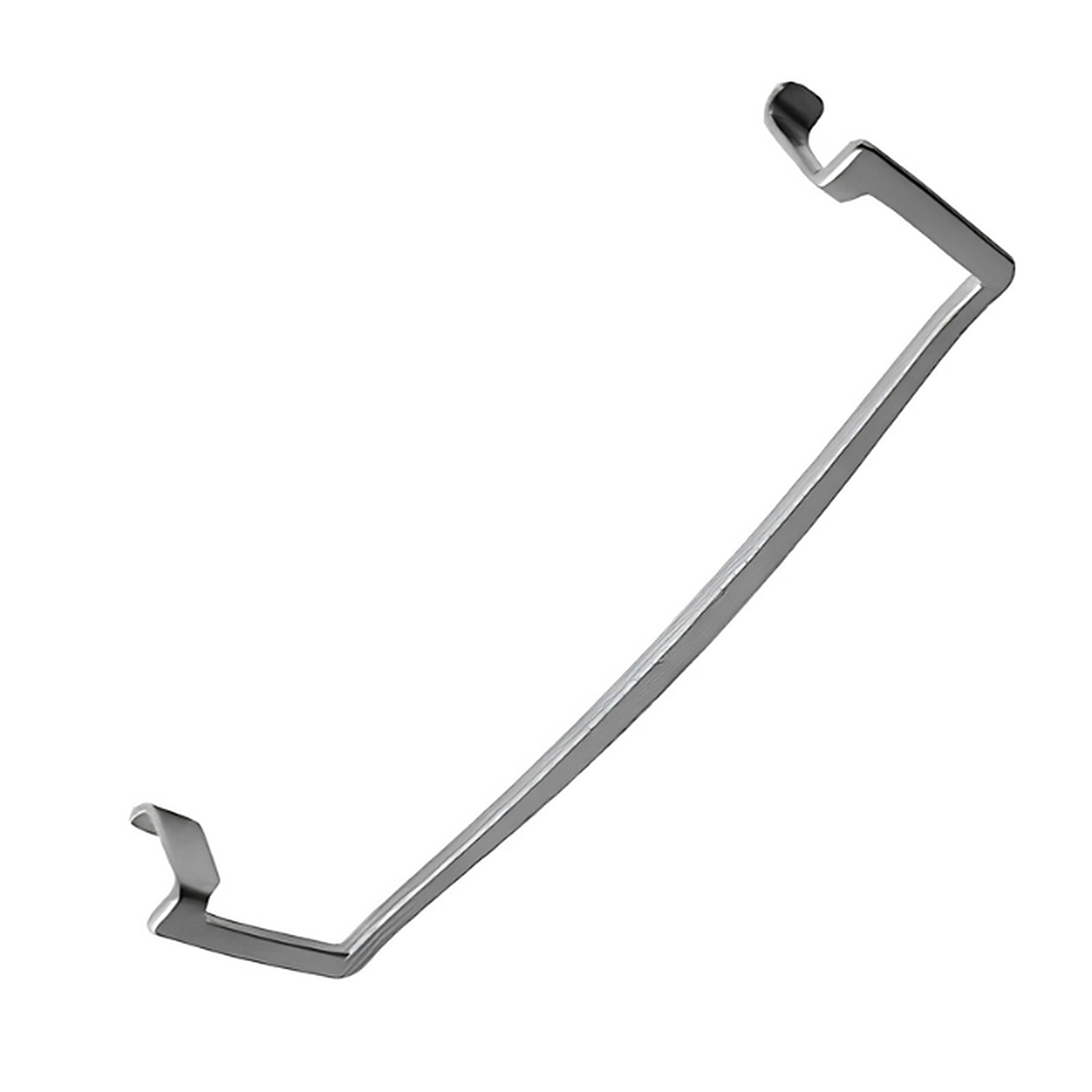
Senn Forward Retractor
$49.00
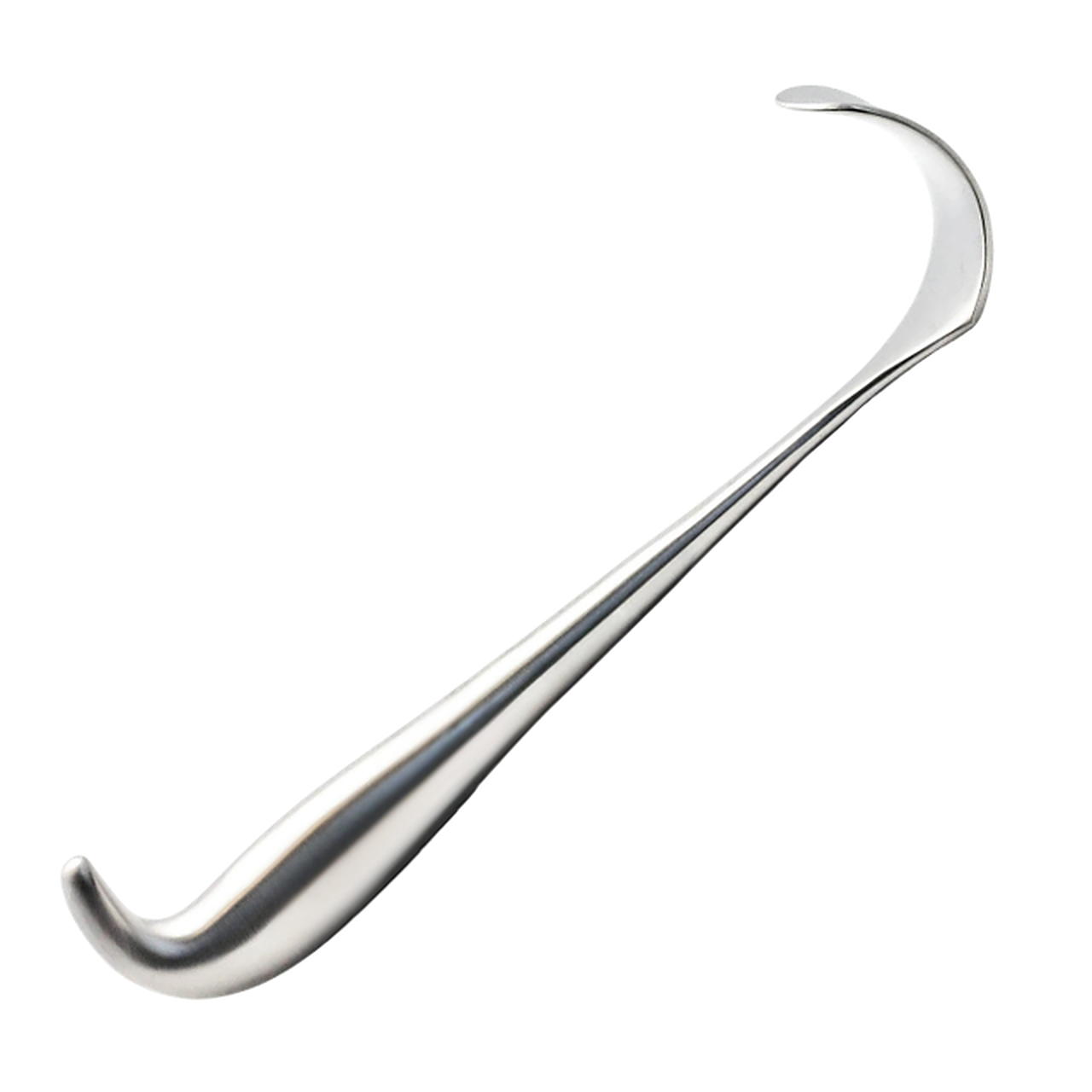
Brewster Retractor
From $159
Langenbeck Retractor-Solid Handle
$49.00
Murphy Retractor
From $44.00
Leriche Retractor-Atraumatic Wide Blade
From $94.00
Lobster General Retractor System
$2,699Free Shipping
Need Surgical Retractors or Components?
Tell us what you need, including the product, configuration, quantity and destination country. Retractor Maker can provide availability, specifications and pricing.
Request a Quote