
Surgical Retractor Guides
Thompson Retractor vs Omni Retractor: Differences, Features & Which System to Choose
Author: Saad Shahid · Updated · 11 min read
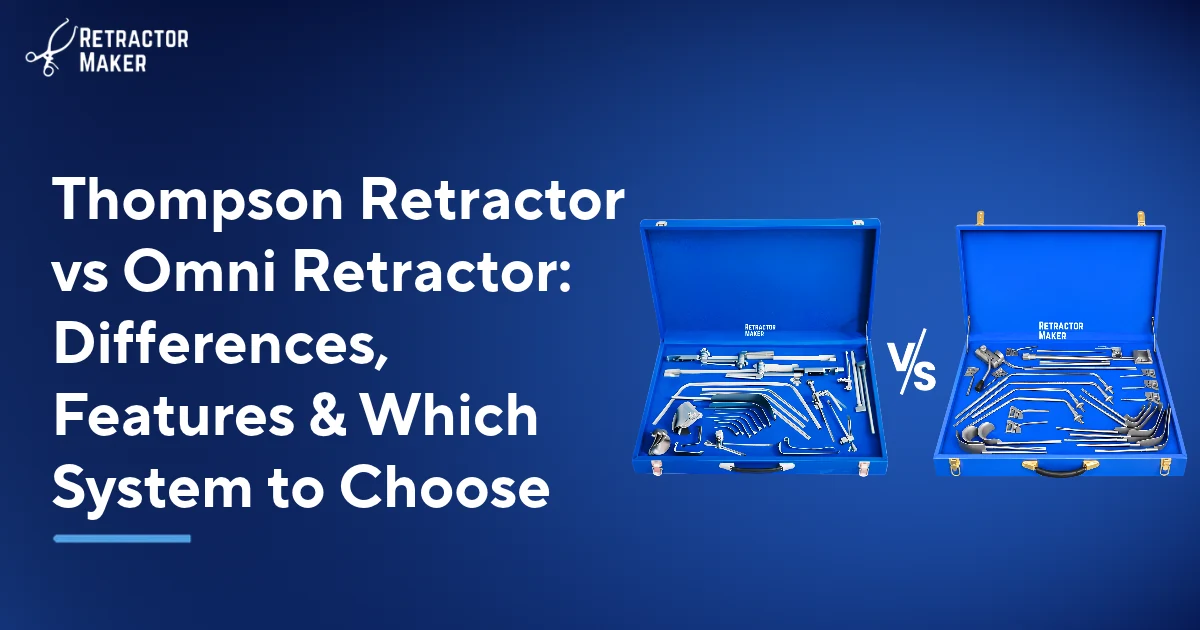
Thompson and Omni retractors both provide table-mounted operative exposure but use different frame and blade-control designs. This guide compares their components, setup, flexibility, applications, and selection considerations.
Retractors discussed in this guide: Thompson Retractor System, Omni Retractor System. Browse all surgical retractors.
The Thompson retractor and Omni retractor systems are table-mounted, self-retaining systems for steady, hands-free wound exposure during high-exposure open procedures. Both lock onto operating table side rails and avoid human hand fatigue. Hospital procurement teams and surgeons often compare their frame designs and adjustments. The Thompson system uses independent double-jointed angled arms, multi-directional crossbars, and micro-adjustable geared handles to pull specific tissues. The Omni system uses a flat, split, fork-shaped Wishbone frame with quick-connect spring clamps and pivoting swivel-joint blades. The choice depends on whether teams need structural customization for deep, high-tension muscle walls or a low-profile frame with rapid, snap-on blade adjustments.
Contents
What is a Thompson retractor?
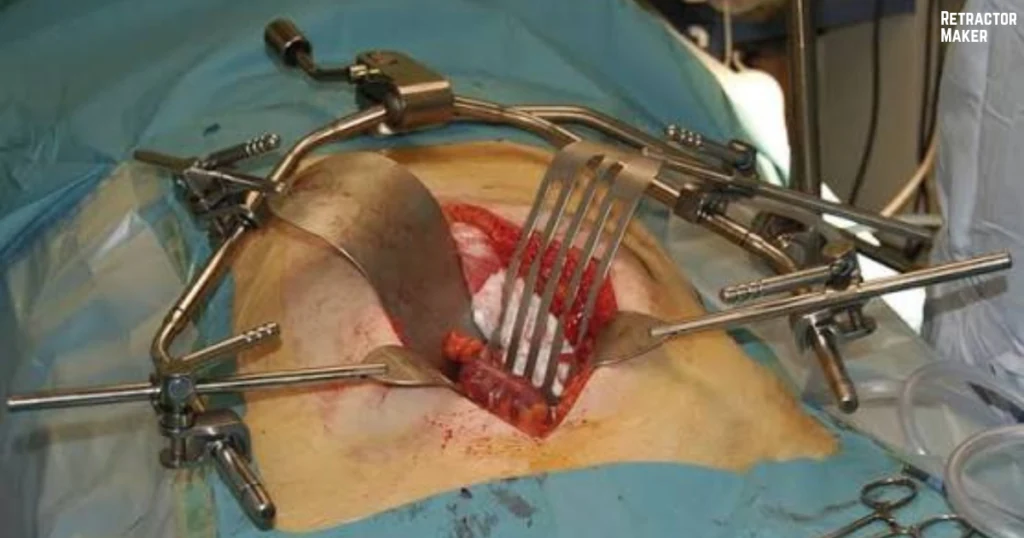
The Thompson retractor is a fully modular, frame-based surgical exposure system for multi-directional, hands-free retraction. Instead of a fixed, pre-shaped ring, the Thompson system uses separate mechanical arms and crossbars to form an adjustable overhead bridge.
Heavy-duty rail clamps secure the bars over the patient. Independent handles have precise threaded dials for fine, incremental blade tension. Each retractor blade can have its own depth, angle, and tension setting. This configuration is valued for large abdominal fields and specialized vascular exposures.
What is an Omni retractor?
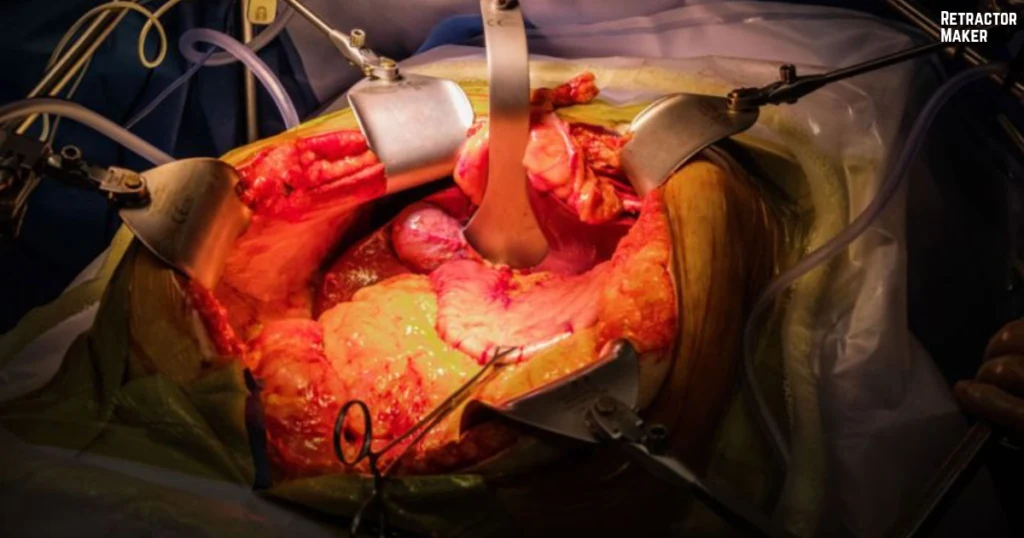
The Omni retractor is a table-mounted, self-retaining system built around a low-profile split Wishbone frame. This specialized, fork-shaped structure connects to a single vertical field post. It extends around both sides of the incision, leaving the space directly above the wound clear of crossbars.
The Omni system uses quick-connect, spring-loaded blade holders. These snap onto any point of the Wishbone perimeter without sliding in from the ends. The holders carry specialized swivel-joint blades that pivot automatically inside the cavity to follow the natural contours of deep organs and vessels.
How do the two systems compare?
Both systems use the operating table as a rigid mechanical anchor, eliminating manual hand-pulling. Their workspace and adjustment requirements differ:
- Thompson system: Complete multi-axis adjustment, independent arm lengths, and precise dial tensioning for deep, rigid cavities.
- Omni system: Flat, low-profile layout, rapid snap-on clamp adjustment, and pivoting tissue contact to protect delicate internal organs.
How do the frame designs differ?
The main design difference is how each frame surrounds the incision. The Thompson system uses multiple straight or angled bars connected by joint blocks to build an angular overhead bridge. The frame can extend high or wide to clear very large abdominal regions.
The Omni system uses a pre-curved, flat Wishbone fork that splits around the wound. The assembly sits low and close to the patient’s body surface, maximizing overhead workspace clearance for the surgical team.
How do the systems mount to the operating table?
Both systems mount to operating table side rails to isolate retraction forces from the patient’s body. The Thompson system typically uses a dual-post configuration. Two heavy-duty rail clamps attach to opposite sides of the table, distributing heavy vertical loads across a strong two-point bridge.
The Omni system typically uses a single heavy-duty post clamp assembly. A modular hinged extension arm balances and projects the Wishbone frame across the entry site.
What components does each kit contain?
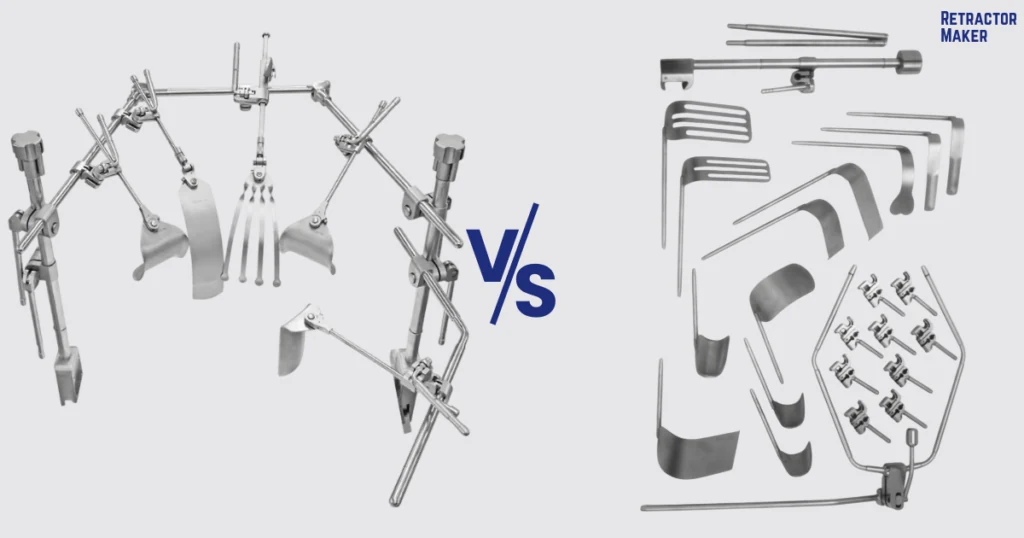
A standard Thompson kit contains heavy vertical rails, jointed extension bars, a hinged bilateral crossbar, slide-on cam clips, and micro-adjustable geared handles. An Omni kit contains a single vertical sterile field post, a split Wishbone frame, a hinged extension arm, and spring-loaded blade holders. Thompson blade shafts insert into independent, dial-controlled handles. Omni blades slot directly into quick-snap holders that lock manually with a simple thumb wheel.
How do the blade options differ?
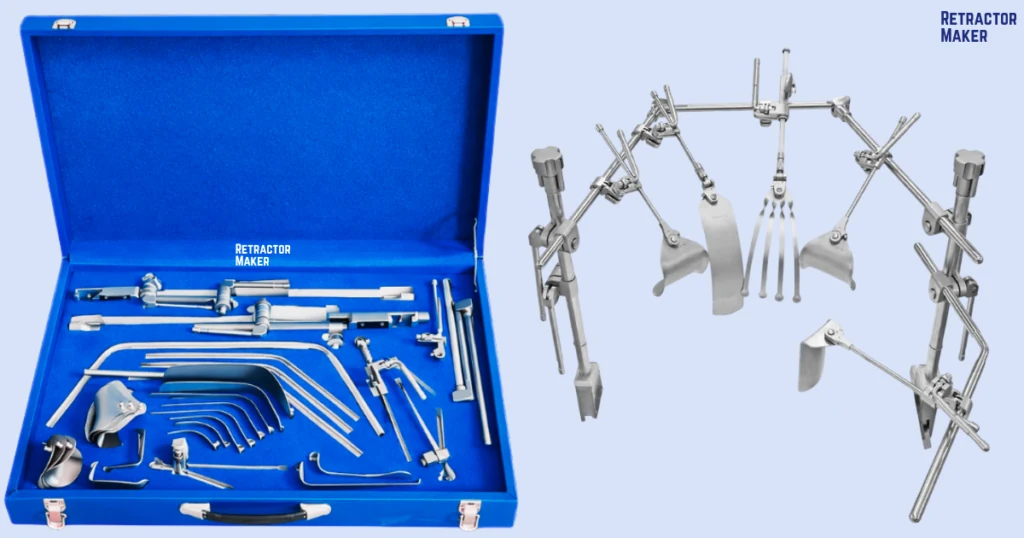
Thompson blades use standard right-angled rigid shafts that lock tightly into adjustable handles. Designed for high-strength traction, they maintain a steady hold on large, heavy muscle blocks, including abdominal walls or thoracic boundaries.
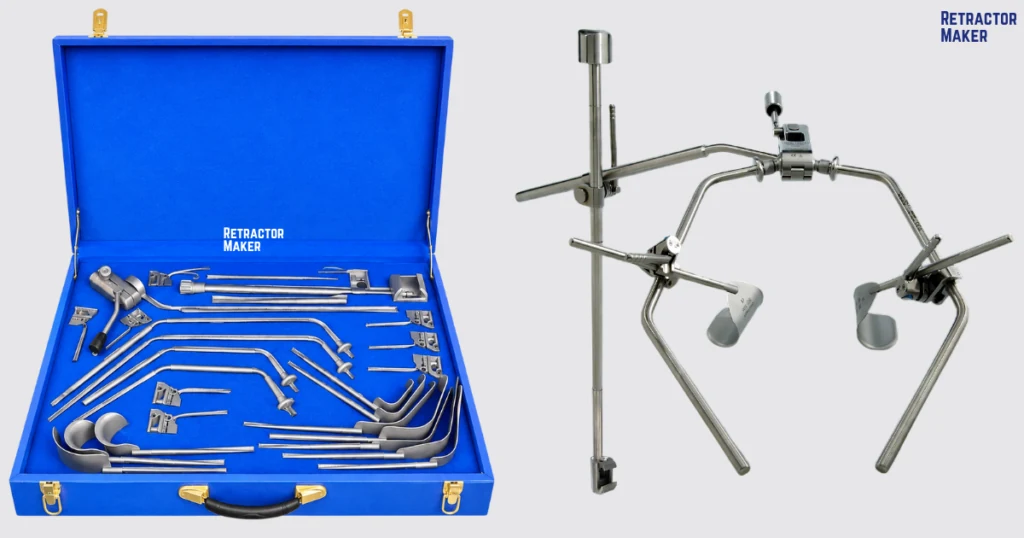
Omni blades are specialized swivel retractors with an integrated pivoting pin joint where the blade face meets the attachment shaft. The blade face pivots freely inside the cavity. It follows the curved surfaces of fragile organs or deep vessels to minimize point-pressure trauma.
How is each system assembled?
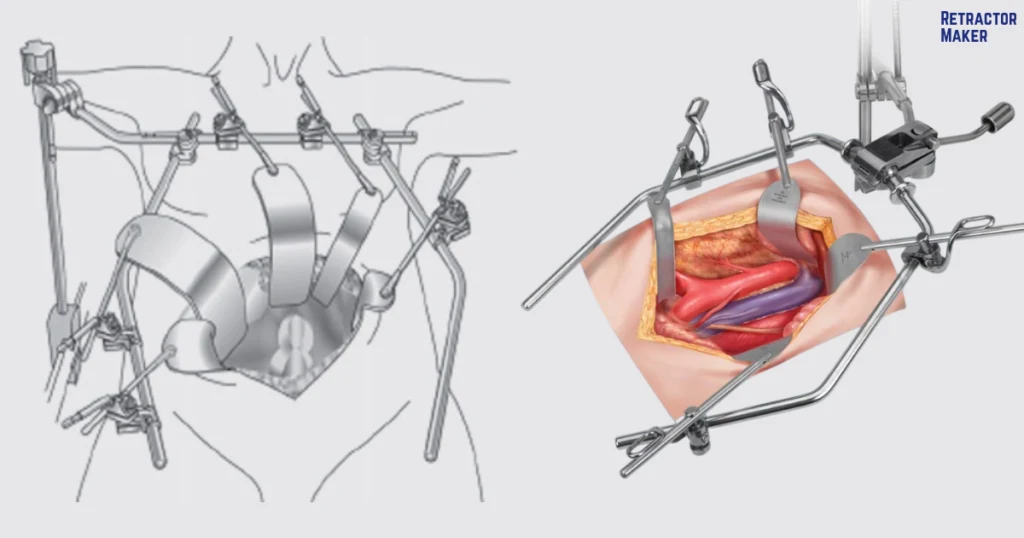
- Thompson assembly: Tighten the dual rail clamps, insert vertical bars, level the bilateral crossbar across the patient, and position cam clips before drawing back blades. Setup requires multi-step manual linking.
- Omni assembly: Secure the single table clamp, raise the vertical post, lock the Wishbone frame, and snap blade holders instantly onto the bars where needed. Setup is streamlined.
How do surgical exposure and stability compare?
The Thompson system provides strong structural rigidity for heavy, deep-cavity open operations. Its two-point table clamping network and lockable gear joints prevent frame flexing or listing under extreme lateral traction forces. The Omni system has a much lower frame profile, allowing surgeons to move closer to shallow fields. Its single-post design is highly stable. Under very large, high-tension muscle loads, however, the Thompson system’s independent arms provide slightly greater absolute rigidity.
How easily can each system be adjusted during surgery?
- Thompson: Extensive spatial customization. Each bar joint rotates, lengthens, or angles independently. Moving a blade holder laterally usually requires sliding it along the crossbar.
- Omni: Rapid adjustment. Spring-loaded blade holders snap instantly on or off any part of the Wishbone frame. Swivel blades automatically follow shifting internal organs without frame adjustments.
What are the common surgical applications?
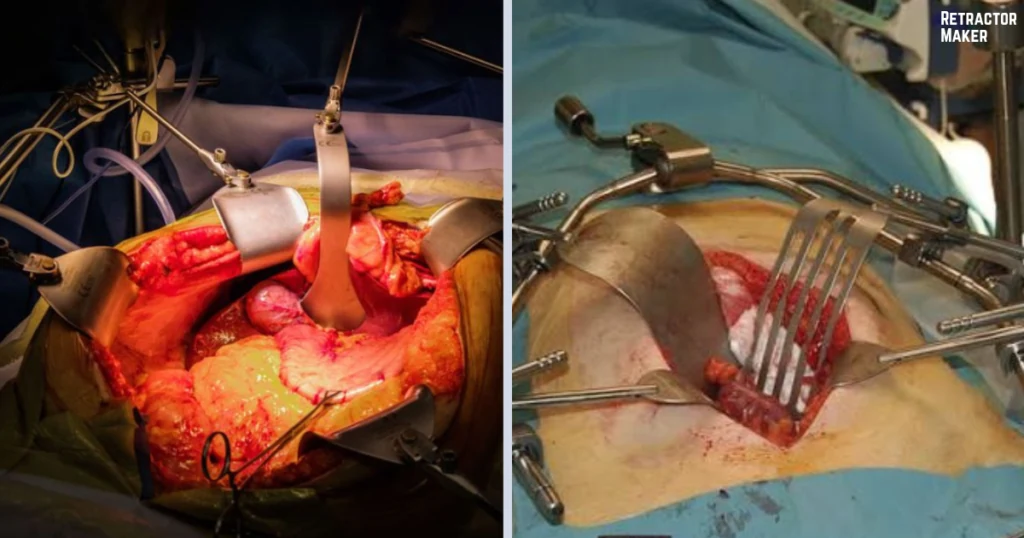
Typical surgical procedures: comparison table
| Surgical Specialty | Thompson System Ideal Procedures | Omni System Ideal Procedures | Sourcing Category |
|---|---|---|---|
| General Surgery | Exploratory Laparotomy, Bariatric Gastric Bypass, Complex Hernia | Appendectomy, Cholecystectomy, Bowel Resection | General Surgery Retractors |
| Urology | Radical Cystectomy, Retroperitoneal Lymph Node Dissection | Nephrectomy, Ureteral Reconstruction, Kidney Transplant | Urology Retractors |
| Gynecology | Deep Pelvic Staging, Radical Hysterectomy | Myomectomy, Ovarian Cyst Removal, Pelvic Node Excision | Obstetrics & Gynecology Retractors |
| Vascular Surgery | Abdominal Aortic Aneurysm (AAA) Repair | Aortofemoral Bypass, Carotid Exposure | General Surgery Retractors |
| Transplant Surgery | Full Orthotopic Liver Transplantation | Donor Nephrectomy, Pancreas Transplant | Urology Retractors |
What are the advantages and limitations?
Advantages and limitations: comparison table
| Retractor System | Key Structural Advantages | Practical Limitations |
|---|---|---|
| Thompson | • High multi-axis bar adjustment • Dual-clamp base offers massive rigidity • Dial handles allow precise micro-tensioning | • Takes more time to assemble the multi-piece frame • Larger frame setup above the patient field |
| Omni | • Flat, low-profile split Wishbone frame • Fast snap-on blade holders save time • Swivel blades conform to delicate organs | • Single post may show minor flex under maximum load • Swivel joints require careful cleaning verification |
Side-by-side system comparison table
| Performance Parameter | Thompson Retractor System | Omni Retractor System |
|---|---|---|
| Mounting Method | Dual-post table rail clamps | Single-post table rail clamp |
| Frame Design | Modular multi-axis crossbar bridge | Flat, split fork-style Wishbone frame |
| Blade Options | Rigid blades (Balfour, Kelly, Malleable) | Swivel-joint blades (Mayo, Renal, Splanchnic) |
| Adjustment Mechanism | Slide-on cam clips and threaded dial handles | Quick-connect, spring-loaded blade holders |
| Stability | Maximum rigidity under heavy muscle load | Excellent stability with a low physical profile |
| Flexibility | Highly customizable bar lengths and angles | Rapid snap-on placements and pivoting blade tracks |
| Typical Procedures | Transplant, hepatobiliary, AAA repair, cystectomy | Nephrectomy, vascular bypass, standard laparotomy |
| Surgical Specialties | General, Vascular, Urology, Transplant | Urology, Vascular, General, Gynecology |
| Ease of Assembly | Requires step-by-step bar and joint linking | Fast, intuitive post-to-frame locking |
| Sterilization | Steam Autoclave (134°C pre-vacuum) | Steam Autoclave (134°C pre-vacuum) |
| Customization Options | Variable arm extensions and handle lengths | Extension arms and flexible frame shapes |
Technical specifications table
| Specification Parameter | Thompson System Standard | Omni System Standard |
|---|---|---|
| Primary Material | Premium Grade AISI 304/316 Stainless Steel (Non-Magnetic) | Premium Grade AISI 304/316 Stainless Steel (Non-Magnetic) |
| Surface Texture | Glare-Reducing Satin Matte Finish | Glare-Reducing Satin Matte Finish |
| Corrosion Class | High-Resistance Surgical Grade | High-Resistance Surgical Grade |
| Bar Diameters | Standard structural rod load capacities | Standard flat Wishbone bar cross-sections |
| Blade Mount Style | Straight slotted flat bar extensions | Pivoting round-shaft swivel couplings |
| Tray Configuration | Packaged in organized storage cases | Packaged in organized storage cases |
Which system should your hospital choose?
Choose according to your operating room’s workflow, clinical focus, and setup preferences. These priorities help distinguish the two table-mounted systems:
When should you choose the Thompson retractor?
- Your facility focuses on large-field transplant operations, hepatobiliary resections, and complex vascular repairs requiring high, constant tension.
- Your surgeons need millimeter-specific blade tension control, using manual threaded dials to retract tough muscle layers gradually.
- You need a dual-clamp framework that remains rigid under maximum physical loads without shifting.
When should you choose the Omni retractor?
- Your operating suites need low-profile instruments close to the patient’s body surface, leaving overhead workspace completely clear.
- Your main caseload includes urological, transplant, and deep pelvic operations requiring blades that pivot automatically around fragile blood vessels and deep internal organs.
- Your surgical teams need fast blade repositioning during surgery, using spring-loaded clamps that snap instantly onto the frame.
Why do hospitals buy from Retractor Maker?
Retractor Maker manufactures surgical retractors exclusively. We do not make a broad catalog of general surgical tools. Our entire facility, machinery, and quality inspections are dedicated to this single category.
- Guaranteed compatibility: Our table posts, crossbars, frames, clamps, and blades match standard industry-recognized dimensions, allowing seamless replacement of missing or broken components in existing hospital trays.
- Material construction: High-tensile, Premium Grade AISI 304/316 Stainless Steel (Non-Magnetic) helps all frames and clamps resist bending and maintain tight mechanical tolerances under load.
- Direct factory sourcing: Buying directly from our Pakistan facility lowers procurement budgets by eliminating third-party trading brokers.
- Reliable lead times: Over 50 skilled employees support a highly predictable average factory production lead time of 12 to 16 days for bulk orders. We serve more than 500 satisfied customers globally with complete export documentation.
Which system fits your surgical exposure needs?
The choice depends on your surgical specialties, surgeon preferences, and case-specific exposure demands. Both the Thompson and Omni retractor systems provide strong surgical exposure, helping operating room teams work with greater precision, safety, and efficiency.
Retractor Maker provides direct factory access to both standardized systems. Our durable, high-precision instrumentation meets standard industry dimensions for your clinical teams.
Our team can help you upgrade surgical suites, replace missing components in existing trays, or establish a reliable direct-factory supply.
Equip your surgical suites through direct-factory sourcing.
- View our Products catalog to explore the complete collection of table-mounted frames and systems.
- Visit our Request a Quote page for an itemized price sheet or wholesale volume brackets.
- Visit our Contact Us page to discuss private-label OEM contract manufacturing or export shipping details.
Clinical notice: This guide is for surgical teams and hospital buyers. Always follow the manufacturer's instructions for use (IFU) and your hospital's sterilization rules before clinical use.
Frequently Asked Questions
Which is better, Thompson or Omni Retractor?
Neither the Thompson nor the Omni Retractor is universally superior; each is designed for different roles. Thompson supports major abdominal, transplant, and vascular procedures requiring dual-rail anchoring, customizable bar structures, and high mechanical tension. Omni suits procedures requiring a low-profile frame, quick-connect snap clamps, and pivoting swivel blades that protect delicate internal organs.
Can Thompson and Omni systems use the same blades?
Standard Thompson and Omni blades are not interchangeable. Standard Thompson blades have rigid flat shafts that slot into Thompson dial handles. Omni blades have specialized round shafts with pivot joints designed to lock into spring-loaded blade holders.
Is Thompson or Omni easier to assemble?
The Omni system is generally faster and easier to assemble. It uses a single vertical post, a pre-curved Wishbone frame, and quick-snap clamps. The Thompson system takes a few extra minutes to securely connect its dual rail clamps, vertical bars, and bilateral crossbars.
Which retractor is better for urology?
Thompson and Omni are both highly effective for urology, but suit different procedures. Omni is widely chosen for nephrectomies and donor transplants. Its low-profile split frame and narrow renal vein swivel blades allow safe access to deep retroperitoneal spaces. Thompson is heavily used for deep pelvic urological reconstructions, including radical cystectomies, requiring high-tension retraction.
Is Thompson or Omni preferred for gynecology?
Thompson is frequently preferred for deep pelvic staging and radical abdominal hysterectomies. Its long angled arms and adjustable handles lift heavy muscle walls upward and outward at precise angles. Omni is favored for more superficial pelvic procedures, such as myomectomies, because it allows rapid adjustment.
Does Thompson or Omni offer more flexibility during surgery?
Omni offers faster adjustments, while Thompson offers greater spatial customization. Omni spring-loaded holders snap instantly onto any part of the frame, and its blades pivot automatically. Thompson allows users to change bar lengths and joint angles in multiple directions.
Are Thompson and Omni systems autoclavable?
Thompson and Omni systems are described as fully compatible with standard hospital steam autoclave cycles (134C to 273C). All components—including table clamps, structural posts, crossbars, frames, and individual blade faces—are forged from Premium Grade AISI 304/316 Stainless Steel (Non-Magnetic).
Can I order OEM versions of Thompson and Omni systems?
Thompson and Omni systems are available through Retractor Maker’s complete contract OEM and private-label manufacturing services. We can adjust blade dimensions or post lengths. We can also laser-etch your company logo and part numbers directly onto the instruments.
What is the average lead time for wholesale orders?
Thompson and Omni bulk orders or custom sets have an average timeline of 12 to 16 days from order confirmation. This timeline covers factory production, quality inspection, and packaging for your bulk order or custom set.
Can I buy separate Thompson and Omni parts or only complete kits?
Thompson and Omni systems are supplied as complete pre-configured systems or individual replacement components. Available separate parts include table clamps, crossbars, separate snap clamps, and specific blades. These replacement components help you replenish existing hospital trays.
What is a Thompson retractor used for?
A Thompson retractor is a surgical exposure system that provides multi-directional, hands-free access for large abdominal fields and specialized vascular procedures. Its modular arms, crossbars, and threaded dial handles let individual blades hold tissue at distinct depths, angles, and tension levels during deep, high-tension open operations.
What is the Wishbone frame on an Omni retractor?
The Omni retractor’s Wishbone frame is a low-profile, split, fork-shaped structure surrounding both sides of the surgical incision. It connects to a single vertical field post. The frame keeps the space directly above the wound clear of crossbars and supports spring-loaded blade holders along its perimeter.
How do Thompson and Omni retractors attach to the operating table?
Thompson and Omni retractors attach to operating table side rails. Thompson typically uses two rail clamps, with opposite-side clamps supporting a two-point bridge. Omni typically uses a single post clamp and a hinged extension arm to project and balance its Wishbone frame over the entry site.
About the author
Saad Shahid · Sales & Marketing Manager
Saad Shahid is the Sales & Marketing Manager and founder of Retractor Maker, started in 2023 in Sialkot, Pakistan. He also works with his father at Hospitech Traders, the family surgical instrument business founded in 1989.
Related Blogs & Guide


Related Retractors
Senn Forward Retractor
$49.00
Brewster Retractor
From $159
Langenbeck Retractor-Solid Handle
$49.00
Murphy Retractor
From $44.00
Leriche Retractor-Atraumatic Wide Blade
From $94.00
Lobster General Retractor System
$2,699Free Shipping
Need Surgical Retractors or Components?
Tell us what you need, including the product, configuration, quantity and destination country. Retractor Maker can provide availability, specifications and pricing.
Request a Quote