
General Surgery Retractors
Kelly Retractor: Deep Abdominal Wall & Visceral Retraction
Author: Saad Shahid · Updated · 7 min read
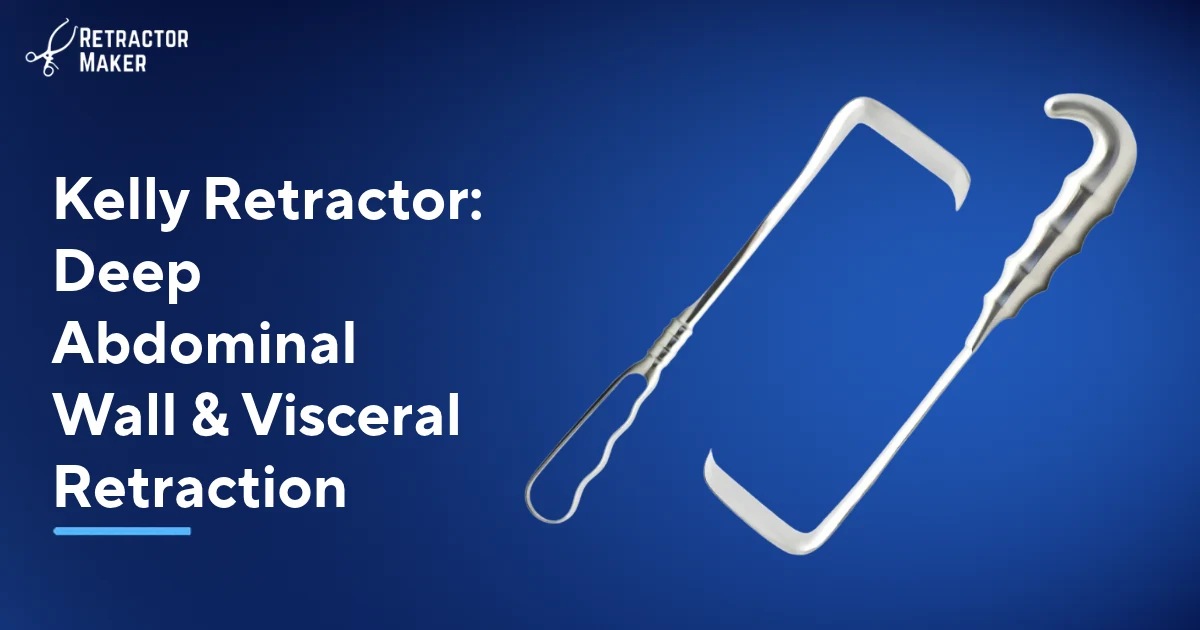
A Kelly retractor is a heavy-duty, handheld surgical instrument featuring a long shaft and a broad, right-angled (L-shaped) blade with a smooth, curved retaining lip. It is primarily used in abdominal and pelvic surgery to retract thick abdominal walls, fascia, and internal viscera.
Retractors discussed in this guide: Kelly Retractor, Kelly Retractor-Grip Handle, Kelly Retractor-Lamb Handle, Kelly Sims Vaginal Retractor. Browse all surgical retractors.
A Kelly retractor is a handheld surgical instrument for deep abdominal wall retraction and visceral displacement. Adequate exposure through a thick abdominal wall is essential in major open cavitary procedures. Dense fascial envelopes, the rectus abdominis muscle, and preperitoneal adipose layers exert strong recoil forces that can narrow the operative corridor.
The Kelly retractor provides deep abdominal wall retraction and visceral displacement during open general, gynecological, and pelvic surgery. It is an established handheld surgical instrument designed for these tasks.
Contents
What Is a Kelly Retractor?
The Kelly retractor was developed for deep cavitary exposure. It is named after Dr. Howard Atwood Kelly, the pioneering American gynecologist and one of the "Big Four" founding professors of Johns Hopkins Hospital.
The Kelly retractor is the large, right-angled manual retractor used for cavitary tissue elevation. Surgical instrument catalogs also use the name "Kelly" for several other common instruments, most notably Kelly hemostatic forceps (clamps).
How Do the Blade Shape and Handle Support Retraction?
The Kelly retractor uses its blade geometry and handle design to provide mechanical leverage against muscular recoil:
- Right-angled (L-shaped) blade: Drops at an approximate 90-degree angle from the shank to provide vertical traction against deep wound margins.
- Curved retaining lip: The terminal edge curves downward and inward, forming a smooth lip that prevents thick muscle bellies and adipose tissue from slipping over the edge under manual tension.
- Broad blade width: Typically 35 mm to 65 mm+, distributing counter-traction across broad wound boundaries to prevent tissue bunching.
- Ergonomic handle: Forged with a contoured handle featuring finger grips or a hollow grip, allowing the assistant to maintain steady, single-axis traction.
Where Is It Used in Abdominal and Pelvic Surgery?
The Kelly retractor is widely used in open abdominal and pelvic approaches for wall retraction and visceral displacement:
- Open laparotomy: Retracts the rectus abdominis muscle and peritoneal wall during exploratory laparotomies, bowel resections, and trauma explorations.
- Pelvic surgery: Displaces lower abdominal walls and pelvic packing during open prostatectomies, cystectomies, and hysterectomies.
- Cesarean delivery: Elevates the superior and lateral margins of a Pfannenstiel or midline incision during uterine delivery.
- Deep visceral displacement: Gently mobilizes deep viscera away from retroperitoneal vascular structures or renal beds.
Kelly vs. Richardson vs. Deaver Retractor
| Feature | Kelly Retractor | Richardson Retractor | Deaver Retractor |
|---|---|---|---|
| Blade Geometry | Broad, deep right-angled blade with curved lip | Right-angled blade with curved retaining lip | Continuous, sweeping curved arc ("question mark") |
| Primary Interaction | Thick abdominal wall, muscle, and deep viscera | Muscular abdominal wall and fascia | Internal visceral organs (liver, stomach, bowel) |
| Blade Surface | Very wide, deep profile | Moderate to wide profile | Narrow to wide flat profile |
| Mechanical Action | Direct directional pulling leverage | Directional vertical pulling leverage | Surface cradling and cupping |
| Handle Design | Contoured or hollow grip | Contoured solid or hollow grip | Flat or hollow-grip handle |
How Should It Be Inspected, Maintained, and Reprocessed?
- Point-of-use handling: Remove blood and biological soils immediately after use with a sterile water-dampened wipe.
- Cleaning and ultrasonic decontamination: Submerge in neutral-pH enzymatic detergent. Scrub the blade-shank junction and retaining lip with soft nylon brushes, then run through an ultrasonic bath.
- Inspection: Check the right-angled bend for metal fatigue or bending and the retaining lip for burrs that could lacerate tissue.
- Sterilization: Autoclave using validated moist heat steam sterilization parameters, following the manufacturer's validated IFU and hospital infection prevention standards.
What Should Buyers Check When Sourcing and Specifying OEM Orders?
Hospital purchasing managers and medical distributors sourcing Kelly retractors should check blade assortments, finish quality, and OEM customization options:
- Blade dimension assortments: Include intermediate blades, such as 38 mm × 50 mm, and extra-deep blades, such as 50 mm × 75 mm+, to accommodate diverse patient body habitus.
- Finish quality: A non-glare satin finish eliminates reflections from overhead surgical lamps.
- OEM customization: Retractor Maker manufactures Kelly retractors in Sialkot, Pakistan, with custom blade lengths, modified lip geometries, and private-label laser-marked branding.
Kelly Retractor Blade Measurements and Sizes
Confirm blade dimensions and the required length-and-blade combination before ordering. Use the listed blade options to specify trays or request quotations. Length × width order is identified where supplied; confirm dimension order for the standard Kelly Retractor. Available lengths and blades are listed separately. Do not assume every pairing is available.
| Model | Overall Length | Blade Size | Notes |
|---|---|---|---|
| Kelly Retractor-Grip Handle | 24 cm; 26 cm | 38×51 mm; 51×63 mm; 63×76 mm; 76×89 mm; 89×76 mm | Length × width; hollow or lightweight grip handle |
| Kelly Retractor | 26 cm | 55×60 mm; 70×40 mm; 95×60 mm | Flat handle with finger rings/contours; blade dimension order: On request |
| Kelly Retractor-Lamb Handle | 24 cm | 51×63 mm; 63×76 mm; 76×89 mm | Length × width; contoured Lamb handle |
| Kelly Sims Vaginal Retractor | 18 cm; 20 cm; 23 cm; 26 cm | 57×25 mm; 70×32 mm; 76×38 mm | Length × width; vaginal model with drop handle |
How Should Surgical Assistants Handle Retraction?
- Maintain a secure, controlled grip with the wrist comfortable. Adjust your stance rather than twisting your wrist or squeezing excessively.
- Agree on traction direction with the surgeon before loading the blade. Avoid levering against the wound edge or changing the angle while tissue is under tension.
- Apply only the traction needed for the requested view. If exposure becomes difficult, request reassessment rather than increasing pulling force.
- Agree on pressure-release intervals with the surgeon and reassess as the procedure changes. Ease tension only when safe for the current operative step.
- Check visible tissue beneath and around the blade for blanching, discoloration, slippage, or trapped structures. Report changes promptly and request repositioning when needed.
- Notify the surgeon before changing position, switching hands, or handing over retraction. Request relief if fatigue makes steady control difficult.
- Before passing, disengage the blade from tissue. Present the handle securely, keep the blade clear of people and drapes, and confirm receiver control before releasing.
What Determines the Autoclave Cycle?
Steam sterilization must follow completed cleaning, rinsing, drying, and inspection; it does not replace soil removal. Prepare and load the retractor according to validated instructions. Exposure is the time at the specified sterilization temperature, not the total cycle duration. Drying requirements depend on packaging, load configuration, and the validated process.
| Cycle | Temperature | Exposure | Drying |
|---|---|---|---|
| Pre-vacuum | 132°C/270°F | 4 min | 20–30 min |
| Pre-vacuum | 134°C/273°F | 3 min; some regions specify 18 min for prion protocols | On request; follow validated IFU |
| Gravity displacement | 121°C/250°F | 30 min | 15–30 min |
The validated instructions for use (IFU), sterilizer manufacturer instructions, and hospital policy always take precedence over typical reference values. These values are not a device-specific validated cycle. Prion protocols require institution-specific guidance. Supplied non-sterile; sterilize before first use.
Clinical notice: This guide is for surgical teams and hospital buyers. Always follow the manufacturer's instructions for use (IFU) and your hospital's sterilization rules before clinical use.
Frequently Asked Questions
What is a Kelly retractor?
A Kelly retractor is a heavy-duty handheld surgical instrument designed for abdominal and pelvic retraction. It has a broad, right-angled blade with a curved retaining lip. The blade is used to retract thick abdominal walls, fascia, and internal viscera.
What is a Kelly retractor used for?
It is primarily used in open abdominal and pelvic surgery to retract thick abdominal walls, fascia, and internal viscera.
How does a Kelly retractor differ from a Richardson retractor?
Kelly retractors generally have broader, deeper blade profiles than a Richardson retractor. Both feature right-angled blades. The broader, deeper Kelly profiles are intended for heavy abdominal wall retraction and deep pelvic exposure during open abdominal and pelvic surgery.
Is a Kelly retractor handheld or self-retaining?
It is a handheld instrument that requires continuous manual holding by a surgical assistant or surgeon.
How does a Kelly retractor differ from Kelly forceps?
A Kelly retractor is a large manual retractor for holding wound margins open, whereas Kelly forceps are hinged hemostatic clamps for occluding blood vessels. Surgical instrument catalogs use the name "Kelly" for multiple instruments, so the full name distinguishes these different functions.
Can a Kelly retractor be autoclaved?
Reusable Kelly retractors are compatible with hospital steam autoclave sterilization. They are forged from Premium Grade AISI 304/316 Stainless Steel (Non-Magnetic). Follow the manufacturer's validated IFU, sterilizer manufacturer instructions, and hospital policy. Complete cleaning, rinsing, drying, and inspection before steam sterilization.
How does a Kelly retractor differ from a Deaver retractor?
A Kelly retractor uses a broad, deep right-angled blade for directional pulling, while a Deaver retractor uses a sweeping curved blade for cradling and cupping. The Kelly works against thick abdominal wall, muscle, and deep viscera. The Deaver primarily interacts with internal visceral organs such as the liver, stomach, and bowel.
How should a Kelly retractor be cleaned and inspected?
A Kelly retractor requires immediate biological soil removal, neutral-pH enzymatic cleaning, soft nylon brushing, ultrasonic decontamination, and inspection. At the point of use, remove soils with a sterile water-dampened wipe. During cleaning, scrub the blade-shank junction and retaining lip. Inspect the right-angled bend for metal fatigue or bending and the lip for burrs that could lacerate tissue.
What should be confirmed when ordering Kelly retractor sizes?
Before ordering a Kelly retractor, confirm the required instrument length, blade dimensions, dimension order, and available length-and-blade combination. The guide lists lengths and blades separately and identifies length × width where supplied. Request the standard Kelly retractor’s blade dimension order rather than assuming it.
About the author
Saad Shahid · Sales & Marketing Manager
Saad Shahid is the Sales & Marketing Manager and founder of Retractor Maker, started in 2023 in Sialkot, Pakistan. He also works with his father at Hospitech Traders, the family surgical instrument business founded in 1989.
Related Blogs & Guide

Related Retractors
Senn Forward Retractor
$49.00
Brewster Retractor
From $159
Langenbeck Retractor-Solid Handle
$49.00
Murphy Retractor
From $44.00
Leriche Retractor-Atraumatic Wide Blade
From $94.00
Lobster General Retractor System
$2,699Free Shipping
Need Surgical Retractors or Components?
Tell us what you need, including the product, configuration, quantity and destination country. Retractor Maker can provide availability, specifications and pricing.
Request a Quote