
ENT Retractors
Tracheal Retractor: Uses, Types, Sizes & Selection
Author: Saad Shahid · Updated · 8 min read
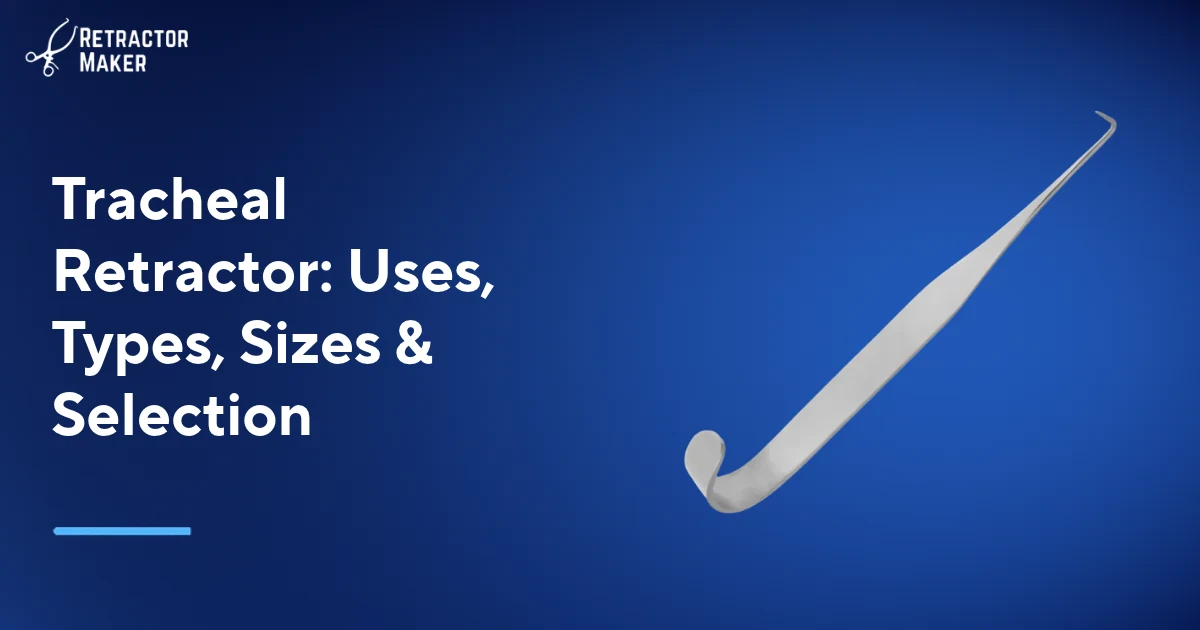
Compare tracheal retractor types, sizes, uses and care requirements. Explore Bose, Jackson, Lukens and hook designs from Retractor Maker in Pakistan.
Retractors discussed in this guide: Bose Tracheal Retractor, Bose Tracheal Retractor Spring Type, Jackson Tracheal Retractor, Jackson Tracheal Retractor-Double Ended. Browse all surgical retractors.
A tracheal retractor is a surgical instrument used to retract pretracheal tissues, elevate the trachea or stabilize tracheal structures during tracheostomy. Its working end may be a sharp hook, a curved blade or a spring-assisted blade arrangement. Choosing between these configurations requires attention to the intended tissue contact, surgical exposure and method of control. This guide compares the supplied Retractor Maker patterns and explains selection, handling and reprocessing considerations for surgeons, operating room staff and hospital buyers.
What is a tracheal retractor?
A tracheal retractor supports surgical exposure around the trachea rather than providing ventilation. Depending on its design, it holds pretracheal tissue away from the operative field, elevates tracheal cartilage or maintains clearance at tracheal margins. It is therefore distinct from a tracheostomy tube, which provides an airway through the tracheostomy opening.
The term covers several instrument patterns, not a single interchangeable shape. A handheld hook requires continued manual control, while a self-retaining spring pattern uses spring tension to maintain retraction. Double-ended instruments offer alternative working ends on a shared handle. These differences matter when specifying a surgical set or replacing an existing instrument.
What is a tracheal retractor used for?
Tracheostomy is the principal procedure identified for these retractors. Their specific roles include retracting pretracheal tissues, elevating the trachea and stabilizing cartilage or tracheal margins. These tasks support exposure, but the appropriate instrument depends on the operative approach and the surgeon’s assessment of the anatomy.
- Pretracheal tissue retraction: identified uses for Bose, Jackson, Jackson Double Ended and Lukens patterns.
- Tracheal elevation and stabilization: identified uses for the Jackson Tracheal Retractor and Tracheal Hook/Retractor.
- Spring-assisted margin retraction: the Bose Tracheal Retractor Spring Type supports tracheal margins during pediatric and adult tracheostomy.
- Airway surgery exposure: included in the intended uses of the Jackson Double Ended and Lukens patterns.
- Emergency and elective tracheostomy: explicitly identified applications for the Tracheal Hook/Retractor.
These instruments are relevant to ENT and surgical teams performing tracheostomy and related airway procedures. A specialty label alone is not enough to determine suitability. Buyers should match the named pattern to the requested surgical function rather than assume that every tracheal retractor performs the same task.
How do tracheal retractor designs and parts differ?
The main design differences are the working end, handle and retention mechanism. Sharp hooks provide focused engagement, while curved or angular blades offer different tissue-contact profiles. Handheld models rely on operator-controlled counter-traction; the Bose Spring Type instead uses a resilient spring-action bridge.
Hooks, blades and orientation
The Bose handheld model has a curved sharp hook blade with selectable Left or Right orientations. The Jackson single-ended model has an 8.0 mm angled, sharp-pointed tip. The Jackson Double Ended offers differing hook curvatures on opposing ends. Lukens combines a 10 mm curved blade with a 7 mm angular blade and rounded margins.
Handles and spring retention
Flat handles support manual control across the handheld patterns. The Jackson single-ended model and Tracheal Hook/Retractor include lateral grip serrations. Double-ended models place the handle centrally between working ends. The Bose Spring Type uses curved blades and spring tension to support the tracheal wall and maintain incision clearance.
The listed material for every model is Premium Grade AISI 304/316 Stainless Steel (Non-Magnetic). All are supplied non-sterile and fully autoclavable. Material and autoclavability do not replace the need for appropriate cleaning, inspection and a validated sterilization process.
Which tracheal retractor types and sizes are available?
The supplied range includes handheld single-ended hooks, double-ended retractors and a spring-loaded self-retaining model. The comparison below uses the stated product dimensions and intended applications. Overall length should be considered alongside working-end geometry, not used as a substitute for assessing tissue contact or operative fit.
| Product name | Design | Listed overall length | Typical use |
|---|---|---|---|
| Bose Tracheal Retractor | Handheld curved sharp hook; Left or Right orientation | 15 cm (approx. 6 inches) | Retracting pretracheal tissues and stabilizing tracheal cartilages during tracheostomy |
| Bose Tracheal Retractor Spring Type | Spring-loaded self-retaining configuration with curved blades | 7 cm (approx. 2.75 inches) | Retracting and stabilizing tracheal margins during pediatric and adult tracheostomy |
| Jackson Tracheal Retractor | Handheld single-ended hook with an angled sharp tip and serrated flat handle | 14 cm (approx. 5.5 inches) | Elevating and stabilizing the trachea and retracting pretracheal tissues |
| Jackson Tracheal Retractor-Double Ended | Opposing curved working ends with differing hook curvatures | 17 cm (approx. 6.7 inches) | Retracting pretracheal tissue and elevating tracheal cartilages during tracheostomy and airway surgery |
| Lukens Tracheal Retractor | Asymmetric curved and angular blades with a central flat handle | 6 ¾ inches (17.1 cm) | Retracting pretracheal tissues and elevating the trachea during tracheostomy and airway procedures |
| Tracheal Hook/Retractor | Handheld curved sharp single prong with a laterally serrated flat handle | 6 inches (15.2 cm) | Elevating and stabilizing the trachea during emergency and elective tracheostomy |
No universal pediatric size or patient-specific fit can be inferred from these lengths. Although the Bose Spring Type is described for pediatric and adult procedures, clinical suitability still depends on anatomy and the planned exposure. Confirm any additional dimensional requirements before purchasing.
How is a tracheal retractor positioned and controlled?
A tracheal retractor should be positioned by trained surgical personnel under direct visualization, according to the operative plan and manufacturer’s instructions. This overview describes handling principles rather than a tracheostomy technique. The working end must suit the intended contact point, and traction should be limited to what is needed for exposure.
For handheld instruments, the operator maintains controlled traction and reassesses tissue response as exposure changes. Sharp hooks require particular care during placement, adjustment and withdrawal. With a double-ended instrument, the unused working end also needs attention during handling and transfer to avoid unintended contact.
Self-retaining does not mean unattended. The Bose Spring Type still requires monitoring of blade position, tissue pressure and operative clearance. Changes in tissue appearance, resistance or instrument stability warrant reassessment. Retraction must remain coordinated with airway management and the wider surgical team.
How should tracheal retractors be cleaned and sterilized?
All listed retractors are supplied non-sterile and require appropriate reprocessing before clinical use. Their individual protective packaging is not a sterile barrier. Fully autoclavable means they can undergo steam sterilization using an appropriate validated process; it does not establish a specific cycle for every facility or load.
- Follow the manufacturer’s current reprocessing instructions and the facility’s infection-prevention procedures.
- Clean thoroughly before sterilization, paying attention to hooks, blade contours, handle serrations and the spring mechanism where present.
- Inspect for residual soil, corrosion, damaged tips, blade deformation and impaired spring action.
- Remove damaged instruments from service for assessment rather than relying on sterilization to address physical defects.
- Use suitable protective arrangements during processing and storage to reduce working-end damage.
The supplied specifications do not provide cleaning agents, sterilization temperatures, exposure times or drying parameters. Request the applicable instructions before processing and have sterile processing personnel verify compatibility with local validated procedures. Do not select cycle settings from the material description alone.
How do you choose and buy from Retractor Maker?
Choose by surgical function first, then confirm configuration, working-end profile and dimensions. Specify Left or Right orientation for the handheld Bose pattern. Distinguish the Jackson single-ended hook from the Jackson Double Ended, and identify the Spring Type explicitly when requesting self-retaining retraction.
Retractor Maker is a surgical retractor manufacturer and exporter in Sialkot, Pakistan, offering wholesale supply, OEM services and worldwide shipping. The listed products are brand new, individually protectively packaged and available with a minimum order quantity of 1 Piece. Include the full product name and required quantity in an inquiry.
Hospital buyers should request current specifications, reprocessing instructions, quotation details and shipping arrangements before ordering. For OEM projects, confirm proposed requirements and feasibility rather than assuming unlisted sizes or features are available. A clearly documented specification helps align the delivered instrument with the surgeon’s preference and the facility’s processing requirements.
Clinical notice: This guide is for surgical teams and hospital buyers. Always follow the manufacturer's instructions for use (IFU) and your hospital's sterilization rules before clinical use.
Frequently Asked Questions
What is a tracheal retractor used for?
A tracheal retractor is used to improve exposure and stabilize tracheal structures during tracheostomy. Depending on the pattern, it retracts pretracheal tissue, elevates the trachea or supports tracheal margins. The Jackson Double Ended and Lukens models also list airway surgery or airway procedures among their intended applications. Selection depends on the required surgical function.
What is the difference between a tracheal hook and a tracheal retractor?
A tracheal hook is a hook-shaped type of tracheal retractor used for tracheal engagement and stabilization. The broader retractor category also includes curved-blade, double-ended and spring-assisted designs. In this range, the Tracheal Hook/Retractor has a curved sharp single prong, while the Bose Spring Type uses curved blades and spring tension for self-retaining retraction.
Is the Bose tracheal retractor self-retaining?
The Bose Tracheal Retractor Spring Type is self-retaining, but the standard Bose Tracheal Retractor is handheld. The Spring Type uses a spring-action bridge and curved blades to retract and stabilize tracheal margins. The handheld Bose has a curved sharp hook blade and selectable Left or Right orientations for manually controlled directional traction.
What sizes do tracheal retractors come in?
The listed tracheal retractors have different overall lengths according to their design. Bose measures 15 cm, Bose Spring Type 7 cm, Jackson 14 cm, Jackson Double Ended 17 cm and Lukens 17.1 cm. The Tracheal Hook/Retractor measures 15.2 cm. Length alone does not establish suitability; working-end geometry and intended use also matter.
Are tracheal retractors supplied sterile?
All tracheal retractors in this supplied range are non-sterile and fully autoclavable. Individual protective packaging does not make them ready for sterile clinical use. Obtain the manufacturer’s reprocessing instructions and follow the facility’s validated cleaning and sterilization procedures before use. The supplied specifications do not state sterilization cycle temperatures, exposure times or drying parameters.
Where can hospitals buy tracheal retractors wholesale?
Hospitals can inquire about wholesale tracheal retractors directly from Retractor Maker in Sialkot, Pakistan. The company offers manufacturing, export, OEM services and worldwide shipping. Specify the product name, configuration, orientation where applicable and required quantity. The listed minimum order quantity is 1 Piece; confirm quotation details, documentation and shipping arrangements before ordering.
About the author
Saad Shahid · Sales & Marketing Manager
Saad Shahid is the Sales & Marketing Manager and founder of Retractor Maker, started in 2023 in Sialkot, Pakistan. He also works with his father at Hospitech Traders, the family surgical instrument business founded in 1989.
Related Blogs & Guide
Related Retractors
Gifford-Jansen Retractor
From $84.00
Hajek Cheek Retractor
$24.00
Lip And Cheek Retractor
$49.00
Bellucci Endaural Retractors
From $174
Aufricht Nasal Retractor
From $59.00
Aufricht Walter Nasal Retractor
$69.00
Need Surgical Retractors or Components?
Tell us what you need, including the product, configuration, quantity and destination country. Retractor Maker can provide availability, specifications and pricing.
Request a Quote