
Orthopedic & Spine Retractors
Glenoid Retractor: Uses, Designs, Sizes & Selection
Author: Saad Shahid · Updated · 7 min read
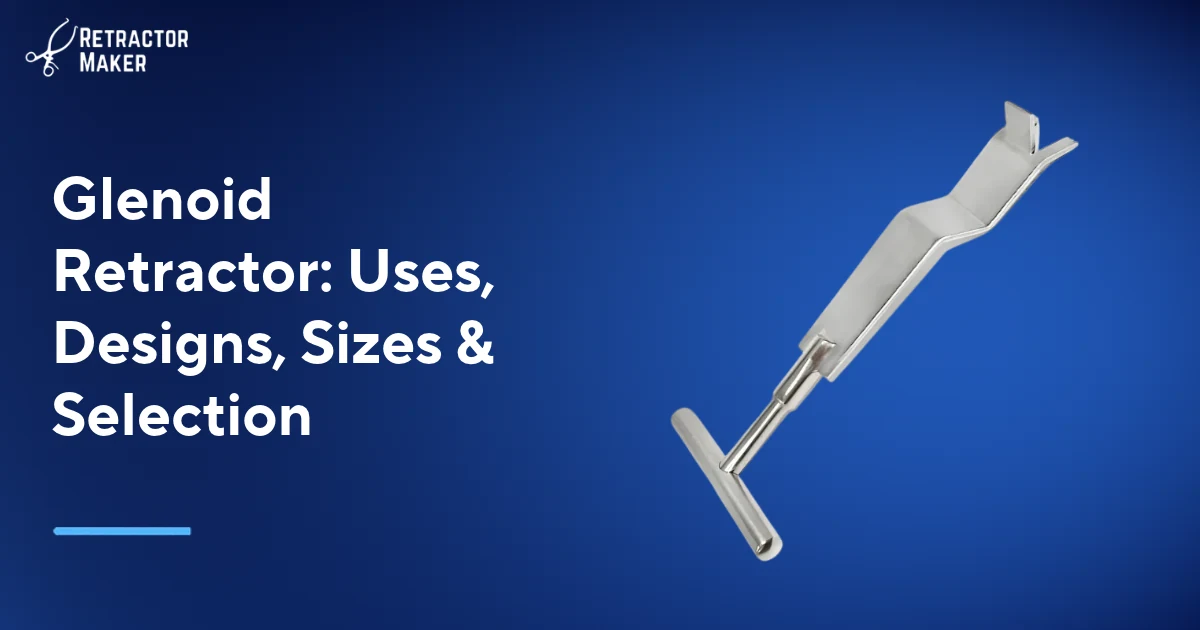
Compare glenoid retractor designs, sizes, shoulder arthroplasty uses, care requirements, and wholesale ordering options from Retractor Maker in Pakistan.
Retractors discussed in this guide: Glenoid Condyle Retractor, Glenoid Retractors, Shoulder Arthroplasty Retractor Glenoid Exposure, Total and Reverse Shoulder Arthroplasty Glenosphere Component Retractor. Browse all surgical retractors.
A glenoid retractor is a handheld orthopedic instrument used to expose the glenoid region by retracting capsular tissue, engaging bone margins, or displacing adjacent structures. The appropriate pattern depends on the exposure task rather than the instrument name alone. For surgeons, OR staff, and hospital buyers, the important distinctions are blade architecture, handle configuration, overall length, and directional orientation. Retractor Maker supplies several patterns with different intended uses, including shoulder arthroplasty exposure and broader shoulder or condylar joint retraction.
What is a glenoid retractor?
A glenoid retractor helps maintain surgical access around the shoulder socket. The glenoid is the socket portion of the shoulder joint, and surrounding tissue or the position of the humerus can limit access during an open procedure. Retraction creates a working view while the surgical team performs the planned operative steps.
The products compared here are handheld instruments, so their position and applied force remain under manual control. They are not interchangeable solely because they share the word glenoid. A hooking blade for bone margins, a directional pronged blade for rim engagement, and a curved blade for humeral displacement serve distinct exposure needs.
What is a glenoid retractor used for?
Glenoid retractors are used for shoulder joint exposure, particularly during shoulder arthroplasty. The Glenoid Retractors product is specifically intended to expose the glenoid rim and retract capsular soft tissue during total and reverse shoulder arthroplasty. Its directional blade supports selection of the required approach to the joint margin.
- Total and reverse shoulder arthroplasty: the Glenoid Retractors pattern provides glenoid rim exposure and capsular soft-tissue retraction.
- Humeral displacement during shoulder arthroplasty: the Shoulder Arthroplasty Retractor Glenoid Exposure is intended to displace the humerus posteriorly and expose the glenoid cavity.
- Shoulder, condylar, and orthopedic procedures: the Glenoid Condyle Retractor is intended to leverage bone margins and retract joint capsules.
Orthopedic teams should distinguish between retracting capsule and moving the humerus to obtain exposure. These tasks may require different contact surfaces and force directions. Product selection should follow the surgeon's operative plan; the broader condylar indication does not establish suitability for every joint or surgical specialty.
How do blade and handle designs differ?
Blade shape determines the intended engagement, while the handle provides manual control and leverage. All three listed products use Premium Grade AISI 304/316 Stainless Steel (Non-Magnetic). That material description does not replace the need to assess the instrument's intended use, condition, and reprocessing instructions.
Hooking and directional pronged blades
The Glenoid Condyle Retractor has a contoured hooking blade designed to seat around glenoid and condylar margins. Its flat ergonomic handle includes lateral serrations for tactile grip stability. The Glenoid Retractors pattern instead uses a contoured pronged blade, with Left-facing or Right-facing options and a heavy-duty flat ergonomic handle for sustained leverage counter-traction.
Curved leverage blade with T-handle
The Shoulder Arthroplasty Retractor Glenoid Exposure combines a curved leverage blade with an integrated ergonomic T-handle. Its blade is contoured to seat behind the glenoid rim, and its listed purpose is posterior humeral displacement. Handle leverage must remain controlled; a leverage-oriented design does not justify excessive force.
Which glenoid retractor types and sizes are available?
Retractor Maker lists three relevant designs, with selectable lengths and orientations for the Glenoid Retractors pattern. Compare the intended task before choosing a size. Overall length describes the complete instrument, not blade reach or blade width.
| Product name | Design and listed dimensions | Typical intended use |
|---|---|---|
| Glenoid Condyle Retractor | Contoured hooking blade; flat ergonomic handle with lateral serrations; 7 inches (approx. 17.8 cm) | Leverage bone margins and retract joint capsules during shoulder, condylar, and orthopedic procedures |
| Glenoid Retractors | Directional contoured pronged blade; heavy-duty flat ergonomic handle; Left-facing or Right-facing; lengths of 8 ¾″, 9″, 9 ½″, 10 ½″, 11″, and 11 ¾″ | Expose the glenoid rim and retract capsular soft tissue during total and reverse shoulder arthroplasty |
| Shoulder Arthroplasty Retractor Glenoid Exposure | Curved leverage blade; integrated ergonomic T-handle; 7 ¾ inches (19.68 cm) overall length; 40 mm blade width | Displace the humerus posteriorly and expose the glenoid cavity during shoulder arthroplasty |
Left-facing and Right-facing describe blade orientation and should not automatically be interpreted as patient-side labels. Confirm the required pattern with the surgeon and supplier. Only the T-handle product has a blade width specified in the supplied details; request clarification rather than assuming matching widths across the range.
How should a glenoid retractor be positioned?
A glenoid retractor should be positioned by trained surgical personnel under direct visualization, according to the selected instrument and operative approach. There is no universal placement instruction for all three designs. The following principles support team preparation and do not replace supervised surgical training or device instructions.
- Confirm the intended exposure task, selected blade pattern, and any required orientation before passing the instrument.
- Check that the working end engages the intended structure without trapping unintended soft tissue.
- Apply controlled traction or leverage using only the force needed to maintain the required view.
- Monitor adjacent soft tissue and maintain awareness of neurovascular structures throughout retraction.
- Reassess placement as the operative field changes, releasing or repositioning the instrument when appropriate.
If the instrument slips or exposure remains inadequate, reassess blade engagement and the exposure strategy rather than simply increasing force. Handheld retraction also requires clear communication between the surgeon and assistant whenever traction direction or instrument position changes.
How are glenoid retractors cleaned and sterilized?
All three products are supplied non-sterile and described as fully autoclavable. They must undergo appropriate preparation and sterilization before surgical use. Individual Protective Packaging protects the supplied instrument but should not be treated as a sterile barrier ready for the operating room.
Follow the manufacturer's validated reprocessing instructions and the facility's sterile-processing procedures. Cleaning must precede sterilization, with attention to blade contours, prongs, and handle serrations where present. Inspect for residual soil, corrosion, deformation, or damage, and remove questionable instruments from service pending assessment.
The supplied product information does not specify detergent compatibility, autoclave temperature, exposure time, or drying requirements. Obtain these instructions before processing rather than selecting a cycle from the material description alone. After processing, maintain packaging integrity and store instruments according to the facility's sterile-storage policy.
How do you choose and buy from Retractor Maker?
Choose a glenoid retractor by matching its intended use and blade geometry to the required exposure, then confirm length and orientation. OR teams should document the exact product name on preference cards and purchasing requests. This reduces ambiguity between rim retraction, capsule displacement, and posterior humeral displacement.
Retractor Maker is a surgical retractor manufacturer and exporter in Sialkot, Pakistan, offering wholesale supply, OEM services, and worldwide shipping. Each listed product is brand new, comes in Individual Protective Packaging, and has a minimum order quantity of 1 Piece. For OEM requests, confirm the proposed specification and its documentation rather than assuming every customization is available.
Before ordering, request confirmation of the selected pattern, current quotation, availability, shipping arrangements, and validated reprocessing instructions. Hospital buyers should also identify the documentation required by their procurement policies and destination market. A complete purchasing specification helps align the surgeon's requested instrument with the item received and processed by the hospital.
Clinical notice: This guide is for surgical teams and hospital buyers. Always follow the manufacturer's instructions for use (IFU) and your hospital's sterilization rules before clinical use.
Frequently Asked Questions
What is a glenoid retractor used for?
A glenoid retractor is used to improve surgical exposure around the shoulder socket. Depending on its design, it may retract capsular tissue, engage bone margins, or displace the humerus. The listed Glenoid Retractors pattern is intended for total and reverse shoulder arthroplasty, while the Glenoid Condyle Retractor also has shoulder, condylar, and orthopedic applications.
What sizes do glenoid retractors come in?
The listed glenoid retractor sizes vary by product pattern. Glenoid Retractors are available in 8 ¾″, 9″, 9 ½″, 10 ½″, 11″, and 11 ¾″ overall lengths. The Glenoid Condyle Retractor measures 7 inches (approx. 17.8 cm). The Shoulder Arthroplasty Retractor Glenoid Exposure measures 7 ¾ inches (19.68 cm) and has a 40 mm wide blade.
What is the difference between left and right glenoid retractors?
Left-facing and Right-facing glenoid retractors differ in their directional blade orientation. These options are listed for the Glenoid Retractors product with its contoured pronged blade. The orientation names should not be assumed to specify the patient's operative side. Confirm the required pattern against the surgeon's exposure plan and supplier information before ordering.
Are glenoid retractors supplied sterile?
The three listed Retractor Maker products are supplied non-sterile and are fully autoclavable. They require appropriate preparation and sterilization before surgical use, despite arriving in Individual Protective Packaging. The supplied specifications do not include validated cycle parameters, so sterile-processing teams should obtain the manufacturer's reprocessing instructions before selecting a cleaning and sterilization process.
Which glenoid retractor is used to displace the humerus?
The Shoulder Arthroplasty Retractor Glenoid Exposure is specifically intended to displace the humerus posteriorly during shoulder arthroplasty. It has a curved leverage blade and an integrated ergonomic T-handle. This intended task differs from the capsular retraction and glenoid rim exposure described for the directional pronged Glenoid Retractors pattern.
Can hospitals order glenoid retractors wholesale or OEM?
Retractor Maker offers wholesale supply and OEM services with worldwide shipping from Sialkot, Pakistan. The listed products each have a minimum order quantity of 1 Piece. Buyers should confirm the exact design, length, orientation where applicable, and documentation requirements, and request current commercial terms and reprocessing instructions before finalizing an order.
About the author
Saad Shahid · Sales & Marketing Manager
Saad Shahid is the Sales & Marketing Manager and founder of Retractor Maker, started in 2023 in Sialkot, Pakistan. He also works with his father at Hospitech Traders, the family surgical instrument business founded in 1989.
Related Blogs & Guide
Related Retractors
Gifford-Jansen Retractor
From $84.00
Hajek Cheek Retractor
$24.00
Lip And Cheek Retractor
$49.00
Bellucci Endaural Retractors
From $174
Aufricht Nasal Retractor
From $59.00
Aufricht Walter Nasal Retractor
$69.00
Need Surgical Retractors or Components?
Tell us what you need, including the product, configuration, quantity and destination country. Retractor Maker can provide availability, specifications and pricing.
Request a Quote