
Orthopedic & Spine Retractors
Humeral Head Retractor: Uses, Designs & Selection
Author: Saad Shahid · Updated · 7 min read
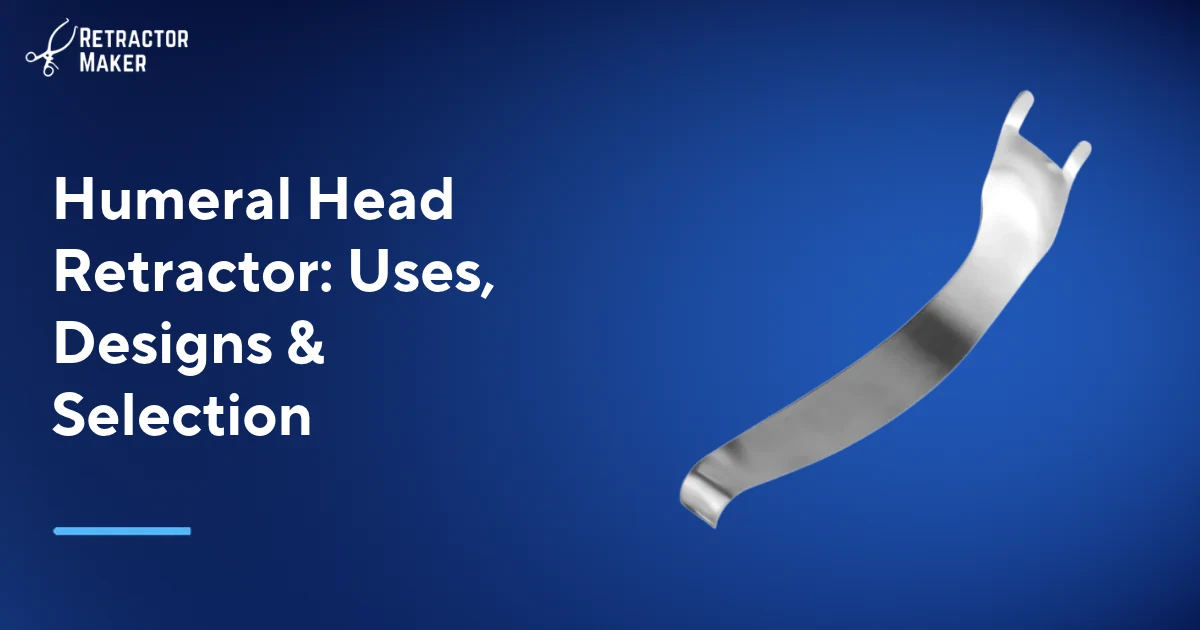
Compare humeral head retractor designs, sizes, shoulder surgery uses, handling and sterilization considerations, plus buying options from Retractor Maker.
Retractors discussed in this guide: Dingo Modified Humeral Head Retractors, Humeral Head Retractor. Browse all surgical retractors.
A humeral head retractor is a handheld orthopedic instrument used to move the proximal humerus out of the operative view and expose the glenoid cavity during shoulder arthroplasty. It provides manual leverage rather than holding the surgical field open independently. For surgeons, OR staff and hospital buyers, the main selection questions concern the bone-contact design, overall length, handle configuration and reprocessing requirements. Retractor Maker supplies two distinct designs: the Humeral Head Retractor with an angled ring-shaped blade and the Dingo Modified Humeral Head Retractors with curved, serrated tips.
What is a humeral head retractor?
A humeral head retractor is a bone-leverage instrument intended to improve access to the glenoid side of the shoulder joint. The humeral head is the ball of the shoulder joint; the glenoid is its socket. Moving the proximal humerus away from the working area helps the surgical team see and access the glenoid during the relevant stages of shoulder replacement.
Both listed instruments are handheld orthopedic humeral leverage retractors. Their position and traction therefore depend on the operator maintaining control. They are not self-retaining retractors, and their described function differs from that of a retractor used primarily to hold back superficial soft tissue. The intended bone-contact geometry is central to choosing between them.
What is a humeral head retractor used for?
The principal use is glenoid exposure during shoulder arthroplasty. The ring-shaped Humeral Head Retractor is specifically designed to displace the humeral head posteriorly. The Dingo modified design is intended to lever the humeral head for glenoid exposure during shoulder arthroplasty and reconstructive surgery, with total shoulder replacement expressly identified in its product description.
- Shoulder arthroplasty: moving the proximal humerus to improve access to the glenoid cavity.
- Total shoulder replacement: using the Dingo modified design for humeral leverage and glenoid exposure.
- Shoulder reconstructive surgery: using the Dingo modified design within its stated intended use.
- Orthopedic shoulder instrument preparation: selecting the requested bone-contact design before the procedure.
These indications do not make either design appropriate for every exposure or every patient. Surgical approach, anatomy and the operative plan influence instrument choice. The supplied product information does not establish compatibility with a particular implant system or a universal shoulder replacement technique. Those requirements should be checked separately rather than inferred from the instrument name.
How do the blade, shank and handle differ?
The key design difference is how the working end engages the proximal humerus. The Humeral Head Retractor has a curved shank and an angled ring-shaped blade contoured to cradle the bone. Its heavy-duty ergonomic flat handle is designed for sustained leverage counter-traction. This configuration combines a shaped bone-contact area with a manually controlled handle.
The Dingo modified design instead uses a curved, serrated tip intended for secure, non-slip purchase on bone. Its heavy-duty ergonomic handle is designed for sustained leverage counter-traction. Serrations describe the intended contact mechanism; they do not remove the need to assess seating, bone quality and the response to applied force.
Both products list the material as Premium Grade AISI 304/316 Stainless Steel (Non-Magnetic). Both are supplied non-sterile and fully autoclavable. An ergonomic handle supports the intended handling function, but it should not be interpreted as permission to apply greater force. Controlled leverage and continuing observation remain necessary regardless of handle style.
Which humeral head retractor types and sizes are available?
Retractor Maker lists a ring-shaped blade model in selectable lengths and a Dingo modified serrated-tip model in a stated overall length. Compare the contact geometry first, then confirm the length requested by the surgical team. Similar overall lengths do not make these working ends interchangeable.
| Product name | Design | Listed overall length | Typical intended use |
|---|---|---|---|
| Dingo Modified Humeral Head Retractors | Curved, serrated tip; heavy-duty ergonomic handle | 10″ (25.5 cm) | Levering the humeral head for glenoid exposure during shoulder arthroplasty and reconstructive surgery |
| Humeral Head Retractor | Curved shank; angled ring-shaped blade; heavy-duty ergonomic flat handle | 8 ¾″, 9″, 10″, 11″ | Posterior displacement of the humeral head for glenoid exposure during shoulder arthroplasty |
The Humeral Head Retractor listing pairs 8 ¾″ with $84.00, 9″ with $89.00, 10″ with $94.00 and 11″ with $99.00. These are listed product prices, not a complete landed-cost quotation. Confirm current pricing and shipping terms when ordering. No price for the Dingo modified model is supplied in the product information.
How is a humeral head retractor positioned safely?
Positioning should follow the surgeon's operative technique, the manufacturer's instructions and direct assessment of the exposed anatomy. This guide is not a substitute for surgical training. The general objective is controlled engagement of the intended bone surface while protecting adjacent soft tissue and neurovascular structures from pressure, entrapment or unintended contact.
Before use, the team should verify the requested model, inspect its working end and handle, and confirm that reprocessing is complete. During use, the ring-shaped blade is intended to cradle the proximal humerus, whereas the Dingo modified tip is intended to gain serrated purchase on bone. Neither description establishes a universal insertion path, leverage angle or force limit.
Apply only the traction needed for the planned exposure and reassess contact as the operative field changes. Avoid blind levering or increasing force to compensate for poor seating. If the instrument slips or exposure remains inadequate, the surgeon should reassess placement and the exposure strategy. Clear communication is especially important when an assistant maintains handheld traction.
How should it be cleaned and sterilized?
Both retractors are supplied non-sterile and fully autoclavable, so they require appropriate processing before clinical use. Individual protective packaging is not a sterile barrier claim. Autoclavability also does not establish a complete sterilization cycle: cleaning methods, packaging, loading and cycle parameters must follow the applicable manufacturer instructions and validated facility procedures.
- Obtain the manufacturer's reprocessing instructions before introducing either instrument into clinical service.
- Follow facility procedures for safe handling, transport and cleaning of contaminated instruments.
- Inspect the serrated tip or ring-shaped blade for retained soil and visible damage after cleaning.
- Check the shank and handle for deformation or other defects that could compromise controlled use.
- Sterilize, dry, inspect and store according to the applicable instructions and validated sterile-processing workflow.
The supplied listings do not include detailed reprocessing instructions. Do not select a temperature, exposure time, detergent or chemical compatibility solely from the material description. Sterile-processing staff should resolve those details before use and remove damaged instruments from service for assessment under facility policy.
How do you choose and buy from Retractor Maker?
Choose the retractor by the surgeon's requested contact design and length, then verify procurement and processing requirements. A purchase specification should name the product explicitly rather than requesting only a shoulder retractor. For the ring-shaped model, include the selected overall length; for the Dingo modified model, specify the curved, serrated-tip design.
Retractor Maker is a surgical retractor manufacturer and exporter in Sialkot, Pakistan, offering wholesale supply, OEM services and worldwide shipping. Both listed products are brand new, individually protectively packaged and available with a minimum order quantity of 1 piece. For OEM inquiries, agree on the proposed specification and documentation before treating any modification as available.
Hospital buyers should request a quotation identifying the model, length, quantity, listed material, non-sterile supply status and destination. Ask for applicable product documentation, reprocessing instructions, shipping costs and delivery terms. Keeping these details in the purchase record helps align the surgeon's preference, the OR tray specification and sterile-processing acceptance.
Clinical notice: This guide is for surgical teams and hospital buyers. Always follow the manufacturer's instructions for use (IFU) and your hospital's sterilization rules before clinical use.
Frequently Asked Questions
What is a humeral head retractor used for?
A humeral head retractor is used to move the proximal humerus and expose the glenoid cavity during shoulder arthroplasty. The ring-shaped model is intended for posterior displacement of the humeral head. The Dingo modified model is intended for humeral leverage during shoulder arthroplasty and reconstructive surgery, including the total shoulder replacement use described in its listing.
What is the difference between a Dingo modified and ring-shaped humeral head retractor?
The main difference is the bone-contact design: the Dingo modified model has a curved, serrated tip, while the ring-shaped model cradles the proximal humerus with an angled blade. Both are handheld leverage instruments. Selection should reflect the surgeon's intended exposure and contact preference rather than an assumption that either design is universally better.
What sizes does the humeral head retractor come in?
The Humeral Head Retractor is listed in 8 ¾″, 9″, 10″ and 11″ overall lengths. The Dingo Modified Humeral Head Retractors listing specifies 10″ (25.5 cm). These measurements describe overall length, not blade width or ring dimensions. Buyers needing additional working-end measurements should request confirmation before ordering.
Is the humeral head retractor supplied sterile?
Both listed humeral head retractor designs are supplied non-sterile and fully autoclavable. They require appropriate processing before clinical use, and individual protective packaging should not be treated as sterile packaging. Obtain the manufacturer's reprocessing instructions and follow validated facility procedures; the listings do not provide a specific autoclave cycle.
What material is the humeral head retractor made from?
Both products list their material as Premium Grade AISI 304/316 Stainless Steel (Non-Magnetic). The same stated material applies to the ring-shaped Humeral Head Retractor and the Dingo modified design. Material wording alone does not establish cleaning chemistry, sterilization parameters or suitability for an MRI environment; obtain the relevant instructions for the intended setting.
Can hospitals order humeral head retractors wholesale from Retractor Maker?
Retractor Maker offers wholesale supply, OEM services and worldwide shipping from Sialkot, Pakistan. Both listed models have a minimum order quantity of 1 piece. Hospitals should specify the product name, requested length, quantity and shipping destination, then confirm current pricing, documentation, processing instructions and delivery terms in the quotation.
About the author
Saad Shahid · Sales & Marketing Manager
Saad Shahid is the Sales & Marketing Manager and founder of Retractor Maker, started in 2023 in Sialkot, Pakistan. He also works with his father at Hospitech Traders, the family surgical instrument business founded in 1989.
Related Blogs & Guide

Related Retractors
Senn Forward Retractor
$49.00
Brewster Retractor
From $159
Langenbeck Retractor-Solid Handle
$49.00
Murphy Retractor
From $44.00
Leriche Retractor-Atraumatic Wide Blade
From $94.00
Lobster General Retractor System
$2,699Free Shipping
Need Surgical Retractors or Components?
Tell us what you need, including the product, configuration, quantity and destination country. Retractor Maker can provide availability, specifications and pricing.
Request a Quote