
Orthopedic Retractor Guides
What Is a Charnley Retractor? Total Hip Arthroplasty Setup & Blades
Author: Saad Shahid · Updated · 7 min read
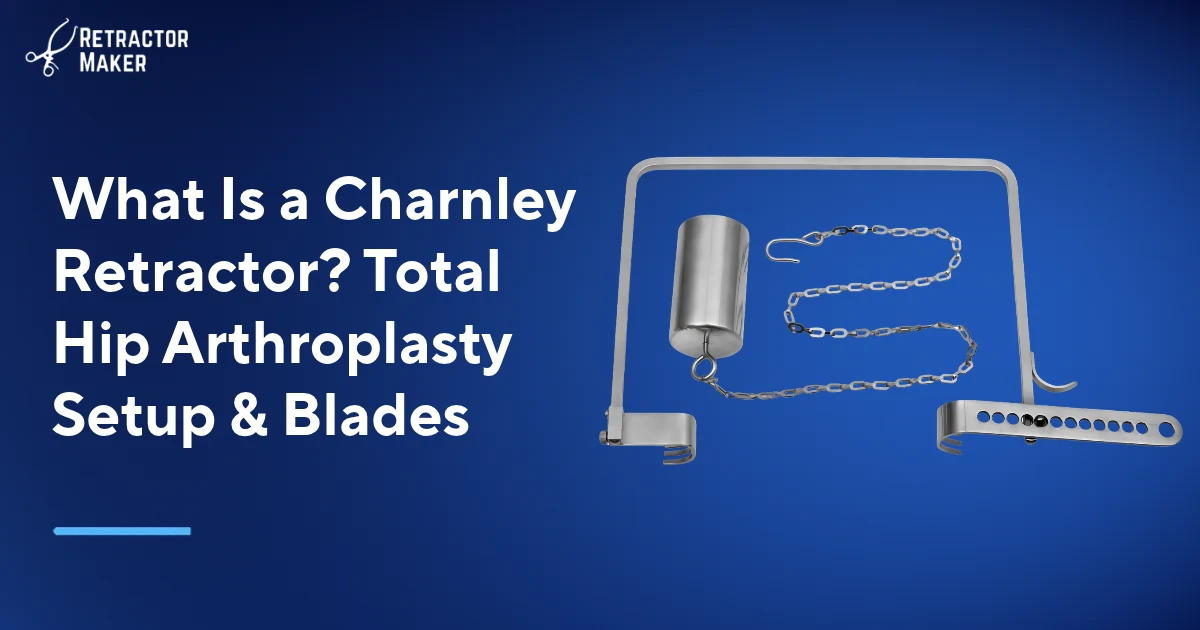
Achieving adequate operative exposure is one of the most critical aspects of total hip arthroplasty (THA). The hip joint is surrounded by dense musculature, fibrous capsular structures, and delicate neurovascular bundles. Displacing these heavy soft-tissue layers manually requires sustained physical effort from surgical assistants, which can lead to fatigue, shifting retraction angles, and obstructed working corridors.
Retractors discussed in this guide: Charnley Initial Incision Retractor. Browse all surgical retractors.
Contents
A Charnley retractor is a self-retaining orthopedic surgical system that maintains stable, hands-free exposure during total hip replacement and hip reconstructive surgery. Often called the Charnley initial incision retractor, it exposes the proximal femur, acetabulum, and surrounding musculature.
A Charnley retractor provides hands-free exposure during total hip arthroplasty. Its rigid mechanical frame, adjustable crossbar, and specialized modular blades maintain steady counter-traction against heavy pelvic and thigh musculature without manual holding.
What Is a Charnley-Style Retractor System?
The Charnley-style system addresses the limitations of relying entirely on handheld instruments during major joint reconstruction. It was developed in conjunction with the principles of low-friction total hip arthroplasty established by Sir John Charnley. Handheld alternatives include Hohmann, Langenbeck, or Bennett retractors.
The Charnley system forms the structural foundation of the operative incision. Handheld retractors remain useful for dynamic, localized bone levering. Once placed and engaged, the mechanical frame applies constant, calibrated lateral and longitudinal traction to wound margins. This hands-free stabilization keeps the site open for acetabular reaming, femoral preparation, and component alignment.
How Does the Charnley Frame Maintain Exposure?
A Charnley-style system distributes mechanical counter-traction across an external perimeter frame:
- Rigid framework: Unlike flexible abdominal rings, the Charnley retractor has a solid, heavy-duty frame that withstands contraction forces from large muscle bellies, including the gluteus medius, gluteus maximus, and tensor fasciae latae.
- Calibrated spread: Threaded screw bars, ratchet racks, or friction-locking slides let surgeons precisely expand and fix the frame width.
- Modular blade coupling: Specialized blades attach to frame arms or intermediate crossbars through slotted attachments, retaining screws, or quick-release clamps.
- Low-profile architecture: The frame rests parallel to the patient's thigh and pelvis, minimizing interference with femoral reamers, acetabular impactors, and surgical navigation equipment.
What Frame and Blade Configurations Are Available?
Charnley systems are available as complete, interchangeable instrument sets. Components and connection geometries vary by manufacturer, but most systems share these functional elements:
How Does the Frame Assembly Work?
The primary chassis typically has two opposing arms linked by a mechanical spreader bar or square-threaded lead screw. Turning an adjustment knob or crank moves the arms apart in parallel or slightly angled paths. This maintains balanced tension on opposing wound margins.
What Do Intermediate Crossbars Do?
Intermediate crossbars support central or superior blades for multi-axial traction. Many Charnley systems have detachable or integrated crossbars perpendicular to the primary opening axis. These convert two-way lateral exposure into three-way or four-way traction.
Which Orthopedic Blade Geometries Are Used?
Charnley-style blades handle dense fibrous tissue and muscle without slipping:
- Curved muscular blades: Wide, contoured blades displace subcutaneous fat and thick muscular envelopes atraumatically.
- Fascial / serrated blades: Small retaining ridges or serrated distal lips prevent slipping from beneath tough fascia lata under heavy tension.
- Flat flange blades: Smooth, broad surfaces distribute contact across anterior or posterior soft-tissue flaps.
- Specialized deep pelvic / femoral blades: Elongated blades reach deeper periacetabular or subtrochanteric planes.
How Do Fixed and Interchangeable Components Differ?
Modern orthopedic retractor manufacturing uses modular configurations, while some legacy models have fixed arms:
- Interchangeable blade systems: Blades of varying depths and widths fit standard frame arms. Selection can match the patient's body habitus and direct anterior, lateral, or posterior surgical approach.
- Fixed-arm configurations: Some legacy models have permanently attached lateral blades. These are structurally rigid but lack flexibility for diverse anatomical depths.
How Is a Charnley Retractor Used in Total Hip Arthroplasty?
The Charnley retractor stabilizes the primary wound corridor during total hip replacement:
- Initial incision clearance: After skin and fascia lata incision, the arms and initial blades are seated to clear subcutaneous boundaries.
- Muscular retraction: The mechanical spreader separates muscular margins away from the trochanteric region and joint capsule.
- Secondary instrument support: The Charnley frame establishes a wide, stable perimeter. This provides clearance for specialized handheld levers, such as acetabular Hohmann retractors, around the femoral neck and acetabular rim without crowding the wound.
- Hands-free field preservation: Frees surgical assistants from holding heavy retractors for extended periods, reducing fatigue-induced field drift.
How Does Charnley Compare With Other Retractor Platforms?
| Feature | Charnley-Style Retractor | General Abdominal Retractor (e.g., Balfour) | Handheld Orthopedic Levers (e.g., Hohmann) |
|---|---|---|---|
| Primary Specialty | Orthopedic Joint Reconstruction (Hip) | General, Abdominal & Pelvic Surgery | Orthopedic Trauma & Joint Surgery |
| Mechanical Foundation | Rigid, heavy-duty self-retaining frame | Wire-form or sliding spreader frame | None (manually held) |
| Tissue Capability | Dense skeletal muscle, fascia lata | Visceral organs, abdominal wall | Periosteum, muscle, bone leverage |
| Blade Fixation | Modular clamp or slotted retaining lock | Sliding tracks with set screws | Integral handle and lever |
| Operator Role | Autonomous once positioned and locked | Autonomous once locked | Requires continuous manual holding |
What Should Hospitals and Distributors Check Before Buying?
Hospitals and medical distributors should assess structural strength, locking reliability, modularity, and surface finish when sourcing Charnley-style systems:
- Metallurgical strength: Hip surgery places substantial torque on frames. Systems should use high-tensile Premium Grade AISI 304/316 Stainless Steel (Non-Magnetic) to resist arm flex or shaft bowing.
- Locking reliability: Threaded lead screws, crossbar clamps, and blade connectors must hold securely under heavy mechanical load without binding or slipping.
- Component modularity: Confirm that replacement blades, crossbars, and locking screws are available individually, so lost or damaged parts do not require a new frame.
- Surface finishing: Matte or non-glare satin passivation reduces harsh reflections under high-intensity operating theater overhead lights.
How Are Charnley Systems Cleaned and Sterilized?
Reusable Charnley retractors require thorough hospital reprocessing between surgical cases:
- Complete disassembly: Remove all modular blades, crossbars, retaining screws, and locking nuts before cleaning. Bioburden, bone fragments, and marrow lipids accumulate in threaded holes, mounting slots, and adjustment tracks.
- Decontamination: Submerge components in neutral or enzymatic detergent baths. Use soft nylon brushes on internal threads, slots, and blade interfaces. Ultrasonic cleaning is recommended for microscopic particles in moving joints and lead screws.
- Inspection: Check lead screws for stripped threads, frame arms for bending, and blade locking mechanisms for firm engagement.
- Sterilization: Autoclave in validated sterilization containment trays. Follow the instrument manufacturer's validated Instructions for Use (IFU) and healthcare facility infection control standards.
What OEM and Custom Manufacturing Options Are Available?
Retractor Maker develops customized Charnley-style frames, specialized blade depths, tailored crossbar extensions, and private-label laser marking. It works with orthopedic distributors and OEM brand partners using approved technical drawings and procurement specifications. Anatomical requirements vary with regional surgical techniques and patient demographics, so custom options can be evaluated directly with the manufacturer.
Request Factory-Direct Sourcing From Retractor Maker
Retractor Maker supplies precision-crafted surgical retractor systems directly to hospitals, healthcare supply chains, and medical device distributors worldwide. It is a specialized surgical retractor manufacturer based in Sialkot, Pakistan.
Contact Retractor Maker to request formal pricing, review technical specifications, or discuss custom OEM/private-label manufacturing for Charnley-style systems.
Clinical notice: This guide is for surgical teams and hospital buyers. Always follow the manufacturer's instructions for use (IFU) and your hospital's sterilization rules before clinical use.
Frequently Asked Questions
What is a Charnley retractor?
A Charnley retractor is a self-retaining orthopedic surgical platform that holds wound margins and dense musculature open during total hip arthroplasty and hip reconstructive procedures. Its mechanical frame maintains hands-free exposure of the proximal femur, acetabulum, and surrounding musculature.
Why is it called a Charnley retractor?
The Charnley retractor is named after Sir John Charnley, the pioneering British orthopedic surgeon who developed modern low-friction total hip replacement techniques. He also introduced specialized instrumentation to optimize joint exposure during these surgical procedures.
Is a Charnley retractor self-retaining?
A Charnley retractor is self-retaining and does not require continuous manual holding by surgical assistants. Its rigid mechanical frame and threaded spreader mechanisms hold the blades in place under tension, maintaining hands-free exposure during total hip arthroplasty.
What types of blades are used with a Charnley retractor?
A Charnley retractor uses modular blades, including wide curved muscular blades, serrated fascial blades, flat flange blades, and deep pelvic retraction blades. These blades come in varying depths and widths, allowing selection to suit patient body habitus and the surgical approach.
How do Charnley and Balfour retractors differ?
A Charnley retractor has heavy-duty structural rigidity for dense skeletal muscle and joint exposure, while a Balfour retractor has lighter frames for soft abdominal walls and visceral retraction. Both are self-retaining, but their frame designs suit these different tissues and exposure needs.
Can a Charnley retractor be autoclaved?
Reusable Charnley retractor systems made from Premium Grade AISI 304/316 Stainless Steel (Non-Magnetic) are fully autoclavable. Processing must follow the manufacturer's validated instructions for use (IFU) and facility protocols. This guidance applies to the reusable systems made from the specified stainless steel.
Who uses a Charnley retractor?
A Charnley retractor is used by orthopedic surgeons, surgical technologists, and operating room teams. These users specialize in adult joint reconstruction, hip arthroplasty, and complex pelvic surgery. Its users therefore include both surgeons and the operating room staff working in these specialties.
How do Charnley and Hohmann retractors differ?
A Charnley retractor holds the operative incision open with a self-retaining mechanical frame, while a Hohmann retractor requires manual holding for localized bone levering. The Charnley frame creates a stable wound perimeter. This provides clearance for handheld acetabular Hohmann retractors around the femoral neck and acetabular rim.
How should a Charnley retractor be cleaned before sterilization?
A Charnley retractor should be completely disassembled before cleaning. Remove modular blades, crossbars, retaining screws, and locking nuts. The guide specifies neutral or enzymatic detergent baths and soft nylon brushes for threads, slots, and blade interfaces. Ultrasonic cleaning is recommended for particles in moving joints and lead screws.
What should be inspected when reprocessing a Charnley retractor?
A Charnley retractor should be inspected for stripped threads on threaded lead screws, bending in frame arms, and firm engagement of blade locking mechanisms. These checks cover components that maintain balanced wound tension and secure blade attachment under the heavy mechanical loads encountered during hip surgery.
About the author
Saad Shahid · Sales & Marketing Manager
Saad Shahid is the Sales & Marketing Manager and founder of Retractor Maker, started in 2023 in Sialkot, Pakistan. He also works with his father at Hospitech Traders, the family surgical instrument business founded in 1989.
Related Blogs & Guide



Related Retractors
Senn Forward Retractor
$49.00
Brewster Retractor
From $159
Langenbeck Retractor-Solid Handle
$49.00
Murphy Retractor
From $44.00
Leriche Retractor-Atraumatic Wide Blade
From $94.00
Lobster General Retractor System
$2,699Free Shipping
Need Surgical Retractors or Components?
Tell us what you need, including the product, configuration, quantity and destination country. Retractor Maker can provide availability, specifications and pricing.
Request a Quote