
Surgical Retractor Guides
What is the FK Retractor (Feyh-Kastenbauer) and How is it Placed?
Author: Saad Shahid · Updated · 12 min read
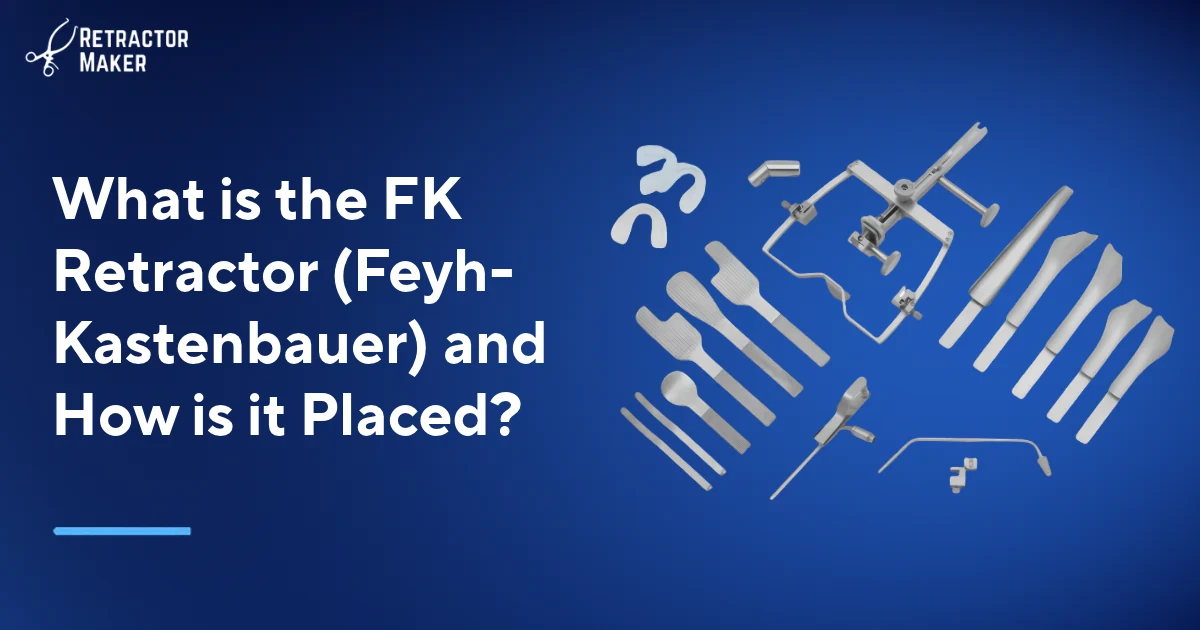
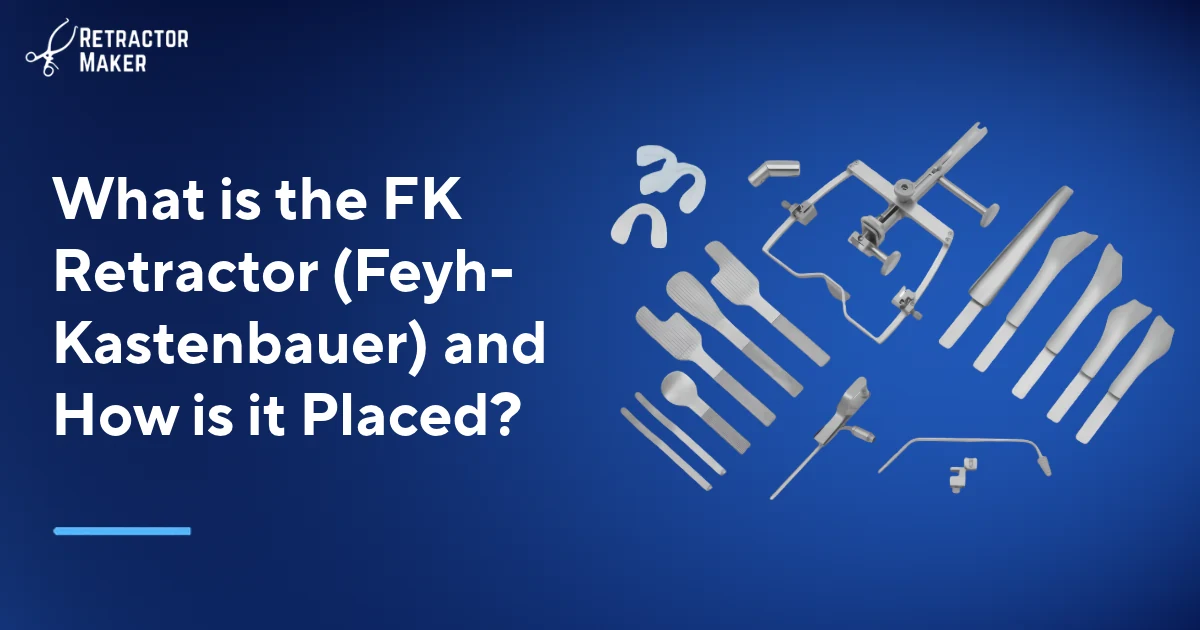
The FK Retractor is an adjustable, open-frame laryngo-pharyngoscope system used to establish surgical access to the upper aerodigestive tract. This guide covers its components, blade options, placement, TORS applications, and safety considerations.
Retractors discussed in this guide: FK Retractor (Feyh-Kastenbauer). Browse all surgical retractors.
The FK Retractor is an open-frame system that provides exposure of the upper aerodigestive tract during head and neck surgery. Access is challenging because the oral cavity, pharynx, and larynx are narrow, deep spaces bounded by sensitive tissues. The system addresses these exposure challenges and was developed from the Feyh-Kastenbauer open-frame concept.
The FK Retractor provides an open, adaptable framework that overcomes the line-of-sight and instrument maneuvering limits of traditional tubular laryngoscopes. It is key to modern Trans-Oral Robotic Surgery (TORS). It also supports operative microsurgery and laser procedures involving the tongue base, larynx, and hypopharynx.
Correct placement of this self-retaining platform is vital for an optimal surgical field. Proper setup holds tissue steadily and maintains open working angles for instruments. It supports surgical precision and protects surrounding patient anatomy.
Contents
What Is the FK Retractor (Feyh-Kastenbauer)?
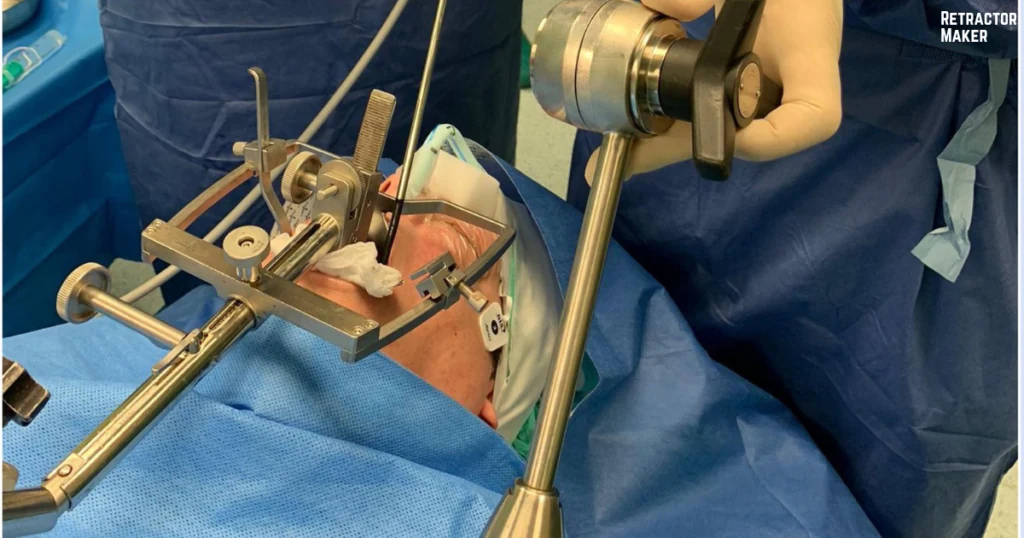
The FK Retractor (Feyh-Kastenbauer) is a self-retaining laryngo-pharyngoscope retractor with a non-tubular, open-frame design. Traditional closed laryngoscopes use narrow cylindrical channels. The FK system instead uses a wide-aperture frame around the operative access point, without enclosed side walls.
The open frame provides a wider aperture and removes physical side barriers. This creates space for multi-instrument triangulation and optical scope placement. It also allows specialized hand tools or robotic end-effectors to maneuver.
The Feyh-Kastenbauer system provides multi-axis adjustment rather than static or single-plane retraction. Blade angles can be controlled independently for elevation and depression. Insertion depth can also be adjusted forward and backward. These controls adapt the operative field to varied patient anatomy in the oral cavity, oropharynx, tongue base, larynx, and hypopharynx.
What Is the FK-WO TORS Retractor Used For?
The FK-WO TORS Retractor setup provides surgical exposure for several advanced operative methods across anatomical regions of the upper aerodigestive tract. Supported applications include:
- Wide-bore access for robotic end-effectors, with multi-arm clearance supporting 3D endoscopes in confined pharyngeal spaces.
- Direct, high-magnification sight lines for precise binocular microscopic intervention.
- It provides a stable, non-flammable access corridor. This is for carbon dioxide ($CO_2$) and other surgical laser systems.
- Direct access to the oropharynx, larynx, hypopharynx, and proximal esophageal inlet.
- Exposure of tongue base lesions, lingual tonsil tissue, supraglottic structures, and piriform sinuses.
- Static soft tissue retraction for open or endoscopic interventions in general oral, laryngeal, and pharyngeal surgeries.
The FK-WO TORS setup maintains an open working space for robotic or conventional instruments. It helps prevent instrument collisions and reduces crowding at the entry point. It also keeps exposure steady during long resections.
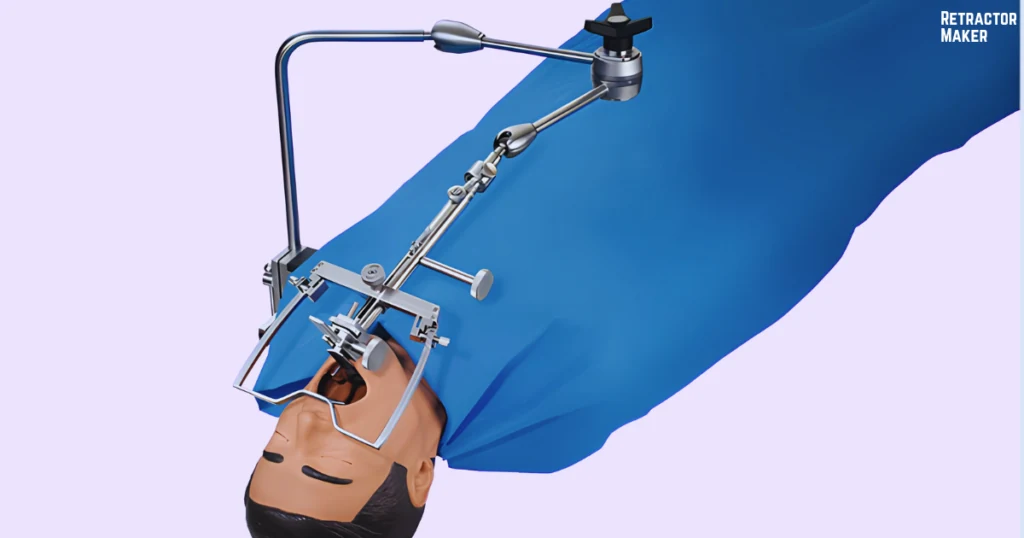
This image shows the wide working aperture and instrument clearance provided by the setup.
What Are the Key Features of the FK Retractor?
FK Retractor function depends on several key mechanical and structural features.
How Does the Non-Tubular Frame Improve Access?
The wide-open frame replaces standard closed cylindrical tubes to improve access. Its open geometry removes rigid side walls. This expands the visual line of sight and increases physical entry angles for surgical tools.
How Is Blade Angle Adjusted?
Surgical staff adjust blade pitch upward or downward to elevate or depress target soft tissues precisely. This aligns the tissues with the visual axis.
How Is Blade Insertion Depth Controlled?
The blade mounting mechanism controls forward and backward movement. This positions the distal tip at the exact anatomical depth needed. Depth adjustment supports superficial tongue base work or deeper hypopharynx work.
How Is the Retraction Space Adjusted?
Operating teams customize retraction space volume by adjusting blade angle and insertion depth together. This matches the patient’s physical aperture and surgical needs.
How Does the Flexible Tension Arm Work?
The multi-jointed, flexible tension arm holds the system in a static, hands-free position during the procedure. It anchors to a central set screw mechanism. Once aligned, the arm locks securely.
How Does the Frame Accommodate Robotic Instruments?
The open frame provides lateral clearance for robotic wrist articulation and instrument movement. During TORS, this space allows multiple robotic arms and an optical scope to operate together.
What Components Come with the FK Retractor?
The FK Retractor (Feyh-Kastenbauer) is a full set with basic mounting hardware, specialized retractor blades, and assisting accessories. It also includes dental protection and containment equipment.
| Quantity | Component | Dimensions / Details |
|---|---|---|
| 1 | FK-WO TORS Basic Frame with Adapter | Main structural frame assembly |
| 1 | Adapter for FK-WO TORS Basic Frame | Mounting connection adapter |
| 1 | Adapter for Tumor Grasping Forceps or Suction Tube | Auxiliary instrument mounting adapter |
| 1 | Light Clip | Lateral cable connection |
| 2 | Cheek Retractors | Curved profile |
| 1 | Suction Tube for Smoke | 4.0 × 170 mm |
| 10 pcs | Teeth Protectors | Latex-free, non-autoclavable |
| 1 | Mandible Blade | 11 cm |
| 1 | Laryngeal Blade | 17 cm, concave |
| 1 | Tongue Blade | Curved |
| 1 | Tongue Blade | Curved, right side open |
| 1 | Tongue Blade | Curved, left side open |
| 1 | TORS Blade according to Weinstein-O’Malley | Standard TORS profile |
| 2 | Small TORS Blade, Left | Compact left-sided configuration |
| 2 | Small TORS Blade, Right | Compact right-sided configuration |
| 1 | Sterilization Box | Formed tray for FK-WO TORS set |
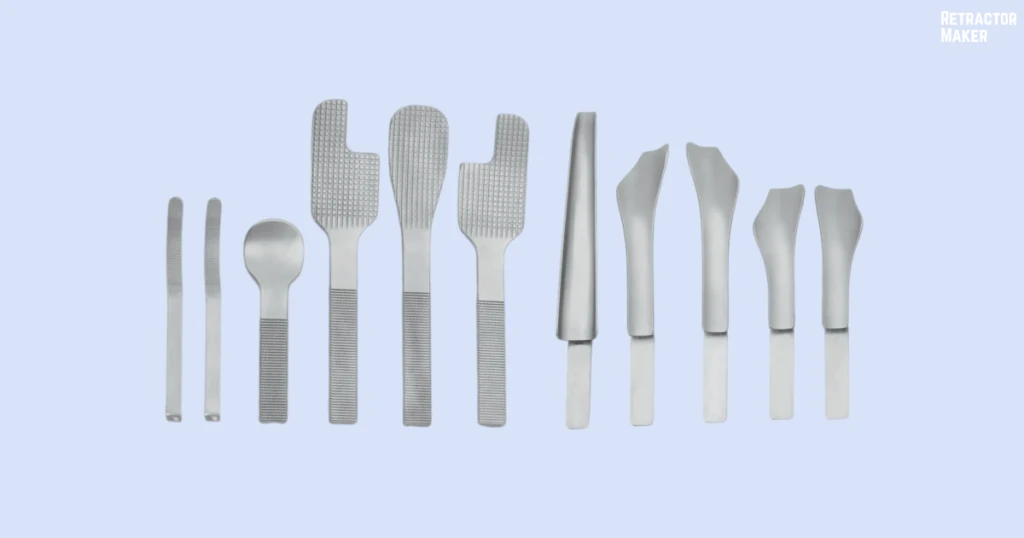
Which FK Retractor Blade Options Are Available?
The Feyh-Kastenbauer platform offers interchangeable blades in different shapes. Blade selection depends on the target area and procedure goals.
- Mandible Blade (11 cm): Seats against the lower jaw to help anchor and balance the frame assembly.
- Laryngeal Blade (17 cm, Concave): Provides a 17 cm reach. Its concave profile fits anterior laryngeal structures for glottic and subglottic exposure.
- Curved Tongue Blades: Depress the lingual dorsum. Lateral-cutout variants include left-open or right-open versions for clear instrument paths along lateral oral corridors.
- Weinstein-O’Malley TORS Blades: Anatomically contoured to maintain tongue base depression and maximize lateral space for robotic tool movement.
- Small TORS Blades (Left and Right): Compact options for restricted oral apertures and pediatric or smaller adult patients.
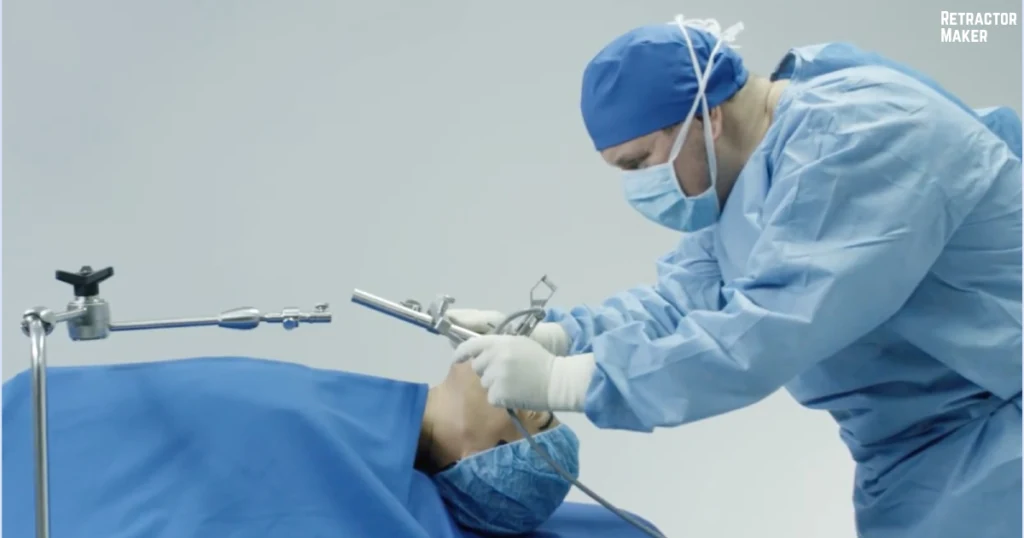
How Is the FK Retractor Placed?
Placing the FK Retractor requires careful preparation, anatomical assessment, and methodical adjustment. Steps vary with patient anatomy and the surgeon’s approach. The general placement workflow follows this sequence:
- Inspect all parts before placement, including frame components, adapters, and tension arms. Check selected blades for proper assembly and function.
- Select a Mandible, Laryngeal, Curved Tongue, or Weinstein-O’Malley TORS blade shape. Match it to patient size and the target exposure zone.
- Apply latex-free teeth protectors over the upper dental arch to protect teeth and mucosal tissue and prevent direct frame contact.
- Introduce the basic frame assembly into the oral cavity. Carefully position the selected blade over the tongue dorsum or target landmark.
- Attach the correct frame adapters to link the basic frame to the support structure.
- Align the frame for initial exposure. Position the open working aperture along the visual axis of the target site: the oropharynx, tongue base, or larynx.
- Adjust vertical blade pitch upward or downward to lift or depress soft tissue until the target structure is clear.
- Advance or retract the blade forward or backward to achieve the correct depth penetration within the pharynx or larynx.
- Lock the optimal combination of blade angle and depth to establish a stable, uncrowded retraction corridor.
- Position the flexible tension arm and connect it to the main frame. Tighten the central set screw to lock the system in a static, self-retaining position.
- Mount auxiliary tools as needed: insert the lateral light clip for illumination, attach curved cheek retractors to hold buccal tissue, and secure the 4.0 × 170 mm smoke suction tube for plume evacuation.
- Verify the setup intraoperatively. Inspect the surgical site, frame stability, and dental protection. Confirm clear space for endoscopes, laser lines, or robotic instruments before proceeding with the operation.
The FK Retractor is a specialized device for surgical exposure. Always follow manufacturer instructions and institutional protocols. Final placement, blade selection, and mechanical adjustment must also follow the operating surgeon's expert judgment.
How Does the FK Retractor Support TORS?
Trans-Oral Robotic Surgery requires space for robotic wrist joints to articulate and a clear optical camera view. The camera must not collide with other instruments. These requirements create unique mechanical challenges.
| Mechanical Aspect | Traditional Tubular Laryngoscope | FK Non-Tubular Frame System |
|---|---|---|
| Aperture & Geometry | Narrow, closed cylindrical tube | Wide, open perimeter frame |
| Tool Entry Angles | Restricted to parallel, straight-line access | Supports wide-angle, multi-axis tool triangulation |
| Robotic Arm Clearance | Confined lumen prevents arm articulation | Expanded aperture allows dual robotic arm movement |
| Visual Corridor | Restricted view through cylindrical tunnel | Open visual field for 3D endoscopes and direct line-of-sight |
| Target Field Exposure | Narrow, fixed target boundary | Expanded, adjustable target field volume |
The FK Retractor supports TORS workflows through open access, targeted exposure, and reduced mechanical crowding:
- Provides an unenclosed aperture: removing side walls allows robotic arms to enter from wider angles.
- Optimizes tongue base and supraglottic access: specialized Weinstein-O’Malley blades flatten and hold down the tongue base without occupying valuable side space.
- Improves piriform sinus exposure: multi-axis depth and pitch controls open deeper hypopharyngeal areas.
- Reduces mechanical crowding: the open design accommodates robotic tools, secondary suction, and tissue forceps simultaneously without binding.
FK Retractor vs. Conventional Tubular Laryngoscopes
The open-frame concept provides a non-tubular alternative to tubular laryngoscopes. These differences explain its role in modern head and neck surgery:
- Standard laryngoscopes have rigid, closed cylindrical shafts. The FK Retractor uses a wide, non-tubular perimeter frame.
- Tubular scopes restrict vision and tools to a narrow lumen. The FK frame provides a broad, open entry zone.
- Closed tubes limit instruments to parallel entry paths. The FK platform allows wide-angle instrument triangulation.
- Tubular scopes usually cannot accommodate multiple robotic arms. The FK Retractor's wide aperture provides TORS clearance.
- Tubular scopes mainly use axial suspension levers. The FK system offers independent blade depth and angle adjustment, plus flexible arm locking mechanics.
Why Is Adjustable Blade Positioning Useful?
Independent blade angle and depth adjustment helps accommodate anatomy, direct tissue tension, and adapt exposure during surgery:
- Patient pharyngeal dimensions vary greatly. Independent depth and pitch controls adapt the hardware to individual anatomical boundaries.
- Precise tension targets the tissue requiring displacement, avoiding unnecessary pressure and protecting adjacent non-target structures.
- Blade depth and angle can be readjusted intraoperatively without removing the frame as resection needs change, such as expansion into the piriform sinus.
Who Should Assemble and Use the FK Retractor?
The FK Retractor (Feyh-Kastenbauer) is a specialized medical device for professional surgical use only. Qualified personnel must perform assembly, component selection, placement, adjustment, and intraoperative operation. Clinical use must follow manufacturer instructions, hospital protocols, and the operating surgeon’s individual judgment.
Summary: Exposure for Upper Aerodigestive Tract Surgery
The FK Retractor (Feyh-Kastenbauer) provides surgical exposure of the upper aerodigestive tract. It replaces rigid tubular laryngoscopes with a wide-aperture, non-tubular frame. This supports visual clarity and instrument maneuverability for surgical teams.
Features include multi-axis blade angle and depth adjustments, specialized Weinstein-O’Malley TORS blades, a flexible tension arm, and integrated accessory mounting points. The FK platform suits Trans-Oral Robotic Surgery, microsurgery, and laser procedures. Placement by trained professionals provides a secure, static, and adaptable foundation for complex head and neck interventions.
Related Products and Sourcing Options
Contact Retractor Maker directly for specialized surgical retraction platforms, component sets, and custom OEM solutions:
- Explore Product Categories: ENT & Head & Neck Retractors, Spine & Orthopedic Retractor Systems, Bookwalter Retractor Systems, Leyla Retractor Systems.
- Contact Our B2B Sales Team: Request a Direct Factory Quote, Contact Us for Wholesale & OEM Inquiries.
Clinical notice: This guide is for surgical teams and hospital buyers. Always follow the manufacturer's instructions for use (IFU) and your hospital's sterilization rules before clinical use.
Frequently Asked Questions
What is the FK Retractor?
The FK Retractor is an open-frame platform for self-retaining surgical exposure in head and neck procedures. It provides exposure in the upper aerodigestive tract, using an open frame to support access to the surgical area.
What does FK stand for in FK Retractor?
FK in FK Retractor stands for Feyh-Kastenbauer, the surgeons who developed the open-frame concept. Their concept is a non-tubular laryngo-pharyngoscope retraction system. The name identifies the surgeons associated with this open-frame approach to surgical exposure.
What is the FK-WO TORS Retractor?
The FK-WO TORS Retractor is an adapted system that provides working space for Trans-Oral Robotic Surgery. It uses Weinstein-O’Malley blade designs and mounting adapters that help robotic instruments. These components support the system's use in robotic surgical workflows.
What is the FK Retractor used for?
The FK Retractor creates open, hands-free surgical access for TORS, microsurgery, and laser surgery. It targets the oropharynx, larynx, and hypopharynx. Its exposure also covers the tongue base, supraglottis, and piriform sinuses during these surgical procedures.
Can the FK Retractor be used for TORS?
The FK Retractor can be used for TORS because its open-frame design and specialized blades support robotic access. Weinstein-O’Malley blades provide the wide clearance required for robotic end-effectors and 3D endoscopes during Trans-Oral Robotic Surgery.
What areas can the FK Retractor help expose?
The FK Retractor helps expose the oral cavity, oropharynx, larynx, hypopharynx, and tongue base. Its exposure also includes the supraglottic region, piriform sinuses, and esophageal inlet. These are the anatomical areas covered by the system's surgical exposure.
What is the purpose of the non-tubular design?
The FK Retractor's non-tubular design removes enclosed side walls to create a wider working area. This open arrangement improves visual access and allows wide-angle instrument triangulation. The design provides an entry area without the restrictions of enclosed side walls.
Can the FK Retractor blade angle be adjusted?
The FK Retractor permits independent blade angle adjustment upward and downward. These movements lift or depress target tissue structures. Angle adjustment allows the blade position to change according to whether the target tissue needs lifting or depression.
Can the FK Retractor insertion depth be adjusted?
The FK Retractor allows insertion depth adjustment through controlled forward and backward movement of the blade assembly. This movement adjusts penetration depth to match specific patient anatomy. Blade depth can therefore be positioned according to the patient's anatomical requirements.
What FK Retractor blade options are available?
The FK Retractor offers Mandible blades (11 cm) and Concave Laryngeal blades (17 cm). Curved Tongue blades come in standard, left-open, and right-open versions. Options also include Weinstein-O’Malley TORS blades and Small TORS blades in left and right versions.
Does the FK Retractor include cheek retractors?
The FK Retractor includes two curved cheek retractors that attach to the basic frame. They hold buccal tissue away from the entry area. These frame-mounted components provide cheek retraction by keeping that tissue away from the surgical entry.
Does the FK Retractor include a suction tube?
The FK Retractor includes a 4.0 × 170 mm smoke suction tube. The tube continuously evacuates laser plumes and removes electrosurgical smoke from the surgical field. It provides smoke evacuation as an included component of the system.
Does the FK Retractor include a light clip?
The FK Retractor includes a self-holding light clip with a lateral cable connection. The clip provides direct illumination from the retractor frame. Its self-holding design and lateral connection form part of the frame-mounted lighting arrangement.
Does the FK Retractor include teeth protectors?
The FK Retractor set includes 10 latex-free, non-autoclavable teeth protectors. They safeguard patient dentition during frame placement. These protectors are supplied as part of the set for use when positioning the frame, and they must not be autoclaved.
Is a sterilization box included with the FK Retractor?
The complete FK Retractor set comes in a heavy-duty Sterilization Box. The box organizes the components and aids transport and autoclaving. It provides a dedicated container for keeping the set's components organized during these handling and processing tasks.
Who should place and use the FK Retractor?
The FK Retractor is a surgical retractor for use only by trained, qualified healthcare professionals. These professionals include otolaryngologists and head and neck surgeons. TORS surgical teams also use the FK Retractor in their work.
What should be checked before placing the FK Retractor?
Before placement, check the FK Retractor’s frame components, adapters, tension arms, and selected blades for proper assembly and function. Match the blade to patient size and the target exposure zone. Manufacturer instructions, institutional protocols, and the operating surgeon’s judgment should guide final blade selection and placement.
How does the FK Retractor stay in a self-retaining position?
The FK Retractor maintains a static, self-retaining position through a flexible tension arm secured by a central set screw. First, align the frame and set the blade angle and depth. The arm then connects to the main frame and locks securely to maintain hands-free positioning during the procedure.
About the author
Saad Shahid · Sales & Marketing Manager
Saad Shahid is the Sales & Marketing Manager and founder of Retractor Maker, started in 2023 in Sialkot, Pakistan. He also works with his father at Hospitech Traders, the family surgical instrument business founded in 1989.
Related Blogs & Guide

Related Retractors
Gifford-Jansen Retractor
From $84.00
Hajek Cheek Retractor
$24.00
Lip And Cheek Retractor
$49.00
Bellucci Endaural Retractors
From $174
Aufricht Nasal Retractor
From $59.00
Aufricht Walter Nasal Retractor
$69.00
Need Surgical Retractors or Components?
Tell us what you need, including the product, configuration, quantity and destination country. Retractor Maker can provide availability, specifications and pricing.
Request a Quote