
Surgical Retractor Guides
What is the Bookwalter Retractor? History, Assembly, and Uses
Reviewed byRetractor Maker technical team· Updated
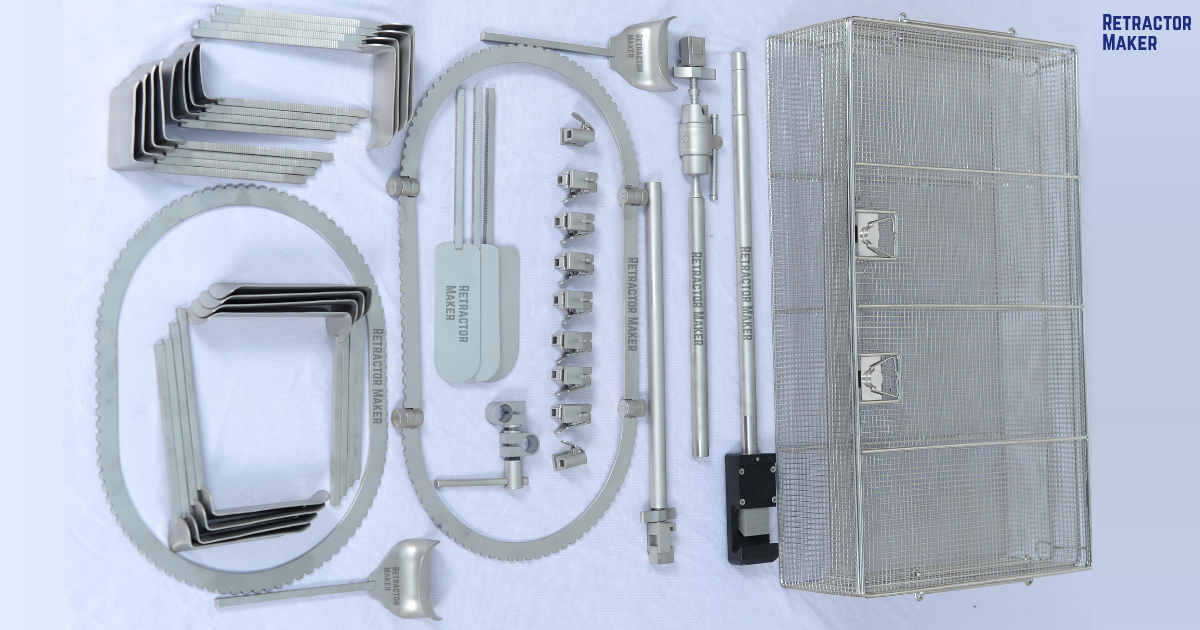
Surgical exposure is one of the most important aspects of any open operation. This complete guide to the Bookwalter retractor system covers its history and invention, every component in a standard kit, a step-by-step assembly walkthrough with practical setup tips, blade types and sizes, the most common setup mistakes to avoid, sterilization and maintenance protocols, and how hospitals use the system across general surgery, urology, gynecology and vascular procedures.
Surgical exposure is one of the most important aspects of any open operation. Without a clear and stable view of the surgical site, surgical teams cannot perform deep-cavity procedures safely. For many decades, achieving this view meant relying on surgical assistants to hold heavy manual retractors for hours at a time, which often led to fatigue, uneven tension, and a crowded workspace. The development of the Bookwalter Retractor changed this completely by introducing a reliable, table-mounted system that holds incisions open mechanically. This comprehensive guide covers the history, main components, step-by-step assembly, and clinical applications of this essential surgical instrument.
Looking to buy? The complete Bookwalter Retractor set (SKU RM-BR-1) — rings, tilt ratchets, posts and a full blade selection — is available direct from the manufacturer for $1,999 with free shipping, or request a quote for hospital and distributor orders. View the Bookwalter Retractor set — $1,999.
What is a Bookwalter Retractor?
A Bookwalter Retractor is a specialized, table-mounted mechanical retractor system used by surgeons to maintain steady, hands-free exposure of deep surgical sites during major open operations. Unlike traditional handheld tools that require a person to pull back tissue continuously, or smaller self-retaining retractors that push against the edges of the skin, the Bookwalter system clamps directly onto the side rail of the operating table.
This table-mounted design transfers all the physical force of retraction away from both the patient’s body and the surgical staff to the heavy steel base of the operating table. Because it is modular, the system can be configured in various ways using a combination of vertical posts, horizontal bars, customizable ring frames, adjustable ratchets, and interchangeable blades to match the patient’s body shape and the specific needs of the incision.
History of the Bookwalter Retractor
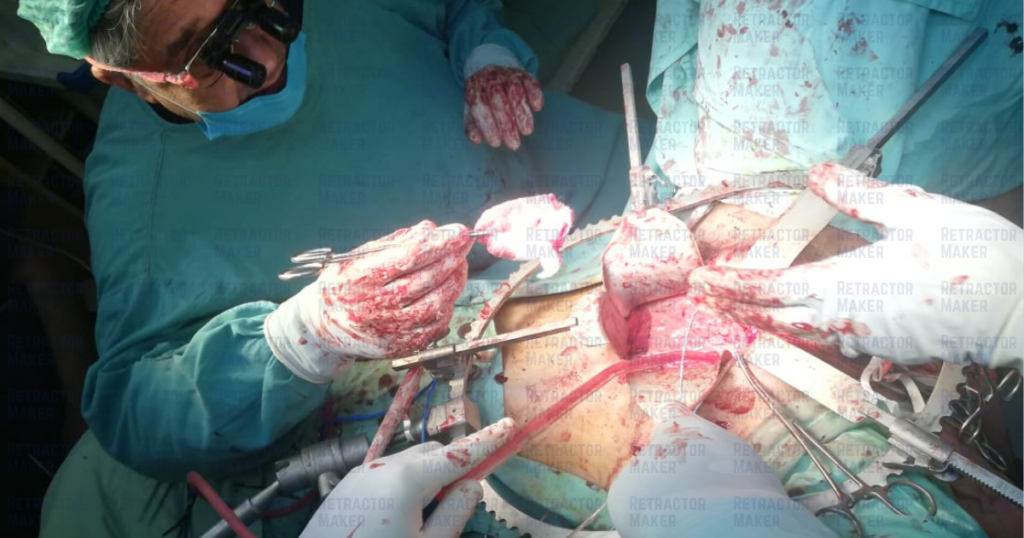
To understand how much the Bookwalter Retractor improved open surgery, it helps to look at the challenges doctors faced in the mid-20th century. Before this system became widely available, open abdominal and pelvic operations required multiple surgical assistants or scrub nurses to stand around the operating table, pulling manual steel blades to keep the wound open.
Who Invented the Bookwalter Retractor?
The system was invented by Dr. John R. Bookwalter, an American general surgeon from Ohio. During his residency and early surgical practice in the 1970s, Dr. Bookwalter regularly noticed the limitations of the fixed abdominal frames used at the time. He found that existing mechanical models were often too bulky, difficult to adjust mid-operation, or prone to losing their grip when working deep inside the pelvic cavity. Working closely with medical engineers and instrument designers, Dr. Bookwalter created a simplified, ring-and-post framework that utilized quick-connect sliding ratchets. His design allowed a single surgeon to set up, adjust, and lock the retraction angles within a few seconds.

Why Was It Developed?
Dr. Bookwalter engineered his system to address three primary difficulties in the operating room:
- Assistant Fatigue: Holding a deep pelvic retractor blade with constant force for three or four hours is physically exhausting. As assistants grew tired, their hands naturally drifted, which could block the surgeon’s view or cause accidental tissue damage.
- Crowded Workspace: Having two or three assistants standing tightly around the incision left very little physical room for the lead surgeon and scrub nurse to move their hands and instruments cleanly.
- Unstable Retraction Pressure: Manual pulling is naturally uneven. The Bookwalter was designed to provide a flat, uniform, and constant mechanical hold, protecting delicate tissue margins from sudden shifts.
Introduced to the international medical marketplace in the late 1970s, his patented design quickly became a staple setup for open abdominal procedures worldwide.
Main Components of a Bookwalter Retractor
The Bookwalter system is not a single tool, but rather an organized kit of interconnected structural elements. Each part has a specific mechanical role to play in building the final frame.

How Each Component Works
The system relies on a structural chain that starts at the table rail and ends inside the surgical wound:
- Post Coupler (Table Clamp): A heavy, solid block of machined steel that clamps directly onto the surgical table side rail. It serves as the foundation for the entire setup.
- Vertical Field Post: A thick steel rod that inserts into the post coupler, extending vertically beside the patient to provide height clearance above the sterile field.
- Horizontal Flex Bar: Connects to the top of the vertical post. It features adjustable joints that allow the horizontal arm to rotate, extend, and lock over the patient’s body.
- Ring Frames (Oval or Segmented): The structural loops that connect to the horizontal bar and hang directly above the incision. Oval rings are solid, rigid loops used for standard entries. Segmented rings feature built-in hinges, allowing the sides of the ring to fold upward or downward to match curved patient bodies.
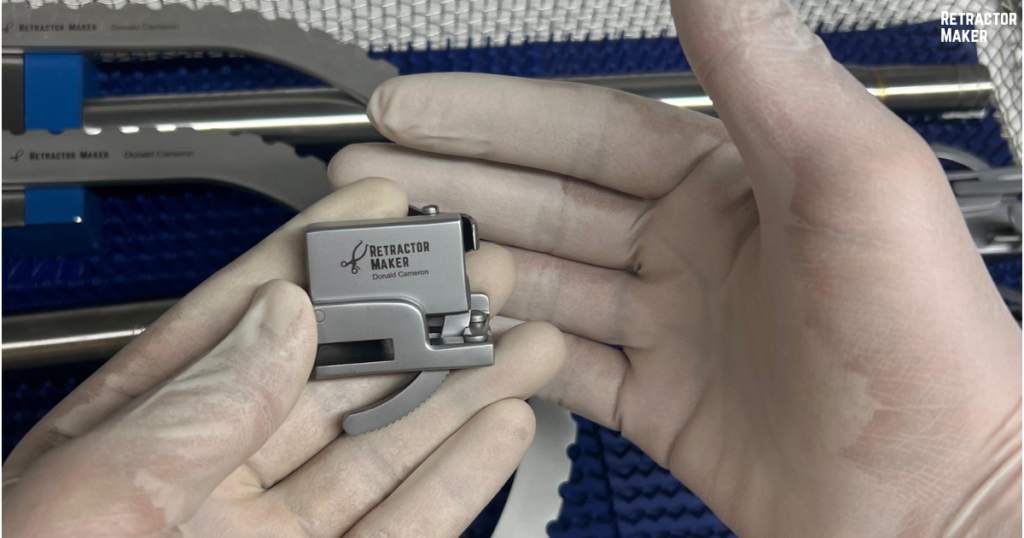
- Slide-On Ratchets (Standard or Tilt): Mechanical clips that slide onto the perimeter ring. They hold the retractor blades and use a simple notch mechanism to pull and lock the blades backward. Tilt ratchets feature an extra gear hinge, letting the user angle a blade tip downward into deep anatomical corners.
- Retractor Blades: Solid metal plates or flexible strips that contact the tissue directly. They fit into the ratchets and pull the wound edges open.
Product Components Table
| Component Name | Quantity in Standard Kit | Primary Function |
|---|---|---|
| Bookwalter Field Post (12″) | 1 | Provides vertical height from the table rail |
| Bookwalter Horizontal Bar | 1 | Extends the assembly over the patient |
| Bookwalter Post Coupler | 1 | Clamps the vertical post to the table rail |
| Bookwalter Horizontal Flex Bar | 1 | Allows angular adjustment of the ring frame |
| Bookwalter Standard Ratchets | 2 | Holds blades in a straight, flat line |
| Bookwalter Tilt Ratchets | 7 | Holds blades and allows downward angle adjustments |
| Medium Oval Ring | 1 | Provides a solid 360-degree frame around the wound |
| Medium Segmented Ring | 1 | Provides a hinged, adjustable frame around the wound |
| Sterilization Organizer Box | 1 | Holds all pieces safely during autoclaving |
Step-by-Step Assembly Guide
Proper assembly is critical to ensure patient safety and maintain sterile field integrity. This guide outlines the standard method for setting up the system on an operating table.
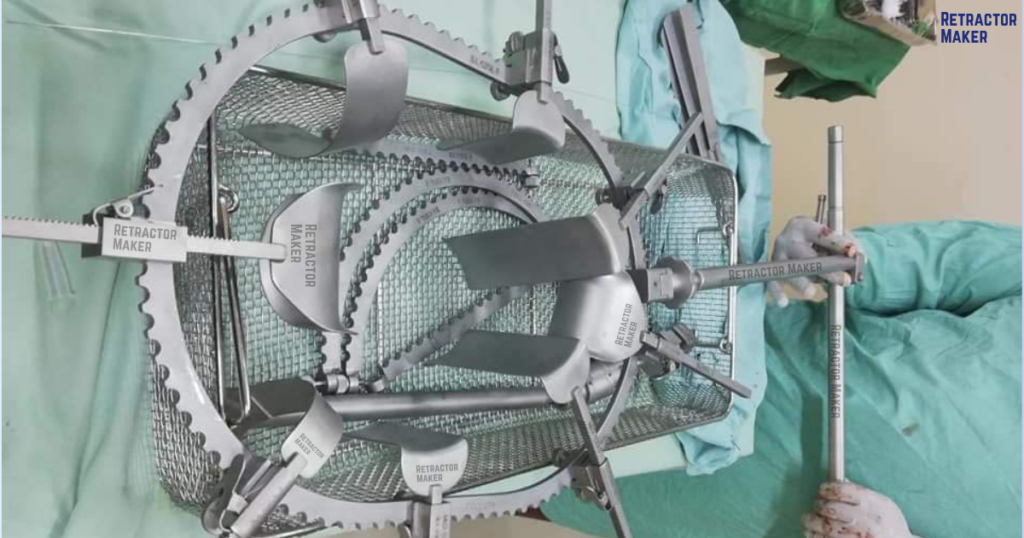
How to Set Up a Bookwalter Retractor
- Mount the Post Coupler: Locate the side rail of the operating table, roughly level with the patient’s hips or lower abdomen. Place the post coupler directly over the side rail and tighten the main mounting screw securely. Ensure the coupler is clamped over the sterile drapes onto a clean, uncovered portion of the side rail for a slip-free metal-on-metal grip.
- Insert the Vertical Field Post: Insert the bottom of the vertical field post into the top hole of the mounted post coupler. Slide it down to the desired height, then tighten the coupler’s locking knob. Give the post a firm manual tug to ensure there is no vertical or rotational wobbling.
- Attach the Horizontal Flex Bar: Slide the horizontal flex bar assembly onto the top of the vertical field post. Use the integrated swivel joint to orient the bar horizontally over the patient’s abdomen, then tighten the post connector knob firmly. Ensure the horizontal arm remains high enough above the patient’s skin to prevent any pressure points.
- Secure the Ring Frame: Select the appropriate ring frame (oval or segmented) for the procedure. Connect the ring’s mounting arm to the clamping lock at the end of the horizontal flex bar. Align the ring so it sits level and centered directly over the surgical incision, then tighten the flex bar clamp to lock the entire frame rigidly in place.
- Slide on Ratchets and Blades: Once the surgeon makes the initial incision, slide the standard or tilt ratchets onto the ring frame. Insert the selected retractor blades into the surgical wound margins, then slide the blade shafts into the waiting ratchet slots. Pull the ratchet levers outward to apply controlled, uniform retraction force, locking them into place once optimal exposure is achieved.
Common Setup Mistakes to Avoid
Most problems attributed to the Bookwalter system in the operating room trace back to a small number of setup errors rather than the instrument itself. Experienced scrub teams check for the following before draping is finalized:
- Mounting the coupler over stacked drapes: Clamping the post coupler onto folded sterile drapes instead of a bare section of the table rail lets the entire frame slip or rotate under load. Always seat the coupler metal-on-metal against the rail.
- Setting the post too low: If the vertical field post is not raised high enough, the ring frame sits too close to the incision, forcing blades into steep angles and limiting the surgeon’s hand space. Set the ring height first, then lock.
- Over-tensioning the ratchets: Mechanical ratchets multiply hand force effortlessly. Pulling blades to maximum travel can bruise or tear wound margins. Retract only to the point of adequate exposure, and recheck tension after the first few minutes as tissue relaxes.
- Clustering all ratchets on one side: Uneven ratchet placement pulls the incision asymmetrically and obstructs one side of the field. Distribute ratchets evenly around the ring perimeter, typically at the 12, 3, 6 and 9 o’clock positions for a standard laparotomy.
- Skipping the tug test: Failing to manually test the coupler, post and flex-bar locks after tightening is the leading cause of mid-procedure frame drift. A five-second pull test on every joint prevents it.
How Surgeons Use the System
During an active operation, surgeons use the Bookwalter system as an external skeleton. Because the ring frames encircle the incision, ratchets can be placed at any position around the perimeter (360 degrees). This allows the surgical team to pull tissues upward, outward, or at oblique angles simultaneously. By using a mix of shallow blades for superficial fat layers and deep or malleable blades for internal cavities, the surgeon can create a clear pathway directly to the target organ.
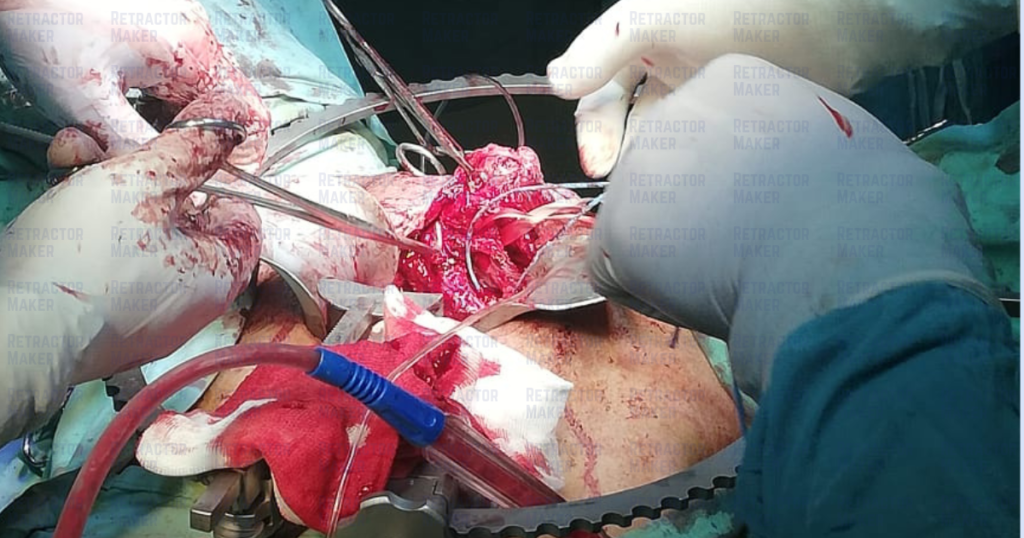
Common Surgical Procedures
The system is highly favored in major, deep-tissue open operations where wide visibility is mandatory.
Common Surgical Procedures Table
| Surgical Specialty | Common Procedures | Primary Sourcing Category |
|---|---|---|
| General Surgery | Exploratory Laparotomy, Cholecystectomy, Bowel Resection, Gastric Bypass | General Surgery Retractors |
| Urology | Nephrectomy, Prostatectomy, Cystectomy, Kidney Transplantation | Urology Retractors |
| Gynecology | Total Abdominal Hysterectomy, Pelvic Mass Debulking, Ovarian Staging | Obstetrics & Gynecology Retractors |
| Vascular Surgery | Abdominal Aortic Aneurysm (AAA) Repair, Aortofemoral Bypass | General Surgery Retractors |
Advantages and Limitations
While the Bookwalter system is a gold standard for abdominal and pelvic procedures, surgical teams must evaluate its performance characteristics alongside operating room considerations.
Advantages vs Limitations Table
| Advantages of the Bookwalter System | Limitations and Considerations |
|---|---|
| Hands-Free Operation: Frees up assistants to focus on passing tools, suctioning, and surgical tasks. | Setup Time: Requires a few extra minutes during room preparation to assemble the post, bars, and rings correctly. |
| Rock-Steady Visibility: Holds tissues completely still, eliminating the natural shaking or drifting associated with human fatigue. | Risk of Over-Tensioning: Because mechanical ratchets apply force effortlessly, users must avoid over-tightening to protect tissue walls. |
| Reduced Tissue Trauma: Applies steady, constant mechanical pressure, which reduces localized bruising or tearing. | Component Tracking: A standard kit contains dozens of blades and ratchets that must be tracked and inventoried carefully. |
| Modular Versatility: Easily adjusts to accommodate pediatric, standard adult, or extra-deep bariatric patient bodies. | Storage Footprint: Requires dedicated tray space in the sterile processing department due to its multiple structural parts. |
Available Blades and Accessories
The overall utility of the system relies heavily on its wide selection of interchangeable blades. Different shapes and depths are deployed depending on the thickness of the patient’s abdominal wall and the fragility of the internal organs.
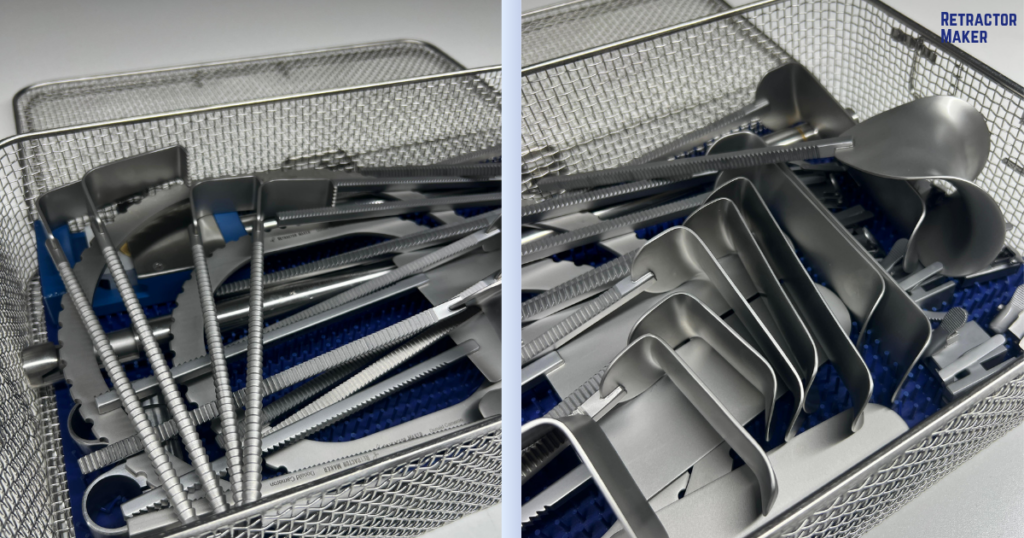
- Kelly Blades: These are standard right-angled blades with smooth, blunt edges. They are used primarily to hold back thick muscle walls, subcutaneous fat layers, and abdominal margins safely without causing localized crushing or necrosis.
- Balfour Blades: Broad, deep-reaching blades designed to retract wide sections of the abdominal wall, frequently used at the lower or upper margins of a laparotomy incision.
- Harrington (Sweetheart) Blades: Featuring a distinctive heart-shaped tip lined with a smooth, wide lip, these are specialized for gently holding back deep, delicate internal organs like the liver or gallbladder.
- Malleable Blades: Crafted from ductile stainless steel alloys, these blades can be manually bent, curved, or twisted by the surgical team to navigate around irregular internal structures or protect fragile tissues safely.
Blade Sizes Table
| Blade Type | Dimensions (Width × Depth) | Primary Clinical Sourcing Target |
|---|---|---|
| Balfour Blade | 2⅝” × 3″ (6.7 × 7.6 cm) | Broad abdominal wall muscle retraction |
| Kelly Blade | 2″ × 3″ (5.1 × 7.6 cm) | Superficial to medium fat layer holding |
| Kelly Blade | 2″ × 4″ (5.1 × 10.2 cm) | Standard adult abdominal wall stabilization |
| Kelly Blade | 2″ × 5″ (5.1 × 12.7 cm) | Deep adult muscle wall tracking |
| Kelly Blade | 2″ × 6″ (5.1 × 15.2 cm) | Deep-cavity or thick abdominal wall exposure |
| Kelly Blade | 2″ × 7″ (5.1 × 17.8 cm) | Extra-deep bariatric abdominal exposure |
| Malleable Blade | 3″ × 6″ (7.6 × 15.2 cm) | Flexible visceral blocking and liver retraction |
| Malleable Blade | 2″ × 6″ (5.1 × 15.2 cm) | Narrow, flexible tissue isolation and protection |
How to Choose the Right Ring Size and Blade Depth
Selecting the correct ring frame and blade combination before the incision saves repositioning time mid-procedure. As a practical rule used by most surgical teams:
- Match the ring to the patient, not the incision: Small rings suit pediatric patients and narrow lower-abdominal approaches; medium oval or segmented rings cover most standard adult laparotomies; large or extra-large segmented rings are reserved for bariatric patients and wide transverse incisions.
- Match the blade depth to the abdominal wall: Measure from the skin surface to the target cavity. A 2″ × 3″ or 2″ × 4″ Kelly blade handles superficial to medium walls; 2″ × 5″ and 2″ × 6″ blades suit deep adult cavities; 2″ × 7″ blades are intended for extra-deep bariatric exposure.
- Use tilt ratchets for angled anatomy: Whenever a blade must reach under the rib cage, the pelvic brim, or a heavy fat apron, pair it with a tilt ratchet rather than forcing a standard ratchet into an oblique pull.
- Protect organs with malleable or Harrington blades: Never use rigid right-angled Kelly blades directly against the liver, spleen, or bowel. Reserve Harrington (sweetheart) and malleable blades for all visceral contact.
Cleaning, Sterilization, and Maintenance
Because these instruments contact deep tissue cavities during high-exposure procedures, strict reprocessing protocols are essential to prevent cross-contamination and prolong the life of the steel components.
Cleaning and Sterilization Protocol
Directly after surgery, wipe down all components with a damp sterile cloth to prevent blood, fat, and tissue residues from drying on the metal surfaces or inside the ratchet gear teeth. Completely separate the post coupler, vertical post, flex bar, ring frame, ratchets, and individual blades.
Immerse all components in a neutral-pH enzymatic cleaning solution. Use a soft plastic bristle brush to clean inside the ratchet locking slots, gear tracks, and connection joints. Never use steel wool or wire brushes, as these will scratch the protective oxide layer of the stainless steel, leading to rust.
Place the disassembled pieces inside a medical thermal disinfector and run a standard cycle using clean, demineralized water. Ensure all parts are thoroughly dried before packaging. Arrange the completely dry, disassembled components inside their dedicated perforated sterilization case and run a standard high-temperature pre-vacuum steam autoclave cycle.
Technical Specifications Table
| Parameter | Manufacturing and Sourcing Specification |
|---|---|
| Primary Material | Premium Medical-Grade Stainless Steel (Non-Magnetic) |
| Surface Finish | Anti-Glare Satin Matte Texture |
| Sterilization Method | Steam Autoclave Compatible (Pre-Vacuum / Gravity) |
| Standard Autoclave Parameters | 134°C (273°F) for 4 to 5 minutes (Pre-Vacuum) |
| Compatibility Profile | Built to match standard industry-recognized dimensions |
| Kit Weight Classification | Heavy-Duty Operating Room Instrumentation Pool |
Maintenance Tips
- Check the Ratchet Locking Teeth: Inspect the locking pawls and spring mechanisms on every ratchet before packaging. If the teeth are worn down or the spring tension is weak, replace the ratchet immediately to prevent slippage during surgery.
- Inspect Weld Joints and Swivels: Check the weld interfaces on the rings and vertical post coupler for microscopic cracks. Ensure all swivel joints rotate smoothly without grinding.
- Apply Approved Instrument Lubricant: Periodically apply a steam-permeable, water-soluble medical instrument lubricant (“instrument milk”) to the ratchet hinges and flex-bar adjustment joints.
- Use Demineralized Water: Always ensure your cleaning and autoclave steam networks utilize high-purity, demineralized water to prevent mineral scale deposits or spot staining.
Why Hospitals Choose Bookwalter Retractor Systems
Hospital procurement boards and theater managers prefer this system because it offers a highly predictable way to stabilize operating room efficiency. By converting manual tasks into a self-retaining mechanical process, the tool helps hospitals manage staffing shortages efficiently. Furthermore, because a single kit can adjust to fit pediatric, adult, or bariatric patient shapes, the hospital does not need to purchase multiple separate specialized frames for different departments.
Why Buy Directly from Retractor Maker
Sourcing your instruments directly from our specialized factory in Pakistan provides clear structural and logistical benefits:
- Specialized Manufacturing Focus: We do not manufacture thousands of unrelated general medical tools. Our entire facility, machinery, and design talent are dedicated exclusively to surgical retractors. This allows us to maintain tight tolerances, perfectly smooth blade borders, and highly reliable locking tracks.
- Cross-Inventory Compatibility: We build our bars, rings, ratchets, and blades to meet standard industry-recognized dimensions. This means you can use our individual components to replace missing or broken pieces in your existing hospital trays seamlessly.
- Efficient Production Timelines: With a dedicated workforce of over 50 skilled employees, we maintain an efficient and highly predictable average factory lead time of 12 to 16 days for wholesale orders.
- Direct Factory Sourcing: Eliminating third-party trading brokers allows international distributors, medical importers, and hospital networks to secure premium instrumentation directly from the source without hidden broker markups. We provide full international export support and secure freight packaging to ensure your shipments arrive safely and on schedule.
Conclusion
The Bookwalter Retractor system remains one of the most successful innovations in modern open surgical exposure, delivering exceptional structural stability, modular flexibility, and hands-free field maintenance. By understanding its step-by-step assembly, material care requirements, and component functions, healthcare facilities can maximize the working life of these essential systems while preserving optimal operating room efficiency.
If you are looking to expand your surgical inventory, replace missing tray components, or view our complete line of specialized instruments, connect directly with Retractor Maker. Our sales engineering team is ready to evaluate your technical drawings, private-label requirements, or volume needs to provide an itemized, factory-direct price quote.
- To check current wholesale volume pricing or request custom dimensions, visit our Request a Quote page.
- To discuss private-label OEM manufacturing runs or speak directly with an export project manager, visit our Contact Us page.
- Direct Phone / WhatsApp Support: +92 327 8345101
- Inquiry Email: info@retractormaker.com
Frequently Asked Questions
What is a Bookwalter retractor used for?
The Bookwalter retractor system is a table-mounted, self-retaining device used to hold open incisions during major open surgical procedures, primarily within abdominal, urological, gynecological, and colorectal disciplines.
Are your Bookwalter blades interchangeable with existing industry-standard rings?
Yes. We manufacture all our Bookwalter Retractor components, ratchets, and blades to match standard industry dimensions, ensuring complete cross-compatibility with your existing hospital inventory.
Why is it called a Bookwalter retractor?
The system is named after Dr. John R. Bookwalter, an American general surgeon who developed and patented the modular table-mounted post-and-ring system in the late 1970s to solve the issues of assistant fatigue and unstable wound exposure.
Can a Bookwalter retractor be used for pediatric surgeries?
Yes. By swapping out standard adult ring frames and deep blades for smaller pediatric rings and shallow micro-blades, the system can be configured safely for pediatric abdominal or thoracic surgeries.
How do I prevent staining on my stainless steel surgical rings?
Staining is typically caused by mineral residue from the wash water or improper chemical dilution during preprocessing. Using neutral pH detergents, rinsing with demineralized water, and ensuring thorough drying before autoclaving will prevent surface staining.
What is the purpose of a tilt ratchet in the system?
A tilt ratchet features an extra internal gear hinge that allows the surgical team to angle the attached retractor blade tip downward or upward into deep tissue spaces, providing visibility under bone edges or heavy fat layers without moving the main ring frame.
Is the Bookwalter retractor system supplied pre-sterilized?
No. Like most heavy-duty reusable surgical instruments, the system is supplied non-sterile. It must undergo standard hospital cleaning, packaging, and steam autoclave sterilization before its first clinical use.
What is the average manufacturing lead time for a wholesale Bookwalter order?
Our average production, quality auditing, and packaging timeline for wholesale lots or complete kits is 12 to 16 days from order finalization.
What material handles the immense mechanical tension inside the frame?
We manufacture all our components using high-tensile, non-magnetic, medical-grade stainless steel. This alloy provides the structural strength required to maintain a wide operating field without bending, flexing, or losing ratchet grip.
Can I buy individual components or replacement blades instead of a full kit?
Yes. While we sell complete pre-configured abdominal kits, we also supply individual oval rings, tilt ratchets, field posts, and separate Kelly or Balfour blades to help you replenish broken or missing items from existing operating room trays.
Need a Bookwalter Retractor or Components?
Tell us what you need, including the product, configuration, quantity and destination country. Retractor Maker can provide availability, specifications and pricing.
Request a Quote